Since 2010 I have been using this site to discuss my interpretations of famous Renaissance paintings including Giorgione's "Tempest" as "The Rest on the Flight into Egypt"; his "Three Ages of Man" as "The Encounter of Jesus with the Rich Young Man"; Titian's, "Sacred and Profane Love" as "The Conversion of Mary Magdalen"; Titian's "Pastoral Concert" as his "Homage to Giorgione", and Michelangelo's"Doni Tondo." The full papers can now be found at academia.edu.

Friday, January 25, 2013

Giorgione's Tempest: the Woman Clothed with the Sun


In my interpretation of Giorgione’s "Tempest" as “The Rest on the Flight into Egypt” I argued that the nudity of the nursing Madonna is the painter’s idiosyncratic attempt to depict the Immaculate Conception of Mary. In this post I will discuss other attempts by contemporaries of Giorgione to also depict the concept of the Immaculate Conception.


Although only proclaimed a dogma by Pope Pius IX in 1854, the Immaculate Conception of Mary was a subject of great debate and controversy in the years up to and including the Renaissance. For centuries theologians had debated the question with the Dominicans and Franciscans, the two preaching orders, taking the lead. Only in the late fifteenth century did Pope Sixtus IV, a Franciscan, attempt to put an end to controversy by adding the feast of the Immaculate Conception to the liturgy of the entire Western church.

As so often happens, the action of Sixtus IV was in response to a tremendous upsurge in devotion to Mary in the fifteenth century. This devotion inevitably led to attempts at artistic depiction. But the concept was a difficult one to depict. Even today many Catholics still confuse the dogma of the Immaculate Conception with the Virgin birth. But the dogma does not refer to the birth of Jesus to a virgin or even to Mary’s own birth. The dogma refers to the freedom of Mary from the stain of original sin from the first moment of her conception in the womb of her own mother. The great nineteenth century historian Emile Male described this mysterious idea that finally blossomed at the time of Giorgione.

toward the end of the fifteenth century, a mysterious idea that had been secretly geminating in man’s soul for more than five hundred years, suddenly blossomed. It now seemed clear to theologians that the Virgin could not have partaken of original sin, being especially exempted from the law by divine decree. Mary, the perfect model of newly created humanity, like Eve at the time she was created by the hands of God, had come into the world free of the burden of sin.*
It was not easy to depict this mysterious, spiritual idea.
The task was difficult. How was one to represent the Virgin as a pure concept? How convey her creation without sin, by God’s decree, her existence in his thought before the creation of time?
In my paper I discussed what might be called the three major templates. But here I would just like to focus on the one that eventually gained the most popularity: the image from the Book of Revelation (Apocalypse) of the woman clothed with the Sun, with the stars in her crown, and with the Moon at her feet.

Here is the image from the Breviary done for Cardinal Grimani, a prince of the Church from one of the leading Venetian families and a noted patron and collector of art. The Grimani Breviary was a product of the Netherlands.
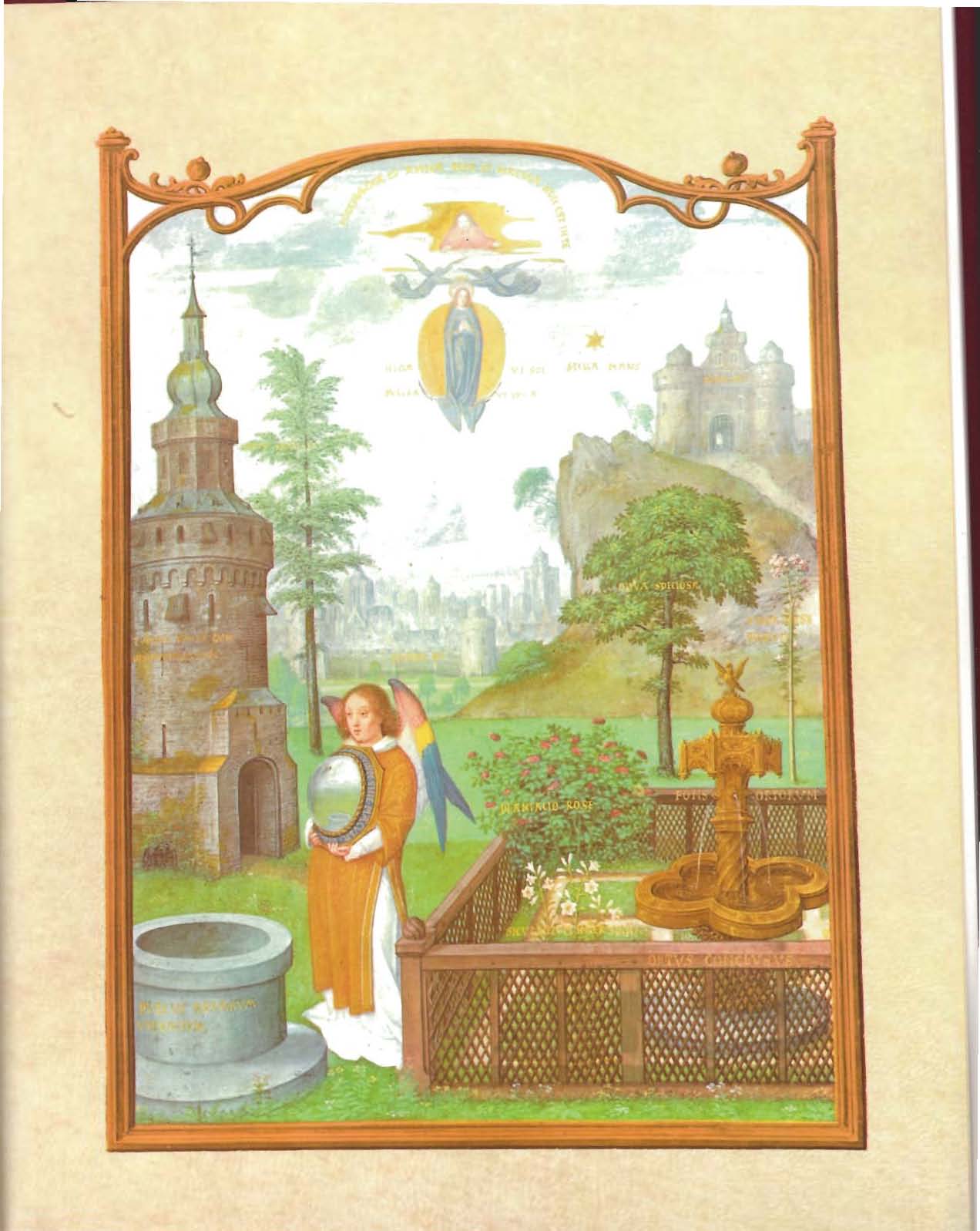
Grimani Breviary: Immaculate Conception
Woman in the sky clothed with the Sun

In “Piety and Patronage in Renaissance Venice” Rona Goffen argued that both Giovanni Bellini’s Frari triptych and Titian’s Assunta represented “the dedication of the Frari to the Immaculate Conception in visual imagery that suggests the similarities of the Madonna, and hence her church, with the Most serene republic of Venice.”**
It appears to me that the visual imagery must include the gold background of both paintings and that both artists were thinking of a way to depict a woman clothed with the Sun.

Giovanni Bellini: Pesaro chapel, Frari


Titian: Assunta, Frari
In a version of the “Rest on the Flight into Egypt” dated around 1516-18 Correggio used an unusual color scheme for the clothing of the Madonna. Her cloak is the traditional blue but her dress, usually a shade of red, has been painted a yellow gold. Was this Correggio’s way to depict the Woman clothed with the Sun? In her doctoral dissertation on the iconography of the flight into Egypt, Susan Schwartz wondered why a depiction of the Rest should have been placed in the Capella della Concezione of the church of San Francesco in Correggio.***


Correggio: Rest on the Flight into Egypt

In the Tempest Giorgione had the audacity to depict the Madonna on the flight into Egypt as the Immaculate Conception clothed only with the bright sun that shines upon her despite the dark storm clouds in the distance.

Finally, a few years after Giorgione's death a Native American, Juan Diego, had a vision of a woman clothed with the Sun whose image was subsequently implanted on his tilna that today can still be seen at the Church of Our Lady of Guadalupe in Mexico City. ###


*Emile Male: Religious Art in France, the Later Middle Ages, Princeton, 1986. p. 197.

**Rona Goffen: Piety and Patronage in Renaissance Venice, Yale, 1986, p. 154.

***Sheila Schwartz, “The Iconography of the Rest on the Flight into Egypt,” New York University, Ph. D., 1975, pp. 142-143.


Tuesday, January 15, 2013

Giorgione's Tempest: Marian Symbols


If it wasn’t for the nudity of the Woman in Giorgione’s “Tempest”, we would easily recognize the painting as a version of “The Rest on the Flight into Egypt.” The broken columns in the mid-ground are commonplace in versions of the Rest. In recent posts we have also seen that at the beginning of the sixteenth century St. Joseph was being portrayed as younger and more virile than in earlier depictions. We also know that a nursing mother will almost always be the Madonna.


Besides the fact that the woman in Giorgione’s “Tempest” is nursing, there are two other elements that help to identify her as the Madonna. First, there is the white cloth that extends over her shoulders and even envelopes her son. Second, there is the plant featured so prominently in front of the woman.


First, let’s consider the cloth. Although some have called it a shirt, it is obvious that it is not an article of a woman’s clothing. It is much too large. No only does it cover the child, but it also covers the woman’s shoulders and back, and then overflows onto the ground. What is it? In my interpretation of the “Tempest” I identified the cloth as the corporale, the white cloth that covers the altar at every Mass. In Franciscan spirituality Mary was identified as the altar on which the Eucharist was placed.

In “Piety and Patronage in Renaissance Venice” the late Rona Goffen, one of the most prolific Venetian Renaissance scholars, noted the connection between the Madonna and the Eucharistic altar. For example, in Giovanni Bellini’s famed Pesaro altarpiece in the Frari,

the viewer-worshipper is meant to identify the Madonna with the altar and the Child with the Eucharist. Bellini's visual assertion of this symbolic equivalence is explained by a common Marian epithet. The Madonna is the "Altar of Heaven." the Ara Coeli, that contains the eucharistic body of Christ....Ave verum Corpus, natum de Maria Virgine."* (53)

Later Titian would utilize the corporale in his famed Pesaro altarpiece. Goffen identified the white cloth on Mary’s head in that famous painting as the corporale:

the Madonna's veil recalls the winding cloth, ritualized as the corporale, the cloth spread on the altar to receive the Host of the Mass.**

Titian: Pesaro Altarpiece, Frari

There are other examples. In the so-called “Allendale Adoration of the Shepherds”, variously attributed to Giorgione or Titian, the infant Christ lies on a white cloth that is placed on the stony ground. Many nativity scenes such as this one were actually depictions of the first Mass. The infant Christ, the Eucharist, lies on the white cloth that covers the stony ground.


A lost Giorgione painting that only exists in a seventeenth century copy was once thought to depict the story of the discovery of the infant Paris on Mt. Ida. It is actually a depiction of an encounter of the Holy Family with robbers, an apocryphal episode associated with the flight into Egypt. In that painting the infant Christ lies on a white cloth spread on the stony ground.


Examples could be multiplied but the fact remains that no other explanation of the “Tempest” has tried to explain the significance of the white cloth.


Despite countless studies and interpretations, scholars have also avoided discussion of the plant in front of the woman. Some think that it is there to cover the woman’s nakedness although it is obviously doing a very poor job. Most interpretations don’t even mention it. If you take another look at the "Allendale Adoration" above, you will see that a plant (probably a bay laurel) also features prominently in that painting.

When I first saw the “Tempest” I wondered about the plant and thought that it might be one of the plants that are commonly associated with the Madonna. Knowing little about plants, I consulted my younger brother, a high school science teacher and master botanist. It is incredible to walk through the woods with him and hear him name every tree and plant and discuss their characteristics. Without flowers it is hard to identify, but he suggested that the root structure and the way it is growing indicate a nightshade.

Even I knew that the most well known nightshade was the deadly nightshade or belladonna, a plant that I subsequently found out was associated with witchcraft and the devil. Although poisonous, Italian women in Giorgione’s time commonly used belladonna extract to dilate and beautify their eyes. The belladonna plant became another piece of the “Tempest” puzzle that fit so easily into place. What else could explain the fact that the part of the plant below the heel of the woman had withered and died than the famous quote from Genesis 3:15? God speaks to the serpent about Eve and her offspring. 
I will make you enemies of each other:
You and the woman,
Your offspring and her offspring.
It will crush your head
And you will strike its heel. 
Modern scholars use either “he” or “it” to indicate that it is the offspring that will crush the head of the serpent. During the Renaissance the Latin Vulgate used “she”. ###

*Rona Goffen, Piety and Patronage in Renaissance Venice, Yale, 1986, p. 53.

Goffen, op. cit., p. 114.

Friday, January 4, 2013

Giorgione's Tempest: The Nursing Woman


In my interpretation of Giorgione’s “Tempest” as the “Rest on the Flight into Egypt” I acknowledged that the nudity of the Woman in the painting was a great difficulty. A nude Madonna is so unique that it is unimaginable. Nevertheless, when I first saw the painting, I think the fact that the woman was nursing her child must have led me to see the Madonna. 

Giorgione: Tempest detail

If Giorgione had clothed the woman, or even just exposed one breast, no one would ever have failed to see the Madonna in this painting. The nursing Madonna or "Maria Lactans" was an extremely popular subject during this era. Usually she is depicted in a landscape with indications that the artist is representing a legendary episode on the flight into Egypt.

Here are some examples. First, we’ll look at two painters from the Netherlands who practically made a living by depicting this subject over and over again. 

Joaquim Patenier: Rest on the Flight into Egypt

Joaquim Patenier painted many versions of the Rest on the Flight into Egypt. In this version the Madonna sits squarely in the center draped in her traditional blue cloak with a white cloth on her head. One breast is exposed as she nurses her Child. St. Joseph's staff and pilgrim's basket are in front of her while off to the left he searches for food. Behind is a large stone ball atop what remains of the Egyptian temple that according to legend crumbled at the approach of the infant Jesus. In the background there is a depiction of a wheat field that is associated with another legend of the flight. In the left background storm clouds cover a city just as in Giorgione's Tempest.


Gerard David: Rest on the Flight into Egypt

Gerard David and his workshop also turned out many versions of the "Rest." In these the Madonna is often just holding her Son on her lap but in the above painting in New York's Metropolitan Museum the Madonna's breast is exposed as she nurses her child. In the right background David depicted the Holy Family on their way into Egypt. A casual tour of the Met or most any museum will disclose other versions of the nursing Madonna by Netherlandish artists.

Italian artists also painted many versions of the nursing Madonna no doubt responding to the demands of patrons. Here are some examples by contemporaries of Giorgione. The Italian versions tended to be more naturalistic than those from the Netherlands and often omitted obvious apocryphal details. Here are examples by Bernardino Luini, Correggio, and Antonio Solario.


Bernardino Luini
Correggio
Antonio Solario

In addition to the above five, a simple image search for "Maria Lactans" will reveal dozens of nursing Madonnas done by contemporaries of Giorgione. On the other hand, it is very difficult to find a pagan goddess or nymph nursing her child. Therefore, whenever we see a nursing mother, we should immediately think Virgin Mary. As far as the "Tempest" is concerned the question should not be, "Who is the Woman?" but "Why did Giorgione want a nude Madonna in this painting.?"


I have dealt with that issue in my paper but will will take another look in subsequent posts. ###


Saturday, December 22, 2012

Giorgione's Tempest: The Young Man, Part II


One of the major pieces in the puzzle that is Giorgione’s “Tempest” is the young man prominently featured in the left foreground. In my interpretation of the famous painting as “The Rest on the Flight into Egypt” I argued that the virile young man must be St. Joseph. In my previous post I provided examples of other virile young Josephs from contemporaries of Giorgione. In this post I would like to bring together some other young Josephs that have gone unrecognized in the scholarly literature.

Lorenzo Lotto: Mystic Marriage of St. Catherine

First, shortly after the death of Giorgione, Lorenzo Lotto painted a version of the “Mystic Marriage of St. Catherine”. Entitled, “Virgin and Child with Saints Catherine of Alexandria and Thomas”, it is in the Kunsthistorische Museum in Vienna where it was featured in the Bellini, Giorgione, Titian exhibition of 2006/7. Here St. Joseph, sporting a full dark beard, kneels next to St. Catherine who gazes at him and not at the infant Christ. They are obviously exchanging vows. Just as in another version of the Mystic Marriage by Paris Bordone that was featured in the same exhibition, Joseph acts a proxy for the marriage of the infant Child and the legendary Queen. Joseph is shown with his traditional pilgrim’s staff but his virile good looks and the spear-point at the end of the staff have led scholars astray.

In his work on Lotto, Bernard Berenson identified the kneeling man as St. James the Greater but provided no explanation. In the catalog of the 1997/1998 Lotto exhibition at the National Gallery of Art in Washington, Peter Humfrey accepted the identification as St. Thomas because of the spear-point. A decade later in the Bellini, Giorgione, Titian exhibition in Vienna, however, the man was still called St. James.

There is no good reason for either St. James or St. Thomas to be in the desert participating in the mystic marriage of St. Catherine. During that era if any male saint is in a Mystic Marriage, he is invariably St. Joseph. True, Lotto does not depict him as a doddering old man but during the Renaissance, as the role and status of St. Joseph became more important, artists followed the lead of theologians and preachers and began to depict younger and more virile Josephs. Perhaps Joseph’s role as protector of the Madonna and Child as well as protector of the Church led artists to give him a more martial aspect. This might explain the spear-point at the end of his traditional staff.

An armed Joseph can also help to explain two other paintings that have long been associated with Giorgione’s “Tempest”. I have discussed both paintings in a post dated Nov. 21, 2010 but will just present brief descriptions here.

Follower of Palma il Vecchio: "Allegory"

In the first painting, now in storage at the Philadelphia Museum of Art, scholars have recognized a striking resemblance to Giorgione’s “Tempest,” even though there is no trace of a storm. On the Museum website the painting is simply given the title “Allegory,” and is attributed to “a follower of Palma il Vecchio.” It is dated 1510. Upon request a curator at the Museum very kindly allowed my wife and I to view this spectacular painting. It is a very large canvas, much larger than the “Tempest”, and despite the need for restoration it is still a beautiful painting.

I have interpreted this painting as a depiction of the Encounter of the Holy Family with the young John the Baptist on the return from the sojourn in Egypt. This subject, featuring four figures in a landscape, was very popular. Whether taking a small cross from His slightly older cousin or embracing him, the infant Savior is accepting his destined role. In this painting there is even a lamb in the background to help identify the Lamb of God. 

In my opinion it is the attire of Mary and Joseph that has led scholars astray. Mary’s humble garb makes her resemble a gypsy woman, and St. Joseph is dressed as a heavily armed young Venetian patrician.  He is standing watch over the woman and children and his staff has changed into a halberd.

Follower of Giorgione: Rustic Idyll

A similar painting, now on loan to the Fogg Art Museum in Boston, was attributed by Edgar Wind to a “Follower” of Giorgione. As in the Tempest" there are three figures in a landscape. In the foreground a fully clothed plainly dressed woman sits on the ground with her infant son standing beside her supported by her arm. She is left of center and looks to the right in the direction of an armored soldier standing guard. He leans not on a staff but on another formidable looking halberd. For Wind the subject of the painting was also an allegory, “Fortezza and Carita,” the same subject he claimed for the “Tempest”.

It would seem that scholars invariably call something an allegory when they can think of no other subject. I agree that the painting has the same subject as the “Tempest” but the subject is “the Rest on the Flight into Egypt,” and the armed soldier must be St. Joseph.


Titian: Mystic Marriage of St. Catherine

Finally, I would like to point to a depiction of the “Mystic Marriage of St. Catherine” done by Titian while he was still in what scholars call his Giorgione phase. The painting is most commonly known as the “Madonna of the Rabbit.”

This small oil on canvas (71 x 87 cm) in the Louvre was discussed extensively by the Louvre’s Jean Habert in a 1990 exhibition catalog . Like every other observer Habert identified the man on the right as a shepherd, but no ordinary shepherd. “The noble shepherd in contrapposto on the right is composed of the same hues, diminutively mimicking the main group.” Moreover, Habert pointed out that scientific examination of the painting indicated that the Madonna’s face was originally turned toward the man.
In an earlier version the Virgin turned her face toward the shepherd, which would tend to confirm the elevated status of this figure who from the beginning was crowned with laurel.*
The shepherd mimics the main group, the Madonna originally gazed in his direction, he wears a laurel wreath, and has an exalted status.

Some questions arise. What is a shepherd doing in a mystic marriage in the first place? Why does he have such a prominent position? Why give him an exalted status?

Although depicted without his staff, Titian’s man is very likely a young, virile St. Joseph. We have seen in other contemporary versions of the Mystic Marriage that Joseph plays an important, even a central role. More to come on the “Madonna of the Rabbit” in a subsequent post. ###

*Titian. Prince of Painters, Venice, 1990. p. 210.

Saturday, December 15, 2012

Giorgione's Tempest: The Young Man


In my interpretation of Giorgione’s "Tempest" as “The Rest on the Flight into Egypt” I identified the young man situated so prominently in the left foreground as St. Joseph. In Giorgione's famous painting the young man stands at the left side of the painting holding a staff. The staff alone should be enough to recognize Joseph but in my interpretation I also discussed his pose and placement in the painting. I acknowledged that the youth and obvious virility of the man was a difficulty, but subsequent investigation has only confirmed my initial intuition.

In recent years scholars have documented the tremendous increase in devotion to St. Joseph that took place in the fifteenth century, a development that continued right through the Reformation. The increasing devotion, that included the establishment of the Saint’s feast day by Pope Sixtus IV in 1479, naturally made St. Joseph an  important figure in the art of the Renaissance.

In this artistic development the image of St. Joseph began to change to accommodate the thought of theologians like Jean Gerson, the sermons of preachers like Bernardino of Siena, and the demands of patrons and devotees. A new Joseph began to appear. Instead of as a sleepy old man, he began to be depicted as younger and virile: strong enough to protect the Madonna and Child especially on their arduous and potentially dangerous flight into Egypt.

Here I would like to present some other images of Joseph by contemporaries of Giorgione that I discovered in my search for a young Joseph. None are as a young as Giorgione’s man but still they appear strong and vigorous enough to protect the Madonna and Child. 

Raphael's "Sposalizio" is perhaps the most striking example. Raphael's version of the marriage of the Virgin became immediately popular after its completion in 1504. The differences between Raphael's version and the one by his old mentor Perugino have long been noted, but it is obvious that Raphael took pains to make his Joseph younger and more vigorous than Perugino's. Raphael's version is on the left and Perugino's on the right. Click on image to enlarge.


Below is a Raphael version of the "Rest on the Flight into Egypt". This Joseph sports grey hair and beard but he is certainly no more than middle-aged and looks vigorous enough. Moreover, he is dressed in royal purple and gold and has been brought into the center of the picture. He carries the legendary staff or rod that always identifies St. Joseph.


After painting the Sposalizio, Raphael moved to Florence in 1504 where he became associated with Fra Bartolommeo, a painter who had become a Dominican friar after the death of Savonarola. Both painters must have influenced each other. In a version of the encounter of the Holy Family with the young John the Baptist on the return from Egypt  Fra Bartolommeo depicted a young, beardless Joseph.


Fra Bartolommeo: Encounter with the Baptist


Fra Bartolommeo did travel to Venice in 1508 to work in the Dominican house on Murano but I don't think it is necessary to posit a direct influence on Giorgione. The idea of a younger, virile Joseph was in the air, especially since his protection of the Madonna had long been seen as implying protection of the Church. After Giorgione's death in 1510 contemporary Venetian painters continued to portray a young, virile Joseph. Paris Bordone, for example, provided striking examples in versions of the Mystic Marriage of St. Catherine, an event that was usually placed in the desert of Egypt.

One of Bordone's versions is in a private collection but was featured prominently in the 2006 Bellini, Giorgione, Titian exhibition jointly sponsored by Washington's National Gallery and the Kunsthistorisches Museum in Vienna. In the exhibition catalog we can see a well-built Joseph in the center with his bare muscular leg prominently displayed. I have argued elsewhere that this scene represents a "proxy"marriage where Joseph stands in for the infant Jesus who is obviously too young to marry.

Paris Bordone: Mystic Marriage of St. Catherine

Bordone used the same device in a depiction of the "Mystic Marriage" now in Leningrad. Once again, a young, virile Joseph displays his powerful leg. He is not an old man.

Paris Bordone: Mystic Marriage of St. Catherine

No one has done more to document the increasing devotion to Joseph and its resulting influence on pre-Reformation art than American scholar, Carolyn Wilson. In a paper presented as the 1998 annual Joseph lecture at St. Joseph's University in Philadelphia, her description of Joseph in a 1566 version of the Rest on the Flight into Egypt by Santi di Tito could well be used to describe Giorgione's man in the Tempest.

Artists in our period sought in innumerable ways to convey Joseph’s protectorship of Mary, and, of course, her Child. These efforts are apparent not only when we observe expressions of Joseph’s strenuous exertions in scenes of the Flight into Egypt or of his tender solicitude in examples of the rest on the Flight but also when we note the inclusion in Nativity scenes of the accoutrements that signal his preparedness for the imminent escape from Bethlehem and from Herod. The latter include, for example, in Santi’s altarpiece the walking staff that the virile figure grips…
Looking still at this picture, we observe, too, that the placement of Joseph at the lower left foreground puts him near the devout spectator of the work…as his or her mediator. St. Joseph is also in position to stand guard, as he does with confidence and elegance, over the Virgin and Infant…*
The Man in Giorgione's "Tempest"  exhibits the same confidence and elegance.


In the next post I will discuss other images that have heretofore gone unrecognized as St. Joseph.###

*Wilson, Carolyn: “St. Joseph as Mary’s Champion: Examining the Distinctive Connection between the ‘Madonna del Giglio’ the ‘Compagnia di San Giuseppe,’ and the Church of San Giuseppe in Florence,”  1998 St. Joseph lecture given at St. Joseph’s University, printed in Joseph of Nazareth, ed. By Joseph F. Chorpenning, O.S.F.S., Philadelphia, 2011. p. 90. In that same volume see the fine essay on Jean Gerson's influence by Brian Patrick McGuire : “Becoming a Father and a Husband: St. Joseph in Bernard of Clairvaux and Jean Gerson.”