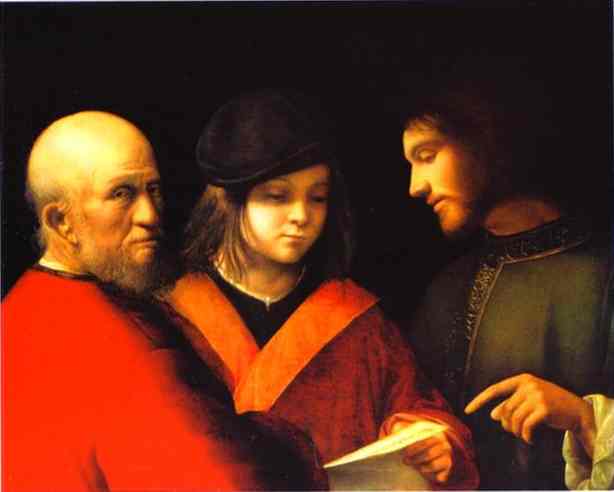
Since 2010 I have been using this site to discuss my interpretations of famous Renaissance paintings including Giorgione's "Tempest" as "The Rest on the Flight into Egypt"; his "Three Ages of Man" as "The Encounter of Jesus with the Rich Young Man"; Titian's, "Sacred and Profane Love" as "The Conversion of Mary Magdalen"; Titian's "Pastoral Concert" as his "Homage to Giorgione", and Michelangelo's"Doni Tondo." The full papers can now be found at academia.edu.
Showing posts with label Pastoral Concert. Show all posts

Saturday, May 30, 2026

Titian: Pastoral Concert, Bibliography

I originally published some bibliographical notes on Titian's Pastoral Concert on this site on May 26, 2012 in preparation for publishing online my interpretation of the famous painting as Titian's "Homage to the Recently Deceased Giorgione."  This year in my previous two posts I have reposted my interpretation, as well as a comparison of it with that of Dr. Joost-Gaugier who also sees the painting as Titian's Homage to Giorgione.To complete the discussion I would like to re-post the bibliographical information here.


The December 1957 issue of The Journal of Aesthetics and Art Criticism featured an essay on the painting by Philipp Fehl entitled, “The Hidden Genre: a Study of the Concert Champetre in the Louvre.”[i] In his study Fehl limited himself to a discussion of the two female nudes in the painting.
My present proposition is simply this: the two women are not human. They are nymphs of the wood who, having been attracted by the music and the charm of the young men, have joined their concert. They are as invisible to the young men as they are, in the full beauty of the landscape which they bodily represent, visible to us. [157]
From this insight that was based primarily on an extensive analysis of literary sources, Fehl drew the following conclusion about the painting.
The picture, if we choose to look at it from this point of view, is now a true pastoral, in the spirit of the idylls of Theocritus. [157]
He did admit that a really convincing proof would require a poem or text which, unfortunately, he had not been able to find.

However, a year later famed Art historian Edgar Wind seemed to add his weight to Fehl’s description of the two nudes in Pagan Mysteries of the Renaissance.[ii]
The same 'philosophy of clothes' can be studied in Giorgione's 'Fete Champetre' in the Louvre. The nymphs, distinguished from the musicians by the absence of clothes, are meant to be recognized as 'divine presences', superior spirits from whose fountain the mortal musicians are nourished…
Wind’s comment was only in a footnote and one would suspect that he came upon Fehl’s interpretation while his own book was in process of publication.

In any event, in 1959 Patricia Egan took Fehl’s analysis a step further in an essay, “Poesia and the Fete Champetre” that appeared in the Art Bulletin.[iii] Egan also concentrated on the two nude females, but she regarded them as muses rather than nymphs. They are sister beings who “constitute the first and strongest section of the picture.”
the left side comprises the water-pouring “muse,” the fine young lute-player, the white gabled building by the lake, and the farther landscape; the enclosed landscape on the right side contains the flute-playing ”muse,” the shepherd boy, the farmhouse, the grove, and the goatherd with his flock. [305]
Egan found a contemporary “Tarocchi” card with an image identified as “Poesia”. Although clothed, she carried the pitcher and pipe (aulos) seen in the “Pastoral Concert”.

Tarocchi card C-27

Entitled Poesia, the girl is seated beside a fountain on grass or leaves, using one hand to play a flute while with the other she empties a pitcher into a small body of water at her side….If we accept this degree of meaning to be implicit in the scene, we may add, tentatively, to the titles already bestowed on the picture, that of “Allegory of Poetry.” [304]
Egan admitted that the connections in the Tarocchi card have become somewhat weaker in the “Pastoral Concert.” “Poesia” has “twinned”, and each twin performs one of the actions depicted on the playing card.
Poesia as the personification of academic eloquence has twinned, and her actions, though simultaneous, no longer depend so closely on one another. [312]
Although Egan identified the nudes as muses and not as nymphs, she agreed with Fehl: the “muses’ belong to one world, the boys to another, the world of Poetry includes them all.” [312]

In 2006 Jaynie Anderson, in the catalog entry for the Bellini, Giorgione, Titian exhibition jointly sponsored by Washington’s National Gallery and Vienna’s Kunsthistorisches Museum, noted the contributions of Fehl and Egan, and claimed that their observations about the unworldly nature of the two nudes were now generally accepted by scholars.[iv] I fully agree and believe that in no way can these two females be considered as girl friends or prostitutes.

Note: Since I originally wrote the above words, I discovered the following sources: 

Joost-Gaugier, Christiane L. The mute poetry of the Fete Champetre: Titian’s memorial to Giorgione. Gazette des Beaux Arts, January 1999, Issue 1560, pp. 1-14.  After my initial intuition I  discovered that famed art historian S. J. Freedberg had also seen the painting as a homage to Giorgione, and noted that in my paper.  S.J. Freedberg, Painting in Italy, 1500-1600, London, 1990, pp. 139-140.

Freedberg just provides a brief mention but Joost-Gaugier's paper is detailed and extensive, and argues that the painting is indeed Titian's Memorial to Giorgione. In my previous post on this site, I have discussed her paper and pointed out areas of agreement and disagreement with my own interpretation.

I also reposted my interpretation on this site earlier this month. My interpretation can also be found   on academia.edu.  I agree with Dr. Joost-Gaugier that the painting is Titian's memorial or homage to Giorgione but disagree with her description of the figures in the painting. 

###


[i]Philipp Fehl: “The Hidden Genre: A Study of the Concert Champetre in the Louvre,” Journal of Aesthetics and Art Criticism, XVI, 2, 1957, pp. 154-168.

[ii] Edgar Wind: Pagan Mysteries of the Renaissance, New Haven, 1958. P.123, n.1.

[iii] Patricia Egan: “Poesia and the Fete Champetre”, The Art Bulletin, Vol. 41 (Dec. 1959), pp. 303-313.

[iv] Brown, David Alan, and Ferino-Pagden, Sylvia, Bellini, Giorgione, Titian, and the Renaissance of Venetian Painting, Washington, 2006. Catalog entry #31 by Jaynie Anderson.  

Saturday, May 16, 2026

Titian: Pastoral Concert continued

In my last post I discussed my interpretation of Titian's Pastoral Concert which I originally published in 2013. This post is designed to draw attention to an interpretation of the Fete Champetre or Pastoral Concert published in 1999 by Dr. Christiane Joost- Gaugier. The article, The mute poetry of the Fete champetre: Titian’s memorial to Giorgione” appeared in the January 1999 issue of the Gazette des Beaux Arts. As the title suggests, Dr. Joost-Gaugier attributed the famous painting to Titian and regarded it as a memorial to the recently deceased Giorgione.


I originally published my interpretation of the painting on my now defunct website, MyGiorgione, in May, 2013. Since then, I have published the full paper it on academia.edu. I believed then and still do that the famous painting that hangs in the Louvre is indeed a homage by the young Titian to Giorgione. Only afterwards did I discover that Dr. Joost-Gaugier had seen the same thing back in 1999. *

Initially, this discovery was embarrassing since I should have found Dr. Joost- Gaugier's interpretation earlier. However, it became somewhat comforting to find that I had come independently to a similar conclusion with someone of her stature, knowledge, and experience. I also found that the technical evidence of the underpainting presented in her article also supported my paper. 

Nevertheless, while I agree with much of Dr. Joost-Gaugier's analysis, I do have disagreements with some of the conclusions she drew from her insights. I will explore both the areas of agreement and disagreement in this review article. 

In an abstract to her paper Dr. Joost-Gaugier laid out her thesis.

This paper will attempt to propose a new reading of this most unusual, indeed unique, picture which will suggest that it was initiated by Giorgione as a poesia based on an antique theme but incorporating his views about painting and, after his death completed by the grieving young Titian who, inspired by Virgil, turned the painting into a memorial to his beloved master who is portrayed as the center around which the entire composition and subject revolve. It will also suggest that Titian valued this painting as a private painting. (2)
Dr. Joost-Gaugier observed that the focus of the painting, despite the scholarly interest in the two nude women, was the young man in the center clothed in red. 

Indeed, the brilliance of his presence makes it clear that he, and not the nude women who have so intrigued former viewers is at the center of the painting…. In contrast to the soft beiges, browns, and olive colors which prevail elsewhere in the painting, the glowing reds of his mantle and hat accentuate the centrality and importance of his presence. (5)
She identified the man in red as Giorgione but saw signs, as I did years later, that he has died. 


Contrary to what many observers have assumed, the brilliantly colored young man at the center of the painting is not playing his instrument. Indeed, his instrument has no strings, a fact that has gone unnoticed and which is assured by the evidence of x-rays. Nor does the protagonist of the painting sing. His lips are closed. In fact, his head is averted so as to cause his features to be lost in deep shadow and darkness. From him there is only silence. He is playing but not playing, singing but not singing. He is seen but not seen. 
The other young man, dressed in plain, rustic garb would then possibly be Titian.
The suggested identification of the young lutist as Giorgione leads to another possibility. Perhaps his companion—who focuses his respect as well as his energies on the main actor—is a self-portrait of the younger Titian who expresses his devotion in a moment of quiet reverence. (6)
In regard to the two nude women, Dr. Joost-Gaugier differed from earlier scholars who regarded them as wood nymphs or muses invisible to the men. For her, the four figures in the painting are “distinctly human beings.” Moreover, both women are the same.
The same figure is represented from the front…and from the back, suggesting different modes or tempos for the engagement of the beholder. (4)
She then speculated that the woman was actually Giorgione’s lover who also died of the plague, and that Giorgione had originally begun the painting in her memory. 
The fact that the two women appear to have been painted from the same model suggests that they may refer to the woman with whom Giorgione had fallen in love shortly before his death. (6)
In summing up Dr. Joost Gaugier believed that while the painting has an Arcadian mood based possibly on an eclogue by Virgil, Giorgione had begun the painting shortly before his own death of the plague as a poetic memorial of his recently deceased lover but that Titian then altered it into a memorial of Giorgione himself. 
Taken together, the above observations show that this painting is neither a “Fete Champetre” nor a “Pastoral Concert, nor a (live) concert at all. They suggest rather a funeral motif.
In my paper I also saw that the elegantly dressed man with the lute is Giorgione, and the other more simply dressed man is Titian. I agree that the painting is Titian’s homage to the recently deceased Giorgione. 
I agree that the absence of strings on the lute is a sign that Giorgione has died and will play no more. I also agree that Giorgione’s face in shadow is another sign of death. Titian would use it later in a crucifixion scene. I went a little further though in seeing another sign of death in the pouring action of the nude on the left. I see her pouring Giorgione’s spirit into the well. 
Moreover, I believe that the dark sky in the background is also a sign of death. I did not mention it in my paper because I could not be certain that the dark sky was original or just the result of aging. Dr. Joost-Gaugier’s examination of the underpainting indicates that the original sky is cloudy and certainly not the appropriate background for a pleasant pastoral idyll.
I agree that the two nude women are one and the same, but I do not believe that they are human. I follow Fehl, Wind, and Egan in this regard but go further and argue that she is Euterpe, the muse of lyric poetry. **
I find it difficult to accept the suggestion that the painting was initially begun by Giorgione as a memorial to his deceased lover, or that the unfortunate woman is depicted in the painting. According to Vasari’s sources, Giorgione died of the plague after contact with his lover. Death for both of them would have been rapid and within days of each other.  He would have been in no shape physically or emotionally to commence a tribute to his lover. A recent discovery indicated that Giorgione spent his last days away from his studio in quarantine on an island in the lagoon.
Moreover, if he meant the painting as a tribute to his lover, why would he include Titian in the painting? Why would he have shown the young woman handing her flute to Titian? According to Dr. Joost-Gaugier all the figures in the painting are original. Scientific analysis of the underpainting reveals that only the standing nude was altered.
I can accept the idea that Titian might have kept this painting in his studio for years but that could mean that he revised and retouched it at a later date using paints mixed years later than 1510. Given this fact, I do not believe the scientific evidence firmly establishes a dual authorship.
I do believe that Titian painted in the style of Giorgione as an act of homage to his recently deceased friend. I would also not be surprised if Titian used Giorgione cartoons. I believe that the young Titian acted more as a colorist than a designer on the walls of the Fondaco de Tedeschi with the result that onlookers mistook his work for Giorgione’s. 
Rather than an Arcadian poesia in an antique style, I believe that Titian used the biblical story of David and Jonathan to express the depth of his sorrow at Giorgione’s passing. Jonathan was the son and heir of King Saul, and David was a young shepherd boy. They became the closest of friends during Israel’s struggle with the Philistines. 
Titian dressed Giorgione in the finery befitting a King’s son while he clothed himself in rustic garb. In my interpretation the shepherd in the mid-ground would then be David’s father left behind with his flocks, and not a typical gamboling Arcadian shepherd. 
Renaissance art historians never tire of trying to find sources in ancient literature for paintings whose subjects mystify them. They go to great lengths to show that painters like Giorgione and Titian were familiar with these texts even though there is little evidence that they could even read Latin. For some reason they find it difficult to imagine that the sources of many of these beautiful paintings are in the Bible and the apocryphal legends that embellished the sparse biblical account. ***
###

Joost-Gaugier, Christiane L. The mute poetry of the Fete Champetre: Titian’s memorial to Giorgione. Gazette des Beaux Arts, January 1999, Issue 1560, pp. 1-14.  After my initial intuition I  discovered that famed art historian S. J. Freedberg had also seen the painting as a homage to Giorgione, and noted that in my paper.  S.J. Freedberg, Painting in Italy, 1500-1600, London, 1990, pp. 139-140.

** Euterpe was also seen by Ethanan Motzkin in "The Meaning of Titians Concert champetre in the Louvre. Gazette des Beaux Arts, 116 (1990), pp. 51-66.

*** The late Ross J. Kilpatrick, a classicist, argued that instead of Virgil, the source of the Pastoral Concert could be found in Horace and Propertius. "Horatian Landscape in the Louvre's "Concert Champetre," Artibus et Historiae, Vol. 21, No. 41 (2000), pp. 123-131. He included a discussion of Dr. Joost-Gaugier's interpretation. 

Saturday, May 2, 2026

Titian: Pastoral Concert or Homage to Giorgione

 Since 2013 I have argued that the so-called Pastoral Concert that hangs in the Louvre should be recognized as Titian's Homage to the Recently Deceased Giorgione. The full paper can now be found on academia.edu.Below find a shortened version that first appeared on Giorgione et al... back in 2013 with some more recent notes. ***************** 


Titian: Pastoral Concert (Louvre)

The “Pastoral Concert” or “Concert Champetre” that now hangs in the Louvre is universally recognized as one of the world’s great masterpieces. Usually dated around 1510-1511 it is surrounded, like other famous products of the Venetian Renaissance, by an aura of mystery and enigma. Not only has scholarly opinion been divided about whether to attribute the painting to Giorgione or Titian, but also no one has been able to come up with a plausible explanation of the subject or meaning of the painting. In this post I present a synopsis of a “working hypothesis” that provides a new interpretation of the subject of the "Pastoral Concert" and also resolves the question of attribution. I argue that Titian used the famous Biblical story of Jonathan and David to provide a framework for a personal homage to Giorgione, his recently deceased mentor and friend. 

Before going any further it should be noted that my reading is speculative and unorthodox. As far as I know a painterly homage would be unique and unprecedented in the art of the Venetian Renaissance.* Nevertheless, there is no settled opinion on the subject of the “Pastoral Concert”, and a Titian homage to Giorgione answers most of the questions that have surrounded the painting. **

This interpretation explains why Titian put so many Giorgionesque elements in the painting, but also identifies the four main figures in the painting as well as their relationship with one another. The man on the left wearing finery and holding the lute is Giorgione. Many of the features of Giorgione that Vasari mentions in his short biography can be seen in this young man. Moreover, three here-to-fore inexplicable details in the painting indicate that Giorgione is dead: his face is in shadow; the lute has no strings; and the nude on the left is pouring into a well. ***

This interpretation then identifies the young rustic on the right as Titian. He depicts himself as Giorgione’s social inferior but also as his successor. His closeness to the other man as well as his connection with the flock in the mid ground brings to mind the biblical story of David and Jonathan. Titian identifies himself with David, the soul-mate and successor of Jonathan.

Cima da Conegliano: David and Jonathan
National Gallery, London, c. 1506-10.

My interpretation agrees with those scholars who have observed that the two female nudes in the painting are muses who are invisible to the two men. Although muses are the source of inspiration, the men are oblivious of their presence. Indeed, I argue that the two nudes are the same muse. She is Euterpe, the muse of lyric poetry and music. The standing nude is pouring Giorgione’s spirit out, but on the right she is looking directly at Titian.

To express his homage to the deceased Giorgione, Titian incorporated many Giorgionesque elements into the painting. Practically everything that Vasari said about Giorgione can be found in this painting. The most telling evidence is the reference to the story of the paragone where Giorgione claimed supremacy for painting over sculpture since he could portray every aspect of a figure on a flat surface. In one glance the viewer sees the front, the back and the profile of the nude Euterpe.

Many have seen that the relationship between the two young men in the “Pastoral Concert” is the key to the painting. Some have even seen a strong trace of  “homo-eroticism.” In my opinion the bond between two young warriors, or two young artists is sufficient to explain the painting. Look at the painting and consider David’s lament on hearing the news of the death of Jonathan.

O Jonathan, in your death I am stricken
I am desolate for you, Jonathan my brother.
Very dear to me you were,
Your love to me more wonderful
than the love of a woman. 
 2 Samuel  1:19-26

### 

* I originally wrote these words in May, 2013. Only in 2020 did I discover that art historian Christiane Joost-Gaugier had seen the painting as Titian's homage to the deceased Giorgione back in 1999. (Joost-Gaugier, Christiane L. "The mute poetry of the Fete Champetre: Titian’s memorial to Giorgione." Gazette des Beaux Arts, January 1999, Issue 1560, pp. 1-14.)

Initially, this discovery was somewhat embarrassing since I should have found Dr. Gaugier's interpretation earlier. However, it became somewhat comforting to find that I had come independently to a similar conclusion with someone of her stature, knowledge, and experience. Nevertheless, while I agree with much of Dr. Gaugier's analysis, I do have disagreements with some of the conclusions she drew from her insights. I discussed the areas of agreement and disagreement in a subsequent post.

** For a bibliographical essay on the painting see the post on Giorgione et al... dated 6/17/2013.

*** Since 2013, I have come to recognize that the dark clouds in the background are also a sign of the death of Giorgione. 

Thursday, March 16, 2023

Titian: Pastoral Concert


Since 2013 I have argued that the so-called Pastoral Concert that hangs in the Louvre should be recognized as Titian's Homage to the Recently Deceased Giorgione. The full paper can now be found on academia.edu., and below find a shortened version that first appeared on Giorgione et al... back in 2013 with some more recent notes.

***************** 

The “Pastoral Concert” or “Concert Champetre” that now hangs in the Louvre is universally recognized as one of the world’s great masterpieces. Usually dated around 1510-1511 it is surrounded, like other famous products of the Venetian Renaissance, by an aura of mystery and enigma. Not only has scholarly opinion been divided about whether to attribute the painting to Giorgione or Titian, but also no one has been able to come up with a plausible explanation of the subject or meaning of the painting.

Titian: Pastoral Concert (Louvre)

In this post I present a synopsis of a “working hypothesis” that provides a new interpretation of the subject of the "Pastoral Concert" and also resolves the question of attribution. I argue that Titian used the famous Biblical story of Jonathan and David to provide a framework for a personal homage to Giorgione, his recently deceased mentor and friend. 

Before going any further it should be noted that my reading is speculative and unorthodox. As far as I know a painterly homage would be unique and unprecedented in the art of the Venetian Renaissance.* Nevertheless, there is no settled opinion on the subject of the “Pastoral Concert”, and a Titian homage to Giorgione answers most of the questions that have surrounded the painting. **

This interpretation explains why Titian put so many Giorgionesque elements in the painting, but also identifies the four main figures in the painting as well as their relationship with one another. The man on the left wearing finery and holding the lute is Giorgione. Many of the features of Giorgione that Vasari mentions in his short biography can be seen in this young man. Moreover, three here-to-fore inexplicable details in the painting indicate that Giorgione is dead: his face is in shadow; the lute has no strings; and the nude on the left is pouring into a well. ***

This interpretation then identifies the young rustic on the right as Titian. He depicts himself as Giorgione’s social inferior but also as his successor. His closeness to the other man as well as his connection with the flock in the mid ground brings to mind the biblical story of David and Jonathan. Titian identifies himself with David, the soul-mate and successor of Jonathan.

Cima da Conegliano: David and Jonathan
National Gallery, London, c. 1506-10.

My interpretation agrees with those scholars who have observed that the two female nudes in the painting are muses who are invisible to the two men. Although muses are the source of inspiration, the men are oblivious of their presence. Indeed, I argue that the two nudes are the same muse. She is Euterpe, the muse of lyric poetry and music. The standing nude is pouring Giorgione’s spirit out, but on the right she is looking directly at Titian.

To express his homage to the deceased Giorgione, Titian incorporated many Giorgionesque elements into the painting. Practically everything that Vasari said about Giorgione can be found in this painting. The most telling evidence is the reference to the story of the paragone where Giorgione claimed supremacy for painting over sculpture since he could portray every aspect of a figure on a flat surface. In one glance the viewer sees the front, the back and the profile of the nude Euterpe.

Many have seen that the relationship between the two young men in the “Pastoral Concert” is the key to the painting. Some have even seen a strong trace of  “homo-eroticism.” In my opinion the bond between two young warriors, or two young artists is sufficient to explain the painting. Look at the painting and consider David’s lament on hearing the news of the death of Jonathan.

O Jonathan, in your death I am stricken
I am desolate for you, Jonathan my brother.
Very dear to me you were,
Your love to me more wonderful
than the love of a woman. 
 2 Samuel  1:19-26

### 

* I originally wrote these words in May, 2013. Only in 2020 did I discover that art historian Christiane Joost-Gaugier had seen the painting as Titian's homage to the deceased Giorgione back in 1999. (Joost-Gaugier, Christiane L. "The mute poetry of the Fete Champetre: Titian’s memorial to Giorgione." Gazette des Beaux Arts, January 1999, Issue 1560, pp. 1-14.)

Initially, this discovery was somewhat embarrassing since I should have found Dr. Gaugier's interpretation earlier. However, it became somewhat comforting to find that I had come independently to a similar conclusion with someone of her stature, knowledge, and experience. Nevertheless, while I agree with much of Dr. Gaugier's analysis, I do have disagreements with some of the conclusions she drew from her insights. I discussed the areas of agreement and disagreement in a subsequent post.

** For a bibliographical essay on the painting see the post on Giorgione et al... dated 6/17/2013.

*** Since 2013, I have come to recognize that the dark clouds in the background are also a sign of the death of Giorgione. 

Monday, February 14, 2022

Titian: Pastoral Concert or Homage to Giorgione


This year I am reprising the most viewed posts on Giorgione et al... Since its inception in 2010, the site has garnered almost 540,000 page views. An introductory essay on the Pastoral Concert ranks number 3 on the list of views. I have added some notes on my findings since then.
*******

The “Pastoral Concert” or “Concert Champetre” that now hangs in the Louvre is universally recognized as one of the world’s great masterpieces. Usually dated around 1510-1511 it is surrounded, like other famous products of the Venetian Renaissance, by an aura of mystery and enigma. Not only has scholarly opinion been divided about whether to attribute the painting to Giorgione or Titian, but also no one has been able to come up with a plausible explanation of the subject or meaning of the painting.

Titian: Pastoral Concert (Louvre)

In this post I present a synopsis of a “working hypothesis” that provides a new interpretation of the subject of the "Pastoral Concert" and also resolves the question of attribution. I argue that Titian used the famous Biblical story of Jonathan and David to provide a framework for a personal homage to Giorgione, his recently deceased mentor and friend. The full 3500 word interpretation can be found at MyGiorgione, a site devoted to my work on Giorgione, Titian, and the art of the Venetian Renaissance.

Before going any further it should be noted that my reading is speculative and unorthodox. As far as I know a painterly homage would be unique and unprecedented in the art of the Venetian Renaissance.* Nevertheless, there is no settled opinion on the subject of the “Pastoral Concert”, and a Titian homage to Giorgione answers most of the questions that have surrounded the painting. **

This interpretation explains why Titian put so many Giorgionesque elements in the painting, but also identifies the four main figures in the painting as well as their relationship with one another. The man on the left wearing finery and holding the lute is Giorgione. Many of the features of Giorgione that Vasari mentions in his short biography can be seen in this young man. Moreover, three here-to-fore inexplicable details in the painting indicate that Giorgione is dead: his face is in shadow; the lute has no strings; and the nude on the left is pouring into a well. **

This interpretation then identifies the young rustic on the right as Titian. He depicts himself as Giorgione’s social inferior but also as his successor. His closeness to the other man as well as his connection with the flock in the mid ground brings to mind the biblical story of David and Jonathan. Titian identifies himself with David, the soul-mate and successor of Jonathan.

Cima da Conegliano: David and Jonathan
National Gallery, London, c. 1506-10.

My interpretation agrees with those scholars who have observed that the two female nudes in the painting are muses who are invisible to the two men. Although muses are the source of inspiration, the men are oblivious of their presence. Indeed, I argue that the two nudes are the same muse. She is Euterpe, the muse of lyric poetry and music. The standing nude is pouring Giorgione’s spirit out, but on the right she is looking directly at Titian.

To express his homage to the deceased Giorgione, Titian incorporated many Giorgionesque elements into the painting. Practically everything that Vasari said about Giorgione can be found in this painting. The most telling evidence is the reference to the story of the paragone where Giorgione claimed supremacy for painting over sculpture since he could portray every aspect of a figure on a flat surface. In one glance the viewer sees the front, the back and the profile of the nude Euterpe.

Many have seen that the relationship between the two young men in the “Pastoral Concert” is the key to the painting. Some have even seen a strong trace of  “homo-eroticism.” In my opinion the bond between two young warriors, or two young artists is sufficient to explain the painting. Look at the painting and consider David’s lament on hearing the news of the death of Jonathan.

O Jonathan, in your death I am stricken
I am desolate for you, Jonathan my brother.
Very dear to me you were,
Your love to me more wonderful
than the love of a woman. 
 2 Samuel  1:19-26

### 

* I originally wrote these words in May, 2013. Only in 2020 did I discover that art historian Christiane Joost-Gaugier had seen the painting as Titian's homage to the deceased Giorgione back in 1999. (Joost-Gaugier, Christiane L. "The mute poetry of the Fete Champetre: Titian’s memorial to Giorgione." Gazette des Beaux Arts, January 1999, Issue 1560, pp. 1-14.)

Initially, this discovery was somewhat embarrassing since I should have found Dr. Gaugier's interpretation earlier. However, it became somewhat comforting to find that I had come independently to a similar conclusion with someone of her stature, knowledge, and experience. Nevertheless, while I agree with much of Dr. Gaugier's analysis, I do have disagreements with some of the conclusions she drew from her insights. I discussed the areas of agreement and disagreement in a subsequent post.

** For a bibliographical essay on the painting see the post on Giorgione et al... dated 6/17/2013.

*** Since 2013, I have come to recognize that the dark clouds in the background are also a sign of the death of Giorgione. 


Saturday, June 13, 2020

Titian: Memorial to Giorgione


This post is designed to draw attention to an interpretation of the Fete Champetre or Pastoral Concert published in 1999 by Dr. Christiane Joost- Gaugier. The article,The mute poetry of the Fete champetre: Titian’s memorial to Giorgione” appeared in the January 1999 issue of the Gazette des Beaux Arts. As the title suggests, Dr. Joost-Gaugier attributed the famous painting to Titian and regarded it as a memorial to the recently deceased Giorgione.


I originally published my interpretation of the painting on the website, MyGiorgione, in May, 2013. I believed then and still do that the famous painting that hangs in the Louvre is indeed a homage by the young Titian to Giorgione. Only last year did I discover that Dr. Joost-Gaugier had seen the same thing back in 1999. *

Initially, this discovery was embarrassing since I should have found Dr. Joost- Gaugier's interpretation earlier. However, it became somewhat comforting to find that I had come independently to a similar conclusion with someone of her stature, knowledge, and experience. I also found that the technical evidence of the underpainting presented in her article also supported my paper. 

Nevertheless, while I agree with much of Dr. Joost-Gaugier's analysis, I do have disagreements with some of the conclusions she drew from her insights. I will explore both the areas of agreement and disagreement in this review article. 

In an abstract to her paper Dr. Joost-Gaugier laid out her thesis.

This paper will attempt to propose a new reading of this most unusual, indeed unique, picture which will suggest that it was initiated by Giorgione as a poesia based on an antique theme but incorporating his views about painting and, after his death completed by the grieving young Titian who, inspired by Virgil, turned the painting into a memorial to his beloved master who is portrayed as the center around which the entire composition and subject revolve. It will also suggest that Titian valued this painting as a private painting. (2)
Dr. Joost-Gaugier observed that the focus of the painting, despite the scholarly interest in the two nude women, was the young man in the center clothed in red. 

Indeed, the brilliance of his presence makes it clear that he, and not the nude women who have so intrigued former viewers is at the center of the painting…. In contrast to the soft beiges, browns, and olive colors which prevail elsewhere in the painting, the glowing reds of his mantle and hat accentuate the centrality and importance of his presence. (5)
She identified the man in red as Giorgione but saw signs, as I did years later, that he has died. 


Contrary to what many observers have assumed, the brilliantly colored young man at the center of the painting is not playing his instrument. Indeed, his instrument has no strings, a fact that has gone unnoticed and which is assured by the evidence of x-rays. Nor does the protagonist of the painting sing. His lips are closed. In fact, his head is averted so as to cause his features to be lost in deep shadow and darkness. From him there is only silence. He is playing but not playing, singing but not singing. He is seen but not seen. 
The other young man, dressed in plain, rustic garb would then possibly be Titian.
The suggested identification of the young lutist as Giorgione leads to another possibility. Perhaps his companion—who focuses his respect as well as his energies on the main actor—is a self-portrait of the younger Titian who expresses his devotion in a moment of quiet reverence. (6)
In regard to the two nude women, Dr. Joost-Gaugier differed from earlier scholars who regarded them as wood nymphs or muses invisible to the men. For her, the four figures in the painting are “distinctly human beings.” Moreover, both women are the same.
The same figure is represented from the front…and from the back, suggesting different modes or tempos for the engagement of the beholder. (4)
She then speculated that the woman was actually Giorgione’s lover who also died of the plague, and that Giorgione had originally begun the painting in her memory. 
The fact that the two women appear to have been painted from the same model suggests that they may refer to the woman with whom Giorgione had fallen in love shortly before his death. (6)
In summing up Dr. Joost Gaugier believed that while the painting has an Arcadian mood based possibly on an eclogue by Virgil, Giorgione had begun the painting shortly before his own death of the plague as a poetic memorial of his recently deceased lover but that Titian then altered it into a memorial of Giorgione himself. 
Taken together, the above observations show that this painting is neither a “Fete Champetre” nor a “Pastoral Concert, nor a (live) concert at all. They suggest rather a funeral motif.
In the paper that I posted on my website I also saw that the elegantly dressed man with the lute is Giorgione, and the other more simply dressed man is Titian. I agree that the painting is Titian’s homage to the recently deceased Giorgione. 
I agree that the absence of strings on the lute is a sign that Giorgione has died and will play no more. I also agree that Giorgione’s face in shadow is another sign of death. Titian would use it later in a crucifixion scene. I went a little further though in seeing another sign of death in the pouring action of the nude on the left. I see her pouring Giorgione’s spirit into the well. 
Moreover, I believe that the dark sky in the background is also a sign of death. I did not mention it in my paper because I could not be certain that the dark sky was original or just the result of aging. Dr. Joost-Gaugier’s examination of the underpainting indicates that the original sky is cloudy and certainly not the appropriate background for a pleasant pastoral idyll.
I agree that the two nude women are one and the same, but I do not believe that they are human. I follow Fehl, Wind, and Egan in this regard but go further and argue that she is Euterpe, the muse of lyric poetry. **
I find it difficult to accept the suggestion that the painting was initially begun by Giorgione as a memorial to his deceased lover, or that the unfortunate woman is depicted in the painting. According to Vasari’s sources, Giorgione died of the plague after contact with his lover. Death for both of them would have been rapid and within days of each other.  He would have been in no shape physically or emotionally to commence a tribute to his lover. A recent discovery indicated that Giorgione spent his last days away from his studio in quarantine on an island in the lagoon.
Moreover, if he meant the painting as a tribute to his lover, why would he include Titian in the painting? Why would he have shown the young woman handing her flute to Titian? According to Dr. Joost-Gaugier all the figures in the painting are original. Scientific analysis of the underpainting reveals that only the standing nude was altered.
I can accept the idea that Titian might have kept this painting in his studio for years but that could mean that he revised and retouched it at a later date using paints mixed years later than 1510. Given this fact, I do not believe the scientific evidence firmly establishes a dual authorship.
I do believe that Titian painted in the style of Giorgione as an act of homage to his recently deceased friend. I would also not be surprised if Titian used Giorgione cartoons. I believe that the young Titian acted more as a colorist than a designer on the walls of the Fondaco de Tedeschi with the result that onlookers mistook his work for Giorgione’s. 
Rather than an Arcadian poesia in an antique style, I believe that Titian used the biblical story of David and Jonathan to express the depth of his sorrow at Giorgione’s passing. Jonathan was the son and heir of King Saul, and David was a young shepherd boy. They became the closest of friends during Israel’s struggle with the Philistines. 
Titian dressed Giorgione in the finery befitting a King’s son while he clothed himself in rustic garb. In my interpretation the shepherd in the mid-ground would then be David’s father left behind with his flocks, and not a typical gamboling Arcadian shepherd. 
Renaissance art historians never tire of trying to find sources in ancient literature for paintings whose subjects mystify them. They go to great lengths to show that painters like Giorgione and Titian were familiar with these texts even though there is little evidence that they could even read Latin. For some reason they find it difficult to imagine that the sources of many of these beautiful paintings are in the Bible and the apocryphal legends that embellished the sparse biblical account. ***
###

Joost-Gaugier, Christiane L. The mute poetry of the Fete Champetre: Titian’s memorial to Giorgione. Gazette des Beaux Arts, January 1999, Issue 1560, pp. 1-14.  After my initial intuition I  discovered that famed art historian S. J. Freedberg had also seen the painting as a homage to Giorgione, and noted that in my paper.  S.J. Freedberg, Painting in Italy, 1500-1600, London, 1990, pp. 139-140.

** Euterpe was also seen by Ethanan Motzkin in "The Meaning of Titians Concert champetre in the Louvre. Gazette des Beaux Arts, 116 (1990), pp. 51-66.

*** The late Ross J. Kilpatrick, a classicist, argued that instead of Virgil, the source of the Pastoral Concert could be found in Horace and Propertius. "Horatian Landscape in the Louvre's "Concert Champetre," Artibus et Historiae, Vol. 21, No. 41 (2000), pp. 123-131. He included a discussion of Dr. Joost-Gaugier's interpretation.

Tuesday, May 19, 2020

Titian: Pastoral Concert


The Pastoral Concert or Concert Champetre that now hangs in the Louvre is universally recognized as one of the world’s great masterpieces. Usually dated around 1510-1511 it is surrounded, like other famous paintings of the Venetian Renaissance, by an aura of mystery and enigma. Not only has scholarly opinion been divided about whether to attribute the painting to Giorgione or Titian, but also no one has been able to come up with a plausible explanation of the subject or meaning of the painting.

Titian: Pastoral Concert (Louvre)

In this post I present a synopsis of a “working hypothesis” that provides a new interpretation of the subject of the Pastoral Concert and also resolves the question of attribution. I argue that Titian used the famous Biblical story of Jonathan and David to provide a framework for a personal homage to Giorgione, his recently deceased mentor and friend. The full 3500 word interpretation can be found at MyGiorgione, a site devoted to my work on Giorgione, Titian, and the art of the Venetian Renaissance. 

Before going any further it should be noted that my reading is speculative and unorthodox. As far as I know a painterly homage would be unique and unprecedented in the art of the Venetian Renaissance. Nevertheless, there is no settled opinion on the subject of the Pastoral Concert, and a Titian homage to Giorgione answers most of the questions that have surrounded the painting. *

This interpretation explains why Titian put so many Giorgionesque elements in the painting, and also identifies the four main figures in the painting as well as their relationship with one another. The man on the left wearing finery and holding the lute is Giorgione. Many of the features of Giorgione that Vasari mentions in his short biography can be seen in this young man. Moreover,  here-to-fore inexplicable details in the painting indicate that Giorgione is dead: his face is in shadow; the lute has no strings; and the nude on the left  pouring into a well.

In addition, the dark sky in the background, a feature inappropriate for a pastoral idyll, was often used by artists as a sign of danger and death. Titian and others used it in crucifixion scenes, and artists often used it to depict the massacre of the Innocents in the background of depictions of the flight into Egypt. 

This interpretation then identifies the young rustic on the right as Titian. He depicts himself as Giorgione’s social inferior but also as his successor. His closeness to the other man as well as his connection with the flock in the mid ground brings to mind the biblical story of David and Jonathan. Titian identifies himself with David, the soul-mate and successor of Jonathan.

Cima da Conegliano: David and Jonathan
National Gallery, London, c. 1506-10.

My interpretation agrees with those scholars who have observed that the two female nudes in the painting are muses who are invisible to the two men. Although muses are the source of inspiration, the men are oblivious of their presence. Indeed, I argue that the two nudes are the same muse. She is Euterpe, the muse of lyric poetry and music. The standing nude is pouring Giorgione’s spirit out, but on the right she is looking directly at Titian.

To express his homage to the deceased Giorgione, Titian incorporated many Giorgionesque elements into the painting. Practically everything that Vasari said about Giorgione can be found in this painting. The most telling evidence is the reference to the story of the paragone where Giorgione claimed supremacy for painting over sculpture since he could portray every aspect of a figure on a flat surface. In one glance the viewer sees the front, the back and the profile of the nude Euterpe.

Many have seen that the relationship between the two young men in the Pastoral Concert is the key to the painting. Some have even seen a strong trace of  “homo-eroticism.” In my opinion the bond between two young warriors, or two young artists is sufficient to explain the painting. Look at the painting and consider David’s lament on hearing the news of the death of Jonathan.

O Jonathan, in your death I am stricken
I am desolate for you, Jonathan my brother.
Very dear to me you were,
Your love to me more wonderful
than the love of a woman. (2 Samuel  1:19-26)
###

* I originally wrote these words in May, 2013. This blog post is intended to present the interpretation to new readers and also provide some additional information. Only last year did I discover that art historian Christiane Joost-Gaugier had seen the painting as Titian's homage to the deceased Giorgione back in 1999. **

Initially, this discovery was somewhat embarrassing since I should have found Dr. Gaugier's interpretation earlier. However, it became somewhat comforting to find that I had come independently to a similar conclusion with someone of her stature, knowledge, and experience. Nevertheless, while I agree with much of Dr. Gaugier's analysis, I do have disagreements with some of the conclusions she drew from her insights.

I will discuss the areas of agreement and disagreement in a subsequent post.

** Joost-Gaugier, Christiane L. The mute poetry of the Fete Champetre: Titian’s memorial to Giorgione. Gazette des Beaux Arts, January 1999, Issue 1560, pp. 1-14.


Monday, October 28, 2013

Hasan Niyazi R.I.P.


I just heard that Hasan Niyazi, my friend and fellow Art history blogger, died suddenly over the weekend.  Hasan was from Australia and in the past three years, his blog, Three Pipe Problem (3PP), had become one of the most popular Art history blogs in the world. He was the son of Turkish Cypriots who had migrated to Australia when Hasan was a young boy. Like Raphael, his favorite painter, Hasan died tragically in the prime of life.


His passion was the art of the Italian Renaissance. He claimed that his interest in Art began at the age of nine when he found a copy of a book by famed art historian Erwin Panofsky. I wonder if it began on the island of Cyprus under the eyes of the goddess Aphrodite, the beloved deity of the island.

I first encountered Hasan when I commented on a blog post he had written for 3PP in July of 2010 on Giorgione’s “Tempest.” We had a spirited back and forth that showed that Hasan was willing to engage in debate but that he was also open to new ideas if they could be backed up with hard evidence. Even though he loved the art of the Renaissance, he had trained and worked in the sciences and believed that Art history should be subject to the same rules that governed the sciences.

Our first encounter led to many more. He helped me immeasurably not only with his research into favorite painters like Raphael but also with the technical aspects of blogging. He was a wizard of design and had a great flair for using images in his work. He willingly shared his knowledge with me, a web newcomer.

Eventually, he allowed me to publish some of my discoveries and reviews on his site. His site was growing by leaps and bounds and he gave me the opportunity to reach a much larger audience. It was not easy because he was a stern taskmaster and editor. We had many arguments and disagreements but I believe we both gained by the exchanges. When I sent him my interpretation of Titian’s  “Sacred and Profane Love,” he chided me for not discussing all the previous interpretations, and eventually decided to do that on his own. It was a great example of web-based cooperation.

Speaking of the Web, Hasan ended his last post with these words.
The future of art history and the internet is a very exciting prospect. This goes beyond the fact that more art historians and institutions are engaging online, but also expands to include an increased public participation and interest in learning about art and history outside of an institutional and pedagogical content. The web allows quality knowledge, and fascinating images and video to be accessible everywhere, and by everyone--hence the potential for art history online is essentially limitless.
As a small token I would like to dedicate my most recent discovery to the memory of Hasan. One of his favorite paintings was Titian’s “Pastoral Concert.” Earlier this year I sent him an advance copy before I posted it on my own website and blog. He read it and very kindly spread the word among his friends and followers. I interpreted the painting as Titian’s homage to his friend Giorgione on his sudden and tragic death at the age of 33.


We never met and he lived on the other side of the world in a place he called, Oz. But he was a dear friend and colleague.

Goodbye, young friend.

Frank

###

Wednesday, September 11, 2013

Renaissance Art Mysteries


This September marks the third anniversary of Giorgione et al… Previously, I had created a website for my work on Giorgione's Tempest but was advised that blogspot would reach a wider audience. Seeing the Tempest as a sacred subject, "The Rest on the Flight into Egypt", provided the key that opened the door to a number of other new interpretations of equally famous and mysterious paintings of the Venetian Renaissance. Below are brief summaries of the four major interpretive discoveries. In a subsequent post I will list a number of secondary but significant discoveries that have arisen from my work on Giorgione and Titian.

Discussions of these interpretations can be found throughout Giorgione et al... by clicking on the labels or using the search box. The full papers have been published at MyGiorgione.

Incredibly, I am not a professional art historian. Although I hold a doctorate in History my field of study was eighteenth century British politics, and I left academe in 1972. Until my retirement in 2007 I was a financial advisor. Only in the last few years did travel and some other factors lead me to Venice.


Giorgione: The Tempest. In the fall of 2005 I interpreted the subject of the Tempest as “The Rest on the Flight into Egypt.” In this interpretation all the major elements in the painting are identified. The nude woman nursing an infant is the Madonna. The man standing at the left functioning as an “interlocutor” is St. Joseph with his staff. The broken columns are commonplace in depictions of the “Rest on the Flight into Egypt.” The city in the background is Judea from where the Holy Family has fled but could also be equated with Padua during the Cambrai war. The scraggly plant in the foreground is identified as a “belladonna” a plant associated with witchcraft and the Devil. Even the bird on the distant rooftop is shown to be derived from a famous Psalm. A short essay was published in the Masterpiece column of the Wall St. Journal In may, 2006. In 2010 I presented a paper on the “Tempest” at the annual meeting of the Renaissance Society of America held that year in Venice.


Titian: Sacred and Profane Love. In 2010 after a visit to Rome’s Borghese Gallery, I realized that the subject of Titian’s Sacred and Profane Love was the Conversion of Mary Magdalen. In this interpretation all the elements in Titian’s famous painting are identified. The finely dressed Woman is Mary Magdalen in the guise of a Venetian courtesan. The nude Woman is the converted Magdalen in the process of throwing off her worldly finery. In her hand she holds the jar of ointment that is found in practically every depiction of the great sinner/saint. The antique relief on the sarcophagus-like fountain, which so far has eluded explanation, can now be seen to depict three great sinners: Adam and Eve, Cain and Abel, and St. Paul falling from his horse. In 2012 I presented my interpretation of the Sacred and Profane Love at the annual meeting of the South Central Renaissance conference in New Orleans.


Giorgione: Three Ages of Man. After seeing the Tempest as a “sacred subject” I was able to take a fresh look at some of his other mysterious paintings. For example, I discovered the subject of the Three Ages of Man to be the Encounter of Jesus with the Rich Young Man derived from an episode in the Gospel of Matthew. So far there has been no scholarly agreement on the subject of this famous depiction of three half-length figures that now hangs in the Pitti Palace in Florence.  The young man in the center, whose clothing indicates his wealth, has just asked how he can achieve eternal life. On the right, Jesus dressed in a green vestment points to the commandments that he has directed the man to follow. On the left, an aging, bald Peter, dressed in martyr’s red, invites the viewer to enter the scene.


Titian: Pastoral Concert. Earlier this year I argued that this famous and mysterious painting whose attribution has been variously given to Giorgione and Titian should be considered as Titian's Homage to Giorgione. There are signs in the painting that the finely dressed lute player is not only Giorgione, but also that he has recently died. His face is in shadow; the lute has no strings; and the female muse at the left is pouring out his soul into the well. I believe that all the Giorgionesque elements in the painting were  put there by Titian in homage to his mentor. The shepherd and flock in the background indicate that Titian, the young rustic on the right, portrayed himself as David grieving over the loss of Jonathan. Both the female nudes are the muse, Euterpe.

Needless to say, these interpretations have not met with acclaim in the scholarly community. It is my hope that young scholars and students (with better tools and more energy than I possess) will be open to see with their own eyes and explore the possibility that Venetians living during the Renaissance were primarily interested in beautiful renditions of traditional sacred subjects.

###