Since 2010 I have been using this site to discuss my interpretations of famous Renaissance paintings including Giorgione's "Tempest" as "The Rest on the Flight into Egypt"; his "Three Ages of Man" as "The Encounter of Jesus with the Rich Young Man"; Titian's, "Sacred and Profane Love" as "The Conversion of Mary Magdalen"; Titian's "Pastoral Concert" as his "Homage to Giorgione", and Michelangelo's"Doni Tondo." The full papers can now be found at academia.edu.
Showing posts with label Anna Jameson. Show all posts

Saturday, August 17, 2024

Review: Anna Jameson


I am not ashamed to admit that I have used the writings of Anna Jameson, a now neglected nineteenth century English writer on Renaissance art, in my studies of Giorgione and Titian. First of all, I love the vivacity of her style. Here she is deploring the varied attempts to depict Mary Magdalen.
  
We have Magdalenes who look as if they never could have sinned, and others who look as if they never could have repented; we have Venetian Magdalenes with the air of courtesans, and Florentine Magdalenes with the air of Ariadnes; and Bolognese Magdalenes like sentimental Niobes; and French Magdalenes, moitie galantes, moitie devotes; and Dutch Magdalenes, who wring their hands like repentant washerwomen. The Magdalenes of Rubens remind us of the ‘unfortunate Miss Bailey;’ and the Magdalenes of Vandyck are fine ladies who have turned Methodists.*


This passage also illustrates the depth and breadth of her knowledge. Mrs. Jameson was an Englishwoman whose life resembled that of a character from a Jane Austen novel. Her father was an educated man but of no great means. She made a bad marriage that quickly fell apart, and had to turn to writing to support herself. She had a great interest in the art of the Renaissance and fortunately somehow managed to travel extensively on the Continent.

A reading of her two major works, “Sacred and Legendary Art,” and “Legends of the Madonna,” makes it clear that she saw an extraordinary number of paintings on her travels, and that she managed in an age before digital cameras and laptops to retain an incredible amount of knowledge. From her writings it is clear that she had a keen eye for observation; an encyclopedic knowledge of the legends and stories that formed the basis of most Renaissance art; and a great flair for descriptive writing.  Here is her description of a Giorgione masterpiece that is now known as “The Three Philosophers.”  


“I must mention a picture by Giorgione in the Belvedere Gallery, well known as one of the few undoubted productions of that rare and fascinating painter, and often referred to because of its beauty. Its significance has hitherto escaped all writers on art, as far as I am acquainted with them, and has been dismissed as one of his enigmatical allegories. It is called in German, Die Feldmasser (the Land Surveyors), and sometimes styled in English the Geometricians, or the Philosophers, or the Astrologers. …I have myself no doubt that this beautiful picture represents the “three wise men of the East,” watching on the Chaldean hills the appearance of the miraculous star…” (332)

Her interpretation, which is shared by some prominent art historians today, shows not only her knowledge and appreciation of Giorgione and his work but also her familiarity with the ancient stories and legends so popular during the Renaissance. Even in her time these legends had been largely forgotten.  In her introduction to “Sacred and Legendary Art” she wrote,

It is curious, this general ignorance with regard to the subjects of Medieval Art, more particularly now that it has become a reigning fashion among us. We find no such ignorance with regard to the subjects of classical Art, because the associations connected with them form a part of every liberal education….(8)
In the old times the painters of these legendary scenes and subjects could always reckon on certain associations and certain sympathies in the minds of the spectators. We have outgrown these associations, we repudiate these sympathies. We have taken these works from their consecrated localities, in which they once held their dedicated place, and we have hung them in our drawing-rooms and our dressing-rooms, over our pianos and our sideboards—and now what do they say to us?...can they speak to us of nothing save flowing lines and correct drawing and gorgeous color? (9)

It was only in her work that I was able to find the story of the encounter of the Holy Family with robbers on the flight into Egypt. This story formed the basis for my interpretation of a lost Giorgione that scholars today still persist in calling the “Discovery of Paris.”


Jameson attributed this scholarly blindness to the prejudice engendered by the Reformation. Speaking of the legends of the Medieval church she wrote,

This form of hero-worship has become, since the Reformation, strange to us—as far removed from our sympathies and associations as if it were antecedent to the fall of Babylon and related to the religion of Zoroaster, instead of being left but two or three centuries behind us, and closely connected with the faith of our forefathers and the history of civilization and Christianity. (1)
Our puritanical ancestors chopped off the heads of Madonnas and Saints, and paid vagabonds to smash the storied windows of our cathedrals;--now, are these rejected and outraged shapes of beauty coming back to us, or are we not rather going back to them? (6)

She insisted that the legends were “an intense expression of the inner life of the Middle Ages”…”and that the art of the renaissance could not be properly understood without them.” (2) She bemoaned the prejudice of her own time.

It is about a hundred years since the passion, or the fashion, for collecting works of Art began to be generally diffused among the rich and noble of this land; and it is amusing to look back and to consider the perversions and affectations of the would-be connoisseurship during this period;…any inquiry into the true spirit and significance of works of Art, as connected with the history of Religion and Civilization, would have appeared ridiculous—or perhaps dangerous; we should have had another cry of “No Popery,” and Acts of Parliament forbidding the importation of Saints and Madonnas….(7)
She also criticized the art dealers and collectors of her time, and, I suppose, our time.
The very manner in which the names of the painters were pedantically used instead of the name of the subject is indicative of this factitious feeling; the only question at issue was, whether such a picture was a genuine “Raphael”? such another a genuine “Titian”? The spirit of the work—whether that was genuine; how far it was influenced by the faith and the condition of the age which produced it; whether the conception was properly characteristic, and of what it was characteristic—of the subject? or of the school? or of the time?—whether the treatment corresponded to the idea within our own souls, or was modified by the individuality of the artist, or by the received conventionalisms of all kinds? –these are questions which had not then occurred to any one; and I am not sure that we are much wiser even now; yet,… how can we do common justice to the artist, unless we can bring his work to the test of truth? And how can we do this, unless we know what to look for, what was intended as to incident, expression, character?
Today most scholars are unaware of Mrs. Jameson and her work, or think it is hopelessly outdated. As a result most graduate students have never heard her name. Fortunately, I believe that online versions are now available. 

###

*Anna Brownell Jameson, Sacred and Legendary Art. V. 1, Boston, 1895, pp. 352-3. Unless otherwise noted all references are to this volume with page numbers in parentheses. 

Friday, March 2, 2012

Mary Magdalen


On March 9, 2012 I will present my interpretation of Titian's "Sacred and Profane Love" as "the Conversion of Mary Magdalen" at the annual meeting of the South Central Renaissance Society to be held this year in New Orleans.


Meanwhile, I thought to put up a few images here interspersed with commentary from Anna Jameson's chapter on Mary Magdalen in her "Sacred and Legendary Art." All citations are from v. 1 of the 1895 edition.***

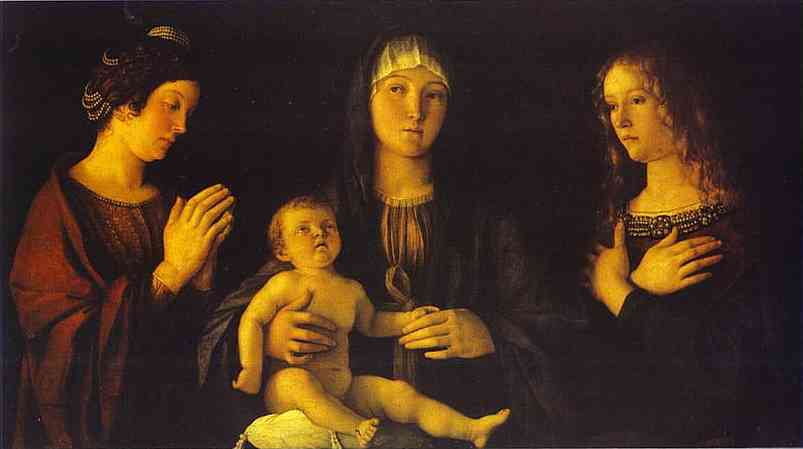
Next to the Madonna, Mary Magdalen was the most popular female saint of the Middle Ages and Renaissance. Around 1495 Giovanni Bellini's depicted her with the legendary Catherine of Alexandria, alongside the Madonna and Child. She stands to the right and her beautiful flowing red hair is enough to identfy her.


Mrs. Jameson believed that many of the attempts to depict the famous sinner/ saint were not so successful.

"As a subject for painting, it is rich in picturesque capabilities. It combines all that can inspire with all they can chasten the fancy; yet, when we review what has been done, how inadequate the result!....Where the penitent prevails, the saint appears degraded; where the wasted, unclad form is seen attenuated by vigils and exposed in haggard unseemliness, it is a violation of that first great rule of Art which forbids the repulsive and the painful.... On the other hand, where sensual beauty has obviously been the paramount home and idea in the artist's work, defeating its holiest purpose and perverting its high significance, the violation on the moral sentiment is yet more revolting. This is especially the fault of the later painters, more particularly of the schools of Venice and Bologna..." (341)

Below find her descriptions of different types of representation.


Donatello

"When exhibited to us as the patron saint of repentant sinners, Mary Magdalene is sometimes a thin wasted figure, with long disheveled hair of a pale golden hue falling over her shoulders almost to the ground;...  But not seldom the sole drapery is her long redundant hair." (348)


Signorelli

"But, in her character of patron St. Mary Magdalene was not always represented with the squalid or pathetic attributes of humiliation and penance. She became idealized as a noble dignified creature bearing no traces of sin or of sorrow on her beautiful face; her luxuriant hair bound in tresses round her head; her drapery rich and ample; the vase of ointment in her hand or at her feet, or borne by an angel near her. Not unfrequently she is attired with the utmost magnificence, either in reference to her former state of worldly prosperity, or rather, perhaps,…it was a common custom to clothe all the ideal figures of female saints in rich habits.... A beautiful instance may be seen in a picture by Signorelli, at Orvieto, where she is standing in a landscape, her head uncovered, and the rich golden hair partly braided, partly flowing over her shoulders; she wears a magnificent tunic embroidered with gold, over it a flowing mantle descending to her feet; she holds a vase with her left hand, and points to it with the right." (348)


Raphael: "St. Cecilia" 


"In the St. Cecilia of Raphael, she stands on the left, St. Paul being on the right of the principal figure; they are here significant of the conversion of the man through power, of the woman through love, from a state of reprobation to a state of reconcilement and grace. St. Paul leans in deep meditation on his sword." (351)


Caravaggio: Martha and Mary
"There are two classes of subjects in which Mary Magdalene is richly habited, and which must be carefully distinguished; those above described, in which she figures as patron saint, and those which represent her before her conversion, as the votary of luxury and pleasure." (352)


Titian

"The Magdalene of Titian was so celebrated in his own time that he painted at least five or six repetition repetitions of it, and copies of engravings have since been multiplied. The eyes, swimming in tears, are raised to heaven; the long disheveled hair flows over her shoulders; one hand is pressed on her bosom, the other rests on the skull; the forms are full and round, the coloring rich; a book and a box of ointment lie before her on a fragment of rock. She is sufficiently woeful, but seems rather to regret her past life than to repent of it, nor is there anything in the expression which can secure us against the relapse.... His idea, therefore, of St. Mary Magdalene was the fusion of an antique statue and a girl taken out of the streets; and with all its beauties as a work of art--and very beautiful it is--this chef-d'oeuvre of Titian is, to my taste, most unsatisfactory." (355)

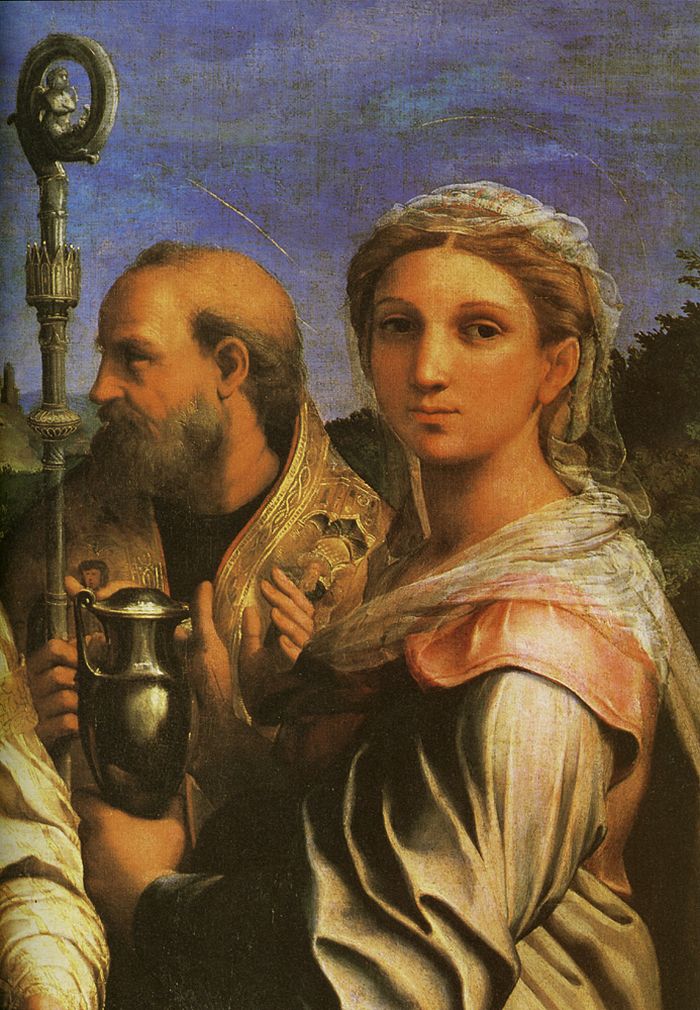
Mrs. Jameson did not approve of Titian's voluptuous penitent sinner but she did admire Raphael's version for a church in Bologna done at about the same time as Titian's Sacred and Profane Love. In this version she looks out at the viewer as if to say, "If I could do it, so too can you,"


Raphael: detail of MM


"Many have well represented the particular situation, the appropriate sentiment, the sorrow, the hope, the devotion; but who has given us the character? A noble creature, with strong sympathies and a strong will, with powerful faculties of every kind, working for good or evil,--such a woman Mary Magdalene must have been, even in her humiliation; and the feeble, girlish, commonplace, and even vulgar women selected as models…by throwing up their eyes and letting down their hair, ill represent the enthusiastic convert or the majestic patroness." (374)###

***For more modern studies of the Magdalen see Susan Haskins, "Mary Magdalen, Myth and Metaphor, NY, 1994, and  Katherine Ludwig Jansen, "The Making of the Magdalen, Preaching and Popular Devotion in the Later Middle Ages", Princeton, 2000. 


Wednesday, February 8, 2012

Giorgione, Titian, and Anna Jameson


I am not ashamed to admit that I have used the writings of Anna Jameson, a now neglected nineteenth century English writer on Renaissance art, in my studies of Giorgione and Titian. First of all, I love the vivacity of her style. Here she is deploring the varied attempts to depict Mary Magdalen.
 
We have Magdalenes who look as if they never could have sinned, and others who look as if they never could have repented; we have Venetian Magdalenes with the air of courtesans, and Florentine Magdalenes with the air of Ariadnes; and Bolognese Magdalenes like sentimental Niobes; and French Magdalenes, moitie galantes, moitie devotes; and Dutch Magdalenes, who wring their hands like repentant washerwomen. The Magdalenes of Rubens remind us of the ‘unfortunate Miss Bailey;’ and the Magdalenes of Vandyck are fine ladies who have turned Methodists.*


This passage also illustrates the depth and breadth of her knowledge. Mrs. Jameson was an Englishwoman whose life resembled that of a character from a Jane Austen novel. Her father was an educated man but of no great means. She made a bad marriage that quickly fell apart, and had to turn to writing to support herself. She had a great interest in the art of the Renaissance and fortunately somehow managed to travel extensively on the Continent.

A reading of her two major works, “Sacred and Legendary Art,” and “Legends of the Madonna,” makes it clear that she saw an extraordinary number of paintings on her travels, and that she managed in an age before digital cameras and laptops to retain an incredible amount of knowledge. From her writings it is clear that she had a keen eye for observation; an encyclopedic knowledge of the legends and stories that formed the basis of most Renaissance art; and a great flair for descriptive writing.  Here is her description of a Giorgione masterpiece that is now known as “The Three Philosophers.” 


“I must mention a picture by Giorgione in the Belvedere Gallery, well known as one of the few undoubted productions of that rare and fascinating painter, and often referred to because of its beauty. Its significance has hitherto escaped all writers on art, as far as I am acquainted with them, and has been dismissed as one of his enigmatical allegories. It is called in German, Die Feldmasser (the Land Surveyors), and sometimes styled in English the Geometricians, or the Philosophers, or the Astrologers. …I have myself no doubt that this beautiful picture represents the “three wise men of the East,” watching on the Chaldean hills the appearance of the miraculous star…” (332)

Her interpretation, which is shared by some prominent art historians today, shows not only her knowledge and appreciation of Giorgione and his work but also her familiarity with the ancient stories and legends so popular during the Renaissance. Even in her time these legends had been largely forgotten.  In her introduction to “Sacred and Legendary Art” she wrote,

It is curious, this general ignorance with regard to the subjects of Medieval Art, more particularly now that it has become a reigning fashion among us. We find no such ignorance with regard to the subjects of classical Art, because the associations connected with them form a part of every liberal education….(8)
In the old times the painters of these legendary scenes and subjects could always reckon on certain associations and certain sympathies in the minds of the spectators. We have outgrown these associations, we repudiate these sympathies. We have taken these works from their consecrated localities, in which they once held their dedicated place, and we have hung them in our drawing-rooms and our dressing-rooms, over our pianos and our sideboards—and now what do they say to us?...can they speak to us of nothing save flowing lines and correct drawing and gorgeous color? (9)

It was only in her work that I was able to find the story of the encounter of the Holy Family with robbers on the flight into Egypt. This story formed the basis for my interpretation of a lost Giorgione that scholars today still persist in calling the “Discovery of Paris.”


Jameson attributed this scholarly blindness to the prejudice engendered by the Reformation. Speaking of the legends of the Medieval church she wrote,

This form of hero-worship has become, since the Reformation, strange to us—as far removed from our sympathies and associations as if it were antecedent to the fall of Babylon and related to the religion of Zoroaster, instead of being left but two or three centuries behind us, and closely connected with the faith of our forefathers and the history of civilization and Christianity. (1)
Our puritanical ancestors chopped off the heads of Madonnas and Saints, and paid vagabonds to smash the storied windows of our cathedrals;--now, are these rejected and outraged shapes of beauty coming back to us, or are we not rather going back to them? (6)

She insisted that the legends were “an intense expression of the inner life of the Middle Ages”…”and that the art of the renaissance could not be properly understood without them.” (2) She bemoaned the prejudice of her own time.

It is about a hundred years since the passion, or the fashion, for collecting works of Art began to be generally diffused among the rich and noble of this land; and it is amusing to look back and to consider the perversions and affectations of the would-be connoisseurship during this period;…any inquiry into the true spirit and significance of works of Art, as connected with the history of Religion and Civilization, would have appeared ridiculous—or perhaps dangerous; we should have had another cry of “No Popery,” and Acts of Parliament forbidding the importation of Saints and Madonnas….(7)
She also criticized the art dealers and collectors of her time, and, I suppose, our time.
The very manner in which the names of the painters were pedantically used instead of the name of the subject is indicative of this factitious feeling; the only question at issue was, whether such a picture was a genuine “Raphael”? such another a genuine “Titian”? The spirit of the work—whether that was genuine; how far it was influenced by the faith and the condition of the age which produced it; whether the conception was properly characteristic, and of what it was characteristic—of the subject? or of the school? or of the time?—whether the treatment corresponded to the idea within our own souls, or was modified by the individuality of the artist, or by the received conventionalisms of all kinds? –these are questions which had not then occurred to any one; and I am not sure that we are much wiser even now; yet,… how can we do common justice to the artist, unless we can bring his work to the test of truth? And how can we do this, unless we know what to look for, what was intended as to incident, expression, character?
Today most scholars are unaware of Mrs. Jameson and her work, or think it is hopelessly outdated. As a result most graduate students have never heard her name. Fortunately, I believe that online versions are now available. A reader has informed me that reprints of her books can be found here.

*Anna Brownell Jameson, Sacred and Legendary Art. V. 1, Boston, 1895, pp. 352-3. Unless otherwise noted all references are to this volume with page numbers in parentheses.

Saturday, May 28, 2011

Giorgione: Sacred Art Guides

Chartres: South Rose Window with evangelists on shoulders of prophets to represent dwarves sitting on the shoulders of giants.


Two great 19th century writers, Emile Male and Anna Jameson, were invaluable resources for me in my work on the Tempest. One was a professional French historian and the other was an English amateur but together they did more than anyone else to preserve the great works of the Middle Ages and the Renaissance from neglect and even destruction.

Emile Male was one of those great 19th century scholars whose work is often overlooked today not only by the general public but even by art historians. His three volumes on the religious art of the 12th, 13th, and 14th centuries were beautifully re-printed by Princeton University Press in 1986. The second volume in the series, Religious Art in France, The Thirteenth Century, is probably best known since it is still available in paperback as “The Gothic Image.”

Male was a pioneer in rediscovering the iconography of the artwork of the Gothic cathedrals after the ignorance of the Enlightenment, and the destruction of the French Revolution. In true 19th century fashion his work was based on innumerable visits to sites throughout France and Europe, but also on exhaustive examination of the texts that formed the basis for the conceptions of the artists.

When I looked for an explanation of the broken columns in Giorgione’s Tempest I recalled something I had read years before in “The Gothic Image.” Writing about the depictions of the Flight into Egypt in the Gothic cathedrals, Male wrote,

“Of all these legends, they scarcely used any other than the Fall of Idols….

Many medieval writers told that when Jesus entered the temple of Sotinen, called Hermopolis by others, he caused the idols to fall, in fulfillment of Isaiah’s words: “Behold the Lord will ascend upon a swift cloud and will enter into Egypt. And the idols of Egypt shall be moved at his presence”…When the governor of the town, Affrodosius, heard of the miracle, he went to the temple; when he saw that all the statues were broken, he worshiped Jesus….

The Church adopted the story of the Fall of the Idols, which like many apocryphal legends, grew out of a desire to justify a prophetic text, and it authorized the artists to represent it….The thirteenth century gave an abridged, almost hieroglyphic form to the legend. There are neither town, temple nor priests…two statues falling from their pedestals and breaking in two suffice to recall the miracle.”
Emile Male: Religious Art in France, The Thirteenth Century, Princeton, 1986. Pp. 220-221.

Could this be the reason why Giorgione used two broken columns?

Anna Jameson seems like a character out of Jane Austen. She was born into a respectable middle class family but her father never had much to give her except an education, and after a bad marriage, she turned to writing about art to support herself.

Modern scholars don’t like to use an amateur like Mrs. Jameson but she was an eyewitness of an incredible array of art before the beginning of the art-historical era. It is likely that many of the paintings she saw were subsequently ruined, dispersed, or lost.

Like Emile Male she also had a great familiarity with the biblical stories and apocryphal legends that formed the basis for most of the great art of the Renaissance. When I saw that the young man in the Tempest must be St. Joseph, I turned to Mrs. Jameson for help. Here’s what she wrote.

"In German pictures, Joseph is not only old, but appears almost in a state of dotage, like a lean, wrinkled mendicant, with a bald head, a white beard, a feeble frame, and a sleepy or stupid countenance. Then again, the later Italian painters have erred as much on the other side; for I have seen pictures in which St. Joseph is not only a young man not more than thirty, but bears a strong resemblance to the received heads of our Saviour." Mrs. Jameson, Legends of the Madonna, Boston, 1885. pp. 271-2.

Later when I realized that Giorgione might have depicted the Holy Family in the lost painting copied by David Teniers and mis-identified as “The Discovery of Paris,” I again found the answer in Mrs. Jameson’s account of the Encounter with the Robbers on the Flight into Egypt.

Mrs. Jameson noted that the encounter with the robbers has been “seldom treated” as an artistic subject but did indicate that she had seen two representations.

“One is a fresco by Giovanni di San Giovanni, which, having been cut from the wall of some suppressed convent, is now in the academy at Florence. The other is a composition by Zuccaro.”

In a later edition she provided a sketch of the Zuccaro “Encounter,” which shows Joseph assisting the Madonna down from the Ass at the behest of the armed robber. Legends of the Madonna, Boston, 1885. pp. 361-362.


Dr. Francis P. DeStefano

Saturday, April 2, 2011

Giorgione and Patenier

Joachim Patenier: Rest on the Flight into Egypt (Prado)

The popularity of the “Rest on the Flight into Egypt” became an important factor in the development of landscape in the late 15th and early 16th centuries. To incorporate the very popular apocryphal infancy legends into their work artists, especially in the Netherlands, had to deepen and broaden their landscape background.

Depictions of the Rest by these “northern” artists found their way into the palaces of Venetian patricians. Marcantonio Michiel even noted a depiction of “Our Lady with St. Joseph in the desert,” by John Scorel of Holland in the home of Gabriele Vendramin, the owner of Giorgione's Tempest.

Joachim Patinier painted many versions of the Rest. One of the best is in the Prado. The Madonna, dressed in blue and white, sits on a rocky outcrop nursing her Child. St. Joseph is off to the left gathering food for her to eat although his pilgrim's staff and sack are featured in the foreground. Behind the Madonna is what appears to be rocky rubble but the large stone ball indicates the remains of the Egyptian idols that collapsed on the arrival of the Child into Egypt. According to Emile Male the legendary “Fall of Idols” was a commonplace in depictions of the flight into Egypt.

Northern artists like Patinier usually included episodes from the very popular apocryphal gospels in their paintings. In addition to the “Fall of Idols” Patinier depicted the legend of the “wheat or corn field” in the background.

Here is a version of the legend told by Anna Jameson in her own inimitable way.

“In many representations of the Flight into Egypt, we find in the background men sowing or cutting corn. This is an allusion to the following legend:--

When it was discovered that the Holy Family had fled from Bethlehem, Herod sent his officers in pursuit of them. And it happened that when the Holy Family had traveled some distance, they came to a field where a man was sowing wheat. And the Virgin said to the husbandman, “If any shall ask you whether we have passed this way, ye shall answer, ‘Such persons passed this way when I was sowing this corn.” For the Holy Virgin was too wise and too good to save her Son by instructing the man to tell a falsehood. But behold, a miracle! For by the power of the Infant Saviour, in the space of a single night, the seed sprung up into stalk, blade, and ear, fit for the sickle. And next morning the officers of Herod came up, and inquired of the husbandman, saying, “Have you seen an old man with a woman and a Child traveling this way?” And the man, who was reaping his wheat, in great wonder and admiration, replied “Yes.” And they asked him again, “How long is it since?” And he answered, “When I was sowing this wheat.” Then the officers of Herod turned back, and left off pursuing the Holy Family….”


Mrs. Jameson added a little aside that could serve as a reminder for scholars even today.

“By those unacquainted with the old legend, the introduction of the cornfield and reapers is supposed to be merely a decorative landscape, without any peculiar significance.

[Anna Brownell Jameson, “Legends of the Madonna, as Represented in the Fine Arts,” Boston and New York, 1885. Pp. 359-360.]

In his seminal study of Netherlandish art Max Friedlander argued that the need to include these legendary stories had an important role in the development of landscape.

“The lovers and buyers of Patenier’s pictures were not satisfied with the effect as a whole, they wanted to read in the picture, they sought in it the leisure of a walk full of varied interest or a journey of discovery. If at every turn in the road they came upon adventure, discovered figures to interpret, relationships to trace, all the more satisfied did they feel….”

In a 1975 unpublished doctoral dissertation Sheila Schwarz also pointed out that these stories created a new justification for landscape. Patenier had to expand and deepen the landscape in order to accommodate these little stories. “Then Patenir studded his landscapes with vignettes whose presence further authorizes the expansion of the setting.” [Sheila Schwartz, The Iconography of the Rest on the Flight into Egypt, New York University, Ph. D., 1975, p. 124.]

In the left background of Patenier’s painting we see the city representing Judea from where the Holy Family has fled. Notice the bridge leading out of the city. Then moving to the right we see the newly grown cornfield and the farmer encountered on the journey. In the foreground Madonna and Child have found safety and rest.


Despite obvious differences, it is not hard to notice the similarity between Patenier’s version of the Rest and Giorgione’s Tempest. In both paintings a woman nurses her child while their protector is off to the left. Patenier used rocks and rubble to depict the Fall of Idols while Giorgione used broken columns and ruins. In both paintings there is a city and a bridge in the background. Dark clouds cover Patinier's city just as in the Tempest. Notice how Patenier causes the sky to lighten and grow blue in the center and right background.


Finally, I have argued in my paper on the Tempest that Giorgione used nudity to depict the Immaculate Conception of the Madonna. Patenier dressed his nursing Madonna not in her traditional red and blue but in blue and white, colors which would later become the standard in depictions of the Immaculate Conception. In addition, Patenier illuminated the Madonna as if to suggest the woman "clothed with the sun" from the Book of Revelation.

Below find comments from Max Friedlander on Patenier and the Prado Rest.

Patenier was a landscape painter, perhaps the first Netherlander to regard himself, and to be regarded, as a landscape painter, like Albrecht Altdorfer in Germany. Therein lies his fame. Durer, who was on friendly terms with him, calls him the ‘gut Landschaftsmaler’ (the good landscape painter). How highly the specialist was valued is made abundantly clear by the fact that two of his greatest contemporaries, Quentin Massys and Joos van Cleve, collaborated with him: they painted the figures and he added the landscape….

The Rest on the Flight into Egypt in the Prado is a mature masterpiece. From the plants in the foreground, studied with loving insight and botanical accuracy, to the dusky masses of foliage in the middle ground, from the fancifully constructed Romanesque temple buildings to the blue distance, everything is scrupulously worked out, abundant and rich. The principal figure, the Madonna in a light cloak, firmly outlined but with a softly flowing line, seems a little out of keeping with the whole.


A powerful mood is emitted from this panel; though descriptive and didactic, it seems imbued with poetry.


Max Friedlander, From Van Eyck to Bruegel, London, 1956, pp. 79-81.