Since 2010 I have been using this site to discuss my interpretations of famous Renaissance paintings including Giorgione's "Tempest" as "The Rest on the Flight into Egypt"; his "Three Ages of Man" as "The Encounter of Jesus with the Rich Young Man"; Titian's, "Sacred and Profane Love" as "The Conversion of Mary Magdalen"; Titian's "Pastoral Concert" as his "Homage to Giorgione", and Michelangelo's"Doni Tondo." The full papers can now be found at academia.edu.
Showing posts with label Lorenzo Lotto. Show all posts

Tuesday, November 21, 2023

Lorenzo Lotto: Mystic Marriage of St. Catherine


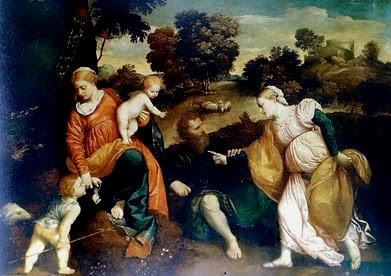
In my interpretation of Giorgione's Tempest as "The Rest on the Flight into Egypt" I explained the reasons why Giorgione chose to portray St. Joseph as a virile, young man. Shortly after Giorgione's death, contemporaries like Paris Bordone, and Lorenzo Lotto also depicted a virile, youthful St. Joseph in versions of the Mystic Marriage of St. Catherine. Here is a discussion of Lotto's version.

Lorenzo: Mystic Marriage of St. Catherine


A painting by Lorenzo Lotto of the Mystic Marriage of St. Catherine provides another example of a young, virile St. Joseph by a contemporary of Giorgione. The painting is in the Kunsthistorisches Museum in Vienna where the man, formerly identified as St. James is now identified as St. Thomas. He kneels next to St. Catherine who gazes at him and not at the infant Christ. They are obviously exchanging vows., and it can only be St. Joseph who acts as a proxy for the marriage of the infant Child, and the legendary Queen of Alexandria. Joseph is shown with his staff but his virile good looks and the spear-point at the end of the staff have led scholars astray.


In his work on Lotto, Bernard Berenson identified the kneeling man as St. James the Greater but provided no explanation. In the catalog of the 1997/1998 Lotto exhibition at the National Gallery of Art in Washington, Peter Humfrey identified the man as St. Thomas because of the spear.* A decade later in the Bellini, Giorgione, Titian exhibition in Vienna, however, the man was still identified as St. James. There is no good reason for either St. James or St. Thomas to be in the desert participating in the mystic marriage of St. Catherine. 

On at least two occasions, and at about the same time as Lotto, Paris Bordone painted the mystic marriage of Catherine with a rustic-looking, vigorous Joseph playing a prominent role. 


One of Bordone’s versions was featured in the same Bellini, Giorgione, Titian exhibition. In that painting Joseph’s muscular, bare foreleg is evidence of his role as the proxy for the mystic union of Catherine with the Christ child. The other version is at the Hermitage and also features the muscular, bare leg. In that version the Madonna has already passed the infant Christ to Joseph.


In Lotto’s painting the Madonna holds the child out to observe the ceremony. In the Lotto catalog Peter Humfrey noted that the painting “is first recorded by Marco Boschini in his 1660 Venetian dialect poem La Carts del Navigar Pittoresco.” Boschini identified the man as St. Joseph. "The majesty to be found in the venerable and devout old St. Joseph is for me expressed by only one brush: a brush that is most singular and memorable!" 

Boschini’s description of Joseph as old, “vechiarelo,” is belied by the saint’s dark beard, full head of hair, and robust physique. In Humfrey’s opinion Boschini’s “accurate evocation of the pictorial qualities of the work is remarkable,” but he claimed that the identification of St. Joseph was “mistaken.” Humfrey believed that it was unlikely that Boschini had actually seen the painting in person, and that the spear-point told against St. Joseph. It is true that a point on the end of Joseph’s spear must be explained but on the whole it is much easier to explain that small item than it is to explain the presence of either St. James or St. Thomas at the marriage of Catherine, or the absence of St. Joseph from this familiar scene.

Years after writing this post in 2011, I can only guess that Joseph's protective role had assumed a martial aspect. The Man in the Tempest was called a "soldier" by a Venetian observer two decades after Giorgione's death mainly, I believe, because of his pose. But he carried a staff, a tradition associated with St. Joseph. For some reason, followers of Giorgione added a spear point to the staff, or even turned it into a halberd.**

Palma Vecchio or follower
Philadelphia Museum


###

 *Lorenzo Lotto, Rediscovered Master of the Renaissance, New Haven, 1997. Catalog #31. “Virgin and Child with Saints Catherine of Alexandria and Thomas,” c. 1528-1530, oil on canvas, 113.5 x 152, Kunsthistorische Museum, Vienna.

** See the discussion of this painting in the previous post at Giorgione et al..

Thursday, January 24, 2019

Lorenzo Lotto: Crucifixion


Italian Renaissance master Lorenzo Lotto was born in Venice around 1480 but spent most of his long career working in provincial towns. Perhaps this is why he is not as well known as Giorgione and Titian, both of whom were born outside of Venice but did most of their work in the great city.

Lorenzo Lotto: Crucifixion
Santa Maria in Telusiano
Monte San Giusto, Marche
oil on wood, 450x250cm

Lotto’s most powerful and dramatic work was a Crucifixion that still stands in its original site in the little church of Santa Maria in Telusiano in the small, out of the way, hill town of Monte San Giusto, located in that part of Italy known as the Marche. The town is not too far from Loreto, the religious center where Lotto eventually spent the last years of his life.

Lotto’s Crucifixion shows that he could hold his own with the greatest of Renaissance masters. My wife and I saw the painting a few years ago as we traveled down the Adriatic coast. Our old guidebook called Lotto’s painting in Monte San Giusto “ the most dramatic and powerful of all his large-scale works,” and so we decided to take a side trip out of our way in hope of finding it.  Although we are very thankful for the wonderful works of art preserved in Italian museums, it is always special to see a work “in situ”, where it was originally meant to be seen.

It was not easy to find the church and we finally had to go into a local bank where a patron kindly offered to lead us there through the curvy narrow streets of the town. We parked outside a long stone staircase that went up and up between stone buildings packed closely together on each side. 

It was hard to immediately recognize the church but we finally found a door that led into what was no more than a large chapel. It was dark inside and the church was empty except for a couple of ladies who seemed to be cleaning. We could hardly see the painting behind the only altar but one of the ladies pointed to a little box. We put a coin in and immediately the huge magnificent painting (450x250cm) that took up almost the whole back wall was revealed.

Revealed is an understatement. The light, color, movement, physicality, and dramatic intensity virtually jumped out at us. In the foreground, the disciple John, robed in green, seems to lead the grieving Mother right out of the picture. Behind them red-haired Mary Magdalene dressed in blue stretches out her arms in grief. A crowd of guards and onlookers stand beneath and around the three crosses that reach high into a dark sky. Jesus is in the middle flanked by the two thieves.

Standing in Santa Maria it is hard to examine the huge painting closely because the impression is so overwhelming. But on reflection we can see that Lotto has depicted the moment right after the death of Jesus. We can see the Roman centurion Longinus on his white horse immediately after he has placed the point of his lance in the side of Jesus to verify his death. He has released the lance and it is about to fall. He reaches both hands toward Jesus in the act of shouting, “truly, this man was the Son of God.”

The death of Jesus is also marked by a great wind that causes the loin cloths of Jesus and the thieves to billow as well as the Roman banner on the right where one can just make our the first letters of the name of Caesar Augustus. In the foreground the Apostle John is taking the Mother of Jesus away from the scene of horror.


Today, it is hard to imagine what churchgoers back in an obscure provincial town must have thought when they beheld this magnificent painting. They could never have seen anything like it before and must have known that a great master had done it. Going to Mass in Santa Maria in Telusiano would never be the same. At the Consecration of the Mass, as the priest at the altar raised high the host, their eyes would behold the sacrificial victim raised high on Calvary in the dramatic and breathtaking altarpiece behind. 

### 
Note: This article was first posted on Giorgione et al... on 7/25/2014.


Friday, July 25, 2014

Lorenzo Lotto: Crucifixion


Italian Renaissance master Lorenzo Lotto was born in Venice around 1480 but spent most of his long career working in provincial towns. Perhaps this is why he is not as well known as Giorgione and Titian, both of whom were born outside of Venice but did most of their work there.


Lotto’s most powerful and dramatic work was a Crucifixion* that still stands in its original site in the little church of Santa Maria in Telusiano in the small out of the way hill town of Monte San Giusto in the Marche. It is not too far from Loreto, the religious center where Lotto eventually spent the last years of his life.

Lotto’s Crucifixion shows that he could hold his own with the greatest of Renaissance masters. My wife and I saw the painting a few years ago as we traveled down the Adriatic coast. Our old guidebook described it as the "most dramatic and powerful" of all Lottos's large scale works, and so we decided to take a side trip out of our way in hope of finding it.  Although we are very thankful for the wonderful works of art preserved today in Italian museums, it is always special to see a work “in situ”, where it was originally meant to be seen.

It was not easy to find Santa Maria in Telusiano and we finally had to go into a local bank where a patron kindly offered to lead us there through the curvy narrow streets of the town. We parked outside a long stone staircase that went up and up between stone buildings packed closely together on each side.

It was hard to immediately recognize the church but we finally found a door that led into what was no more than a large chapel. It was dark inside and the church was empty except for a couple of ladies who seemed to be cleaning. We could hardly see the painting behind the only altar but one of the ladies pointed to a little box. We put a coin in and immediately the great magnificent painting (450x250cm) that took up almost the whole back wall was revealed.

Revealed is an understatement. The light, color, movement, physicality, and dramatic intensity virtually jumped out at us. In the foreground, the disciple John seems to lead the grieving blessed Mother right out of the picture. Behind them red-haired Mary Magdalene dressed in blue stretches out her arms in grief. A crowd of guards and onlookers stand beneath and around the three crosses that reach high into a dark sky. Jesus is in the middle flanked by the two thieves.

Standing in Santa Maria it is hard to examine the huge painting closely because the impression is so overwhelming. But on reflection we can say that Lotto has depicted the moment right after the death of Jesus. We can see the Roman centurion Longinus on his white horse immediately after he has placed the point of his lance in the side of Jesus to verify his death. He has released the lance and it is about to fall. He reaches both hands toward Jesus in the act of shouting, “truly, this man was the Son of God.”

The death of Jesus is also marked by a great wind that causes cloths that cover him and the thieves to billow. The same wind causes the Roman banner on the right to unfurl and reveal the first letters of the name of Caesar Augustus. The disciple John leads the Mother of Jesus away from the scene of horror.

Today, it is hard to imagine what churchgoers back in an obscure provincial town must have thought when they beheld this magnificent painting. They could never have seen anything like it before and must have known that a great master had been in their midst. Going to Mass in Santa Maria in Telusiano would never be the same. At the Consecration, as the priest at the altar raised high the consecrated host, their eyes would also behold the sacrificial victim raised high on Calvary in the dramatic and breathtaking altarpiece behind.

### 

*Lorenzo Lotto: Crucifixion, 1531. Santa Maria in Telusiano, Monte San Giusto, Macerata, Marche. (oil on wood, 450x250 cm). See detail below.


Thursday, May 17, 2012

Bellini, Titian, Lotto


On May 15, 2012 a new exhibition opened at New York’s Metropolitan Museum of Art, entitled “Bellini, Titian, Lotto: North Italian Paintings from the Academia Carrara, Bergamo.”

My wife and I visited the exhibition on opening day and found it to be a fine but modest offering housed in a relatively small room. Though limited to one room, the room is right in the middle of the Met’s great collection of Renaissance art, and so it is easy to place these paintings in a broader context.

The title of the exhibition is a little misleading. There is only one painting, a Pieta, by Giovanni Bellini although many of the others showed his influence. Moreover, the only Titian is a very small version of the story of Orpheus and Euridice. The catalog calls it a very early Titian but admits that the attribution is questionable.


The real star of the show is Lorenzo Lotto with four representative works. The first three are predella pieces separated in the nineteenth century from his magnificent altarpiece that was originally in Bergamo’s church of Saints Stephen and Dominic, but that is now in the church of St. Bartholomew. One piece depicts a story from the life of St. Dominic while another depicts the stoning of St. Stephen. In the middle is an Entombment that, like the others, exhibits the life, emotion, and vivacity that Lotto brought to all of his work. These predella pieces are also full of naturalistic detail including very detailed contemporary costumes.

Lotto is also represented by a portrait of Lucina Brembati, a granddame from Bergamo, in all her finery. The exhibition catalog quotes Bernard Berenson’s appraisal of Lotto’s portraits. "They all have the interest of personal confessions. Never before or since has any one brought out on the face more of the inner life."

Lorenzo Lotto
Portrait of Lucina Brembati
1518-23

However, the exhibition also serves to introduce the viewer to some lesser-known artists who were working in Northern Italy at the time of Bellini, Giorgione, and Titian. Vincenzo Foppa is represented by the “The Three Crosses,” a Crucifixion scene  of the mid fifteenth century that demonstrates a remarkable use of perspective.

There are two religious works by the Milanese painter styled Bergonone including a very striking nursing Madonna from around 1485. Also represented are Bartolomeo Montagna, Giovanni Cariani, Moretto da Brescia, Andrea Previtali, and Giovanni Battista Moroni. Most of their contributions are sacred subjects but there are also a few outstanding portraits.

Previtali, for example, combined a sacred subject with two very realistic portraits of the Bergamo donors in “Madonna and Child with Saints Paul and Agnes, and Paolo and Agnese Casotti.”


All the paintings are on loan from Bergamo’s Accademia Carrara currently in the midst of renovations that will be completed in 2013. In the catalog, M. Cristina Rodeschini, the Head of the Accademia Carrara, provided an overview of the storied history of the collection including the contribution of Giovanni Morelli, one of the great figures in the nineteenth century revival of interest in the art of the Renaissance.

Andrea Bayer, who participated with Dr. Rodeschini in putting the exhibition together, also contributed essays on the history of the Museum, as well as on the individual paintings in the Met exhibition.  Her introduction should make anyone want to visit Bergamo and the Accademia Carrara after the completion of the renovation in 2013.
Arriving at the Accademia Carrara is a memorable experience, especially if traveling to Bergamo by train from Milan. Greeted upon arrival by the lower part of the town, the visitor follows a route past the historic Teatro Donizetti before beginning the climb toward the great medieval neighborhood of Bergamo Alta perched on the hills above. Along the way, one passes a number of the city’s most important churches, home to some of Lorenzo Lotto’s greatest paintings, as well as the twisting Via Pignolo, lined by noble Renaissance palaces. Finally, the great fortifying walls of the upper city appear, and there on an irregular piazza stands the neoclassical building that houses the city’s extraordinary art collections, the result of more than two hundred years of collecting and a direct outgrowth of the local culture embodied in these very streets, churches and homes. ###