Since 2010 I have been using this site to discuss my interpretations of famous Renaissance paintings including Giorgione's "Tempest" as "The Rest on the Flight into Egypt"; his "Three Ages of Man" as "The Encounter of Jesus with the Rich Young Man"; Titian's, "Sacred and Profane Love" as "The Conversion of Mary Magdalen"; Titian's "Pastoral Concert" as his "Homage to Giorgione", and Michelangelo's"Doni Tondo." The full papers can now be found at academia.edu.
Showing posts with label Signorelli. Show all posts

Thursday, July 9, 2026

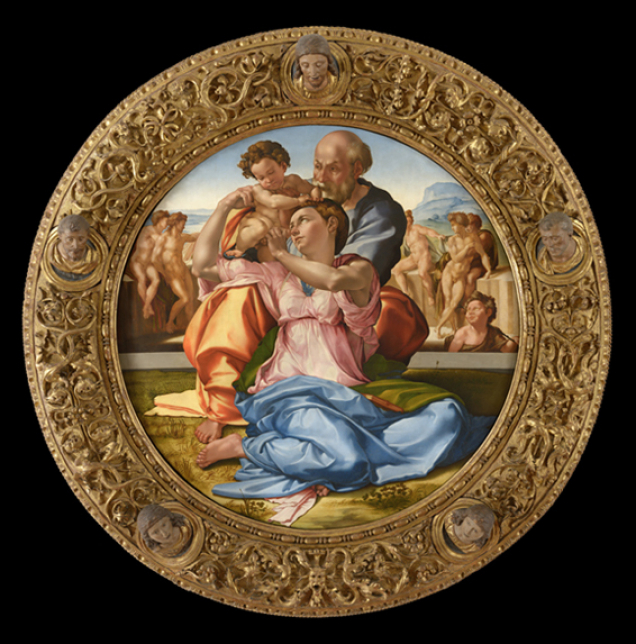
Michelangelo's Don Tondo: the Nudes


I published my interpretation of Michelangelo's Doni Tondo in installments on this site back in 2015. The complete paper can now be read or downloaded at academia.edu. I have decided to re-post it this year win order to bring together all of my interpretive discoveries. In the two previous posts I argued that in the foreground of the painting Michelangelo depicted the Madonna offering her Son in the same way that a priest offers the Eucharistic host during the Consecration of the Mass. The second post  discussed the role of the young John the Baptist in the mid-ground. Today, I reprise the third part of that paper that identified the nudes in the background as the Nephilim of the Hebrew scriptures at the time of Noah.

***

In recent years the five nude young men in the background of Michelangelo’s Doni Tondo have received as much, if not more, attention than the Holy Family in the foreground. There would appear to be no agreement as to who they are or what they represent. Among other things, they have been variously interpreted as angels without wings, sinners, penitents awaiting Baptism, figures from pagan antiquity, or figures from the Old Testament.


In a paper, entitled “Michelangelo’s Doni Tondo: Holy Family and Family Myth,” Andree Hayum concentrated on the scene in the background. She noted the many different interpretations offered for the five nude men, but found the source in the Old Testament account of the drunkenness of Noah. She saw an obvious connection between the young men and Michelangelo’s famous depiction of the Noah story on the ceiling of the Sistine chapel.

But if one thinks of them as a constellation of three, the figures they recall are Michelangelo’s sons of Noah in the Sistine fresco of Noah’s Drunkenness. The most notable feature of Michelangelo’s sons of Noah is their nudity.*


Michelangelo: Drunkenness of Noah

In her interpretation the three men on the viewer’s right in the Doni Tondo would be Noah’s sons Ham, Seth, and Japheth before the incident of their father’s humiliating drunkenness. After drinking of the fruit of the vine, Noah had fallen naked into a stupor in his tent. Ham looked upon his father’s nakedness but the other two averted their faces and covered him. When Noah awoke and realized what had happened, he cursed Ham. Hayum argued that the two innocent or sinless sons are therefore depicted after the episode on the viewer’s left.

There is a connection between the young John the Baptist in the midground of the Doni Tondo and the story of Noah. Not only did theologians and artists see the Baptist, the last and greatest of the Hebrew prophets, as a link between the Old and New Covenants, but also they had related the story of Noah to Baptism.

In the First Letter of St. Peter the saving of Noah and his family are seen as prefiguring Baptism. Just as the waters of the Flood wiped away sin, so too do the waters of Baptism. There can be no doubt of the prominence of the Noah story during Michelangelo’s time. Savonarola, his favorite preacher, had given perhaps his most famous series of sermons on Noah and the Flood right before the French invasion of Italy in 1494. Michelangelo featured the Noah story on the ceiling of the Sistine chapel only a few years after the completion of the Doni Tondo.

Nevertheless, I have some questions about Hayum’s hypothesis. In the first place, where is Noah in the Doni Tondo? For Hayum this question was not a problem because she saw Noah in the figure of St. Joseph.

As in the sacrifice of Noah, the Holy Family alludes to Noah and his sibylline daughter-in-law. They have come to rest holding up the future male child. Like the ritual of sacrifice, the thanksgiving and the gift are one, and a sense of celebration prevails. **

Noah’s daughter-in-law was reputed to be a sibyl and given the sibyls in the Sistine chapel, it was easy for Hayum and others to recognize a sibyl in Mary’s posture. Nevertheless, I believe it would be impossible to find another reference to Joseph as Noah. If anything, Noah is a type of Christ, not of St. Joseph. Noah’s salvation of mankind from destruction at the time of the Flood prefigured the salvation effected by Christ on the Cross.

My second question relates to the postures of the nude figures in the Doni Tondo. Rather than participating in the scene of their father’s drunkenness, they lounge about like modern Italian men on a street corner ogling passing young women. A similar posture can be seen in an earlier devotional tondo by Luca Signorelli that is usually called the Medici Madonna. Hayum and others have seen a connection between the five nudes in Michelangelo’s tondo and the four practically nude young men in Signorelli’s painting.

Luca Signorelli: Medice Madonn

In the foreground of Signorelli’s painting the Madonna sits on the ground while her son appears to be taking his first step. St. Joseph and John the Baptist are absent but a bust of the Baptist as a man appears in the fictive frame above the tondo with a banner reading “Ecce Agnius Dei”. However, the four young men in Signorelli’s tondo also appear to be idlers. It is hard to see how they could be the sons of Noah either before or after the incident of his drunkenness.


I would like to suggest that the nudes in both paintings are related to the story of Noah but that they are not his sons. In the Book of Genesis there is a brief reference to giants upon the earth. Here is an English translation of the Vulgate Latin.

Now giants (gigantes) were upon the earth in those days. For after the sons of God went in to the daughters of men, and they brought forth children, these are the mighty men of old, men of renown. [Genesis 6:4]

The Golden Legend embellished the biblical account of the time of Noah.

This time men began to multiply upon the earth, and the children of God, that is to say of Seth, as religious, saw the daughters of men, that is to say of Cain, and were overcome by concupiscence and took them to their wives. This time was so much sin on earth in the sin of lechery, which was misused against nature, wherefore God was displeased…
A fuller account can be found in the apocryphal legends of the Jews.

Unlike Istehar, the pious maiden, Naamah, the lovely sister of Tubal-cain, led the angels astray with her beauty, and from her union with Shamdon sprang the devil Asmodeus. She was as shameless as all the other descendants of Cain, and as prone to bestial indulgences. Cainite women and Cainite men alike were in the habit of walking abroad naked, and they gave themselves up to every conceivable manner of lewd practices. Of such were the women whose beauty and sensual charms tempted the angels from the path of virtue. The angels, on the other hand, no sooner had they rebelled against God and descended to earth than they lost their transcendental qualities, and were invested with sublunary bodies, so that a union with the daughters of men became possible. The offspring of these alliances between the angels and the Cainite women were the giants, known for their strength and their sinfulness… ***

The legends of the Jews ascribed a number of names to these giants but one was Nephilim, “because bringing the world to its fall, they themselves fell.” The modern Jerusalem bible does use the word Nephilim instead of giants to describe these troublemakers whose sins were so great that it took a flood to wipe them out. In addition to walking about naked, the Nephilim were noted for their arrogance and wantonness.

They knew neither toil nor care, and as a consequence of their extraordinary prosperity they grew insolent. In their arrogance they rose up against God…. It was their care-free life that gave them space and leisure for their infamies. ***


The description of the Nephilim in the Jewish legends fits the depiction of the nude young men in the background of both Signorelli’s Medici Madonna and Michelangelo’s Doni Tondo. The painter of the ceiling of the Sistine chapel certainly had knowledge of the Book of Genesis. Scholars have demonstrated that he could have read the text in Italian because of the publication of the vernacular Malerbi bible in 1490. He obviously used the Malerbi woodcuts in his work in the Sistine chapel.

Could he have been familiar with the folklore and legends of the Jews? Michelangelo grew up in a Florence that was a center of Hebraic studies. Michelangelo trained at the Medici court where Pico della Mirandola was known for his knowledge of the Hebrew lore and traditions that were all lumped together under the heading of Cabala. Most of Savonarola’s sermons were based on the books of the Old Testament. Also, Sante Pagnini, who succeeded Savonarola as Prior of San Marco, was a Dominican specialist in Hebrew language and grammar. He spent practically his entire career translating the Hebrew Scriptures into Latin.

Finally, another source for the Nephilim was readily available in a book published only a decade before Michelangelo painted the Doni Tondo. David Whitford’s 2009 study, The Curse of Ham in the Early Modern Era, included a chapter devoted to the Giants or Nephilim. In particular, he discussed the Commentaria of Annius of Viterbo, a Dominican friar, whose book containing alleged writings and fragments of pre-Christian Greek and Latin authors appeared in 1498. Contemporary humanists suspected that the Commentaria and its author were frauds. Annius claimed linguistic knowledge that he did not possess, and even planned a fake archaeological discovery. Nevertheless, the book became very popular and was reprinted in 1515 with only minor corrections.

Here is Whitford’s account of Annius on Noah and the Nephilim.


Book One begins by stating that before the “famous catastrophe of the waters, by which the entire world perished, many ages passed.” In these ages, giants ruled the world from their great city, Enos. The giants were corrupt and prone to tyranny, lechery, and debauchery. They devoted themselves to sexual immorality such that, “they had intercourse with their mothers, their daughters, their sisters, with other men and with wild beasts.” They also despised religion and the gods. Despite warnings and prophecies that the world would be destroyed because of this wickedness, the giants continued their impiety. Only one giant, who was more “reverential to the gods and wiser than the rest,” paid any attention to the prophecies; because of this he survived. His name was Noa “and he had three sons, Samus, Japetus, and Chem.” Noa (or Noah) survived because he could read the stars and foresaw the deluge to come. Thus, beginning 78 years before the Flood, he built an ark. When the floods came, the whole human race was drowned, except for Noa and his family. From this family sprang all the peoples of the earth. #

Despite the spurious nature of the Commentaria, it would appear that the story of the Nephilim was in the air even before its publication in 1498, and that the Commentaria of Annius only added to its popularity.

Why would Michelangelo place the proud giants or Nephilim in the Doni Tondo? I can only offer the following suggestion. The painting is a devotional image. The Madonna elevates her infant Son in the way a priest elevates the Host at Mass. John the Baptist looks at the Host and utters the words of the Agnus Dei: Behold the Lamb of God…. But the full version of the ancient prayer is “Behold the Lamb of God, who takes away the sins of the world, have mercy on us.

The Nephilim represent the sins of the world. I suggest that they are the nudes in the background of both the Doni Tondo and Signorelli’s Medici Madonna. In both paintings the Madonna and Child have turned their backs on the nudes in the background. Instead of a Flood, the Lord has sent his only Son to take away the sins of the world.

###


*Andree Hayum, "Michelangelo’s Doni Tondo: Holy Family and Family Myth". Reprinted in Michelangelo, Selected Scholarship in English, edited with Introduction by William E. Wallace, New York and London, 1995, V. 1.Life and Early Works, p. 421-424.

** Hayum, op. cit., p. 427.

*** Louis Ginzberg, The Legends of the Jews, 1909, V. 1, c. 4. Available online.
# David Whitford, The Curse of Ham in the Early Modern Era. 2009. 

Saturday, November 15, 2025

Signorelli, Giorgione and Cardinal Grimani

 The broken columns and ruins in Giorgione's Tempest must be discussed in any plausible interpretation. In my interpretation I showed that they were commonplace in depictions of the "Rest on the Flight into Egypt." After delivering my paper at a conference in Venice in 2010, my wife and I stopped over in Orvieto before proceeding on to Rome. We wanted to revisit the famous cathedral of the beautiful hill-top city. In particular, we wanted to see the St. Brisio chapel with its frescoes by Fra Angelico and Luca Signorelli. 


Imagine my surprise when I noticed the columns depicted in the above image. Scholars have pointed out the connection between the work of Luca Signorelli in the S. Brisio chapel in Orvieto and the work of Michelangelo and Raphael. Perhaps, there is also a connection between Signorelli and Giorgione. Begun in the middle of the fifteenth century by Fra Angelico, the frescoes of the famous chapel were completed by Signorelli between 1499 and 1504. The “outer bay” of the chapel contains Signorelli’s version of the end of the world. 

Among the many iconographical details in this section are three prominent broken columns that bear a striking resemblance to the broken columns in the Tempest. Here is Creighton Gilbert’s description of this section:

 “One may take these to be the tribulations that Luke had described just before in the same chapter, where people are told to flee and are led away as captives, while no stone is left on another. These are precisely the motifs Signorelli shows us, with people running from a ruined colonnade, a nearby building showing cracks, and soldiers tying people up.” p.139. 

The ruined colonnade is actually three truncated white columns standing erect surrounded by rubble. In his book on the Tempest Salvatore Settis provided a number of broken column images but none were as similar to Giorgione’s or as close in time as the ones in the S. Brisio chapel. Signorelli’s use of the broken columns could not be clearer. It indicates the destruction of the World.

In "How Fra Angelico and Signorelli Saw the End of the World" Creighton E. Gilbert tried to identify the sources for Signorelli’s whole iconographic scheme in the S. Brisio chapel. He argued that two prominent churchmen, both associated with Orvieto, might have played pivotal roles. One was the young Cardinal Alessandro Farnese, the future Pope Paul III, and the other was a famous Venetian cardinal.

 "In this scenario a second powerful name should be mentioned, that of Cardinal Grimani, whose connection both with connoisseurship and with the Borgia group in control of Orvieto have been observed. It would be logical to see him seconding a proposal by Farnese." p. 115. 

Domenico Grimani was the son of the famous Doge as well as the Patriarch of Aquileia. He was also an avid art collector who is perhaps most well known for the magnificent illustrated Grimani Breviary. Gilbert points out that Grimani had strong ties to Orvieto.

 "Grimani too visited Orvieto in 1493 and 1495 with Farnese, Borgia, and the rest. More of interest is that in 1505 he built himself a vacation house below the city walls, at the abbey of Santa Trinita." p. 81.

 Signorelli’s work was completed in 1504 and the Tempest painted in 1509. It is not difficult to imagine Grimani describing Signorelli’s justly famous frescoes to eager Venetian hearers. Certainly, Giorgione’s use of the broken columns to symbolize the Fall of the Egyptian idols on the Flight into Egypt is strong evidence for the Grimani connection. On the other hand, the idea could have been conveyed to Signorelli by Grimani. 

Another sign of the connection between Signorelli and Giorgione is in the use of nudity. The following quotes from Gilbert’s work point out the novelty of Signorelli’s approach to nudity, 

“These saved are innovative in their nudity, surely unlike what Angelico had projected. All previous Judgments in this tradition contrasted the clothed saved with the naked damned,…This innovation, as such, seems not to have interested writers. Perhaps they found it only what one would expect in 1500, in the emerging High Renaissance, especially from a painter praised as an anatomist. Yet a closer look is surely warranted. At this period the saved appeared nude, outside a High Renaissance context, in the great sequence of Judgment paintings in northern Europe. …This was a time when the theme did not flourish in Italian painting. The nudity was logical in that the souls were regularly seen emerging naked from their tombs… Mainstream theology always affirmed that they would then be perfect bodies…." p. 80. "The nude saved do appear in Italy before Signorelli in various less noticeable contexts, presumably under northern influence…. The saved appear nude more conventionally in a large Venetian woodcut around 1500, possibly later than Signorelli…" p. 81. 

In the S. Brisio chapel Signorelli also depicted a nude Judith. This famous Jewish heroine was commonly regarded as a precursor of the Virgin Mary. Gilbert noted this unique portrayal as well as a northern equivalent.

 "Also about 1508, he [Niccolo Rosex da Modena] engraved a nude Judith, inscribed with her name. She is the only one in Italy of this period other than Signorelli’s monochrome found in this same outer bay of the chapel." p. 147. 


About five years after Signorelli completed his work in the S. Brisio chapel, Giorgione painted a nude woman nursing her child in the Tempest. Is it really that unimaginable to consider that she might be the Madonna?

###

Gilbert, Creighton E.: How Fra Angelico and Signorelli Saw the End of the World, Penn State, 2003.

Note: This post is a slightly revised version on the one published here 15 years ago.


Saturday, May 24, 2025

Giorgione's Tempest: Broken Columns II

The broken columns and ruins in Giorgione's Tempest must be discussed in any plausible interpretation. In my interpretation, I showed that they were commonplace in depictions of the "Rest on the Flight into Egypt." After delivering my paper at a conference in Venice in 2010, my wife and I stopped over in Orvieto before proceeding on to Rome. We wanted to revisit the famous cathedral of the beautiful hill-top city. In particular, we wanted to see the St. Brisio chapel with its frescoes by Fra Angelico and Luca Signorelli. 


Imagine my surprise when I noticed the columns depicted in the above image. Scholars have pointed out the connection between the work of Luca Signorelli in the S. Brisio chapel in Orvieto and the work of Michelangelo and Raphael. Perhaps, there is also a connection between Signorelli and Giorgione. Begun in the middle of the fifteenth century by Fra Angelico, the frescoes of the famous chapel were completed by Signorelli between 1499 and 1504. The “outer bay” of the chapel contains Signorelli’s version of the end of the world. 

Among the many iconographical details in this section are three prominent broken columns that bear a striking resemblance to the broken columns in the Tempest. Here is Creighton Gilbert’s description of this section:

 “One may take these to be the tribulations that Luke had described just before in the same chapter, where people are told to flee and are led away as captives, while no stone is left on another. These are precisely the motifs Signorelli shows us, with people running from a ruined colonnade, a nearby building showing cracks, and soldiers tying people up.” p.139. 

The ruined colonnade is actually three truncated white columns standing erect surrounded by rubble. In his book on the Tempest Salvatore Settis provided a number of broken column images but none were as similar to Giorgione’s or as close in time as the ones in the S. Brisio chapel. Signorelli’s use of the broken columns could not be clearer. It indicates the destruction of the World.

In "How Fra Angelico and Signorelli Saw the End of the World" Creighton E. Gilbert tried to identify the sources for Signorelli’s whole iconographic scheme in the S. Brisio chapel. He argued that two prominent churchmen, both associated with Orvieto, might have played pivotal roles. One was the young Cardinal Alessandro Farnese, the future Pope Paul III, and the other was a famous Venetian cardinal.

 "In this scenario a second powerful name should be mentioned, that of Cardinal Grimani, whose connection both with connoisseurship and with the Borgia group in control of Orvieto have been observed. It would be logical to see him seconding a proposal by Farnese." p. 115. 

Domenico Grimani was the son of the famous Doge as well as the Patriarch of Aquileia. He was also an avid art collector who is perhaps most well known for the magnificent illustrated Grimani Breviary. Gilbert points out that Grimani had strong ties to Orvieto.

 "Grimani too visited Orvieto in 1493 and 1495 with Farnese, Borgia, and the rest. More of interest is that in 1505 he built himself a vacation house below the city walls, at the abbey of Santa Trinita." p. 81.

 Signorelli’s work was completed in 1504 and the Tempest painted in 1509. It is not difficult to imagine Grimani describing Signorelli’s justly famous frescoes to eager Venetian hearers. Certainly, Giorgione’s use of the broken columns to symbolize the Fall of the Egyptian idols on the Flight into Egypt is strong evidence for the Grimani connection. On the other hand, the idea could have been conveyed to Signorelli by Grimani. 

Another sign of the connection between Signorelli and Giorgione is in the use of nudity. The following quotes from Gilbert’s work point out the novelty of Signorelli’s approach to nudity, 

“These saved are innovative in their nudity, surely unlike what Angelico had projected. All previous Judgments in this tradition contrasted the clothed saved with the naked damned,…This innovation, as such, seems not to have interested writers. Perhaps they found it only what one would expect in 1500, in the emerging High Renaissance, especially from a painter praised as an anatomist. Yet a closer look is surely warranted. At this period the saved appeared nude, outside a High Renaissance context, in the great sequence of Judgment paintings in northern Europe. …This was a time when the theme did not flourish in Italian painting. The nudity was logical in that the souls were regularly seen emerging naked from their tombs… Mainstream theology always affirmed that they would then be perfect bodies…." p. 80. "The nude saved do appear in Italy before Signorelli in various less noticeable contexts, presumably under northern influence…. The saved appear nude more conventionally in a large Venetian woodcut around 1500, possibly later than Signorelli…" p. 81. 

In the S. Brisio chapel Signorelli also depicted a nude Judith. This famous Jewish heroine was commonly regarded as a precursor of the Virgin Mary. Gilbert noted this unique portrayal as well as a northern equivalent.

 "Also about 1508, he [Niccolo Rosex da Modena] engraved a nude Judith, inscribed with her name. She is the only one in Italy of this period other than Signorelli’s monochrome found in this same outer bay of the chapel." p. 147. 


About five years after Signorelli completed his work in the S. Brisio chapel, Giorgione painted a nude woman nursing her child in the Tempest. Is it really that unimaginable to consider that she might be the Madonna?

###

Gilbert, Creighton E.: How Fra Angelico and Signorelli Saw the End of the World, Penn State, 2003.

Note: This post is slightly revised from the original posted over 10 years ago.  

Thursday, September 15, 2022

Signorelli and Giorgione

The broken columns and ruins in Giorgione's Tempest must be discussed in any plausible interpretation. In my interpretation I showed that they were commonplace in depictions of the "Rest on the Flight into Egypt." After delivering my paper at a conference in Venice in 2010, my wife and I stopped over in Orvieto before proceeding on to Rome. We wanted to revisit the famous cathedral of the beautiful hill-top city. In particular, we wanted to see the St. Brisio chapel with its frescoes by Fra Angelico and Luca Signorelli. 


Imagine my surprise when I noticed the columns depicted in the above image. Scholars have pointed out the connection between the work of Luca Signorelli in the S. Brisio chapel in Orvieto and the work of Michelangelo and Raphael. Perhaps, there is also a connection between Signorelli and Giorgione. Begun in the middle of the fifteenth century by Fra Angelico, the frescoes of the famous chapel were completed by Signorelli between 1499 and 1504. The “outer bay” of the chapel contains Signorelli’s version of the end of the world. 

Among the many iconographical details in this section are three prominent broken columns that bear a striking resemblance to the broken columns in the Tempest. Here is Creighton Gilbert’s description of this section:

 “One may take these to be the tribulations that Luke had described just before in the same chapter, where people are told to flee and are led away as captives, while no stone is left on another. These are precisely the motifs Signorelli shows us, with people running from a ruined colonnade, a nearby building showing cracks, and soldiers tying people up.” p.139. 

The ruined colonnade is actually three truncated white columns standing erect surrounded by rubble. In his book on the Tempest Salvatore Settis provided a number of broken column images but none were as similar to Giorgione’s or as close in time as the ones in the S. Brisio chapel. Signorelli’s use of the broken columns could not be clearer. It indicates the destruction of the World.

In "How Fra Angelico and Signorelli Saw the End of the World" Creighton E. Gilbert tried to identify the sources for Signorelli’s whole iconographic scheme in the S. Brisio chapel. He argued that two prominent churchmen, both associated with Orvieto, might have played pivotal roles. One was the young Cardinal Alessandro Farnese, the future Pope Paul III, and the other was a famous Venetian cardinal.

 "In this scenario a second powerful name should be mentioned, that of Cardinal Grimani, whose connection both with connoisseurship and with the Borgia group in control of Orvieto have been observed. It would be logical to see him seconding a proposal by Farnese." p. 115. 

Domenico Grimani was the son of the famous Doge as well as the Patriarch of Aquileia. He was also an avid art collector who is perhaps most well known for the magnificent illustrated Grimani Breviary. Gilbert points out that Grimani had strong ties to Orvieto.

 "Grimani too visited Orvieto in 1493 and 1495 with Farnese, Borgia, and the rest. More of interest is that in 1505 he built himself a vacation house below the city walls, at the abbey of Santa Trinita." p. 81.

 Signorelli’s work was completed in 1504 and the Tempest painted in 1509. It is not difficult to imagine Grimani describing Signorelli’s justly famous frescoes to eager Venetian hearers. Certainly, Giorgione’s use of the broken columns to symbolize the Fall of the Egyptian idols on the Flight into Egypt is strong evidence for the Grimani connection. On the other hand, the idea could have been conveyed to Signorelli by Grimani. 

Another sign of the connection between Signorelli and Giorgione is in the use of nudity. The following quotes from Gilbert’s work point out the novelty of Signorelli’s approach to nudity, 

“These saved are innovative in their nudity, surely unlike what Angelico had projected. All previous Judgments in this tradition contrasted the clothed saved with the naked damned,…This innovation, as such, seems not to have interested writers. Perhaps they found it only what one would expect in 1500, in the emerging High Renaissance, especially from a painter praised as an anatomist. Yet a closer look is surely warranted. At this period the saved appeared nude, outside a High Renaissance context, in the great sequence of Judgment paintings in northern Europe. …This was a time when the theme did not flourish in Italian painting. The nudity was logical in that the souls were regularly seen emerging naked from their tombs… Mainstream theology always affirmed that they would then be perfect bodies…." p. 80. "The nude saved do appear in Italy before Signorelli in various less noticeable contexts, presumably under northern influence…. The saved appear nude more conventionally in a large Venetian woodcut around 1500, possibly later than Signorelli…" p. 81. 

In the S. Brisio chapel Signorelli also depicted a nude Judith. This famous Jewish heroine was commonly regarded as a precursor of the Virgin Mary. Gilbert noted this unique portrayal as well as a northern equivalent.

 "Also about 1508, he [Niccolo Rosex da Modena] engraved a nude Judith, inscribed with her name. She is the only one in Italy of this period other than Signorelli’s monochrome found in this same outer bay of the chapel." p. 147. 


About five years after Signorelli completed his work in the S. Brisio chapel, Giorgione painted a nude woman nursing her child in the Tempest. Is it really that unimaginable to consider that she might be the Madonna?

###

Gilbert, Creighton E.: How Fra Angelico and Signorelli Saw the End of the World, Penn State, 2003.

Note: This post is slightly revised from the original posted over 10 years ago.  

Sunday, January 30, 2011

Giorgione: Grimani Breviary


Grimani Breviary
Immaculate Conception


Grimani Breviary
Rest on the Flight into Egypt


In my interpretation of the "Tempest" as "The Rest on the Flight into Egypt" I argued that Giorgione depicted the Madonna as nude because of her Immaculate Conception. In researching I was surprised and emboldened when I discovered that the last two images in the famous "Grimani Breviary" juxtaposed the Immaculate Conception with a version of the Rest on the Flight into Egypt. There they are. On the left the artist has placed the "Woman, Clothed with the Sun" from the Book of Revelation in the sky, and symbols of the "Woman, without stain or blemish" from the Song of Songs on the ground below. In the next image the Madonna sits with her child in a landscape always used in depictions of the Rest. Joseph and the Ass can be seen in the background.


The Grimani Breviary is famous for its depictions by Northern Renaissance miniaturists of ordinary life. Nevertheless, the last two images depart from that scheme and depict Mary. The owner of the Breviary was Cardinal Domenico Grimani, not only an important figure in the life of Venice and the Church but also one of the greatest art collectors of the early 16th century. Was there a connection between the owner of the Breviary and Giorgione? The editor of the beautiful facsimile edition of the Breviary recently published by Levenger Press raised the possibility.


"Outside Flanders this manuscript could not have found a more suitable home than Venice. The natural world is depicted in the Grimani Breviary with a care paralleled only in Venetian painting, which at this time was turning to an ever deeper study of nature, and this Flemish masterpiece must have aroused the curiosity of the Venetian painters, whose formation and sensitivity were quite different from those of their Tuscan counterparts. Certain of it meticulous landscapes must have aroused the interest of masters such as Giorgione and the young Titian…" ["The Grimani Breviary": Levenger Press, DelRay Beach, Florida, 2007, p. 38.]

In the recent catalog of the 2010 Giorgione exhibition in the artist's hometown of Castelfranco Veneto, Enrico dal Pozzolo also speculated about the connection between Grimani and Giorgione. After summarizing Cardinal Grimani's collection, Pozzolo wrote:

"here we have a number of elements that would lead us to wonder whether behind this manifest connection between Cardinal Grimani’s interests and some of the themes developed by the artist there were an actual, if unrecorded, patron-artist relationship—which might have been at the root of the mix of cultures that defined the young artist."[Enrico Maria dal Pozzolo: "Giorgione", Milan, 2009. pp. 210-212]

In an earlier post I have written about the connection between the work of Luca Signorelli in the S. Brisio chapel in Orvieto's cathedral and Giorgione's Tempest. On a recent visit to Orvieto I discovered that Signorelli's broken columns in his depiction of the end of the world bore a close resemblance to the ones Giorgione depicted in the Tempest.

In a study of the S. Brisio chapel Creighton Gilbert argued that Grimani played a key advisory role in its iconography.

"Grimani too visited Orvieto in 1493 and 1495 with Farnese, Borgia, and the rest. More of interest is that in 1505 he built himself a vacation house below the city walls, at the abbey of Santa Trinita.”
[Gilbert, Creighton E.: "How Fra Angelico and Signorelli Saw the End of the World", Penn State, 2003. p. 81.]

Below find notes from the introduction to the Levenger Press beautiful facsimile edition of the Grimani Breviary.

p. 10. The Breviary is for Franciscan use and consists of some 832 parchment folios.

p. 10. Some hold that work on the manuscript started some time after 1480 and continued until about 1520; as far as we can see, however, it was completed in about a decade.

p. 13. The naturalism in the Grimani Breviary clearly derives from the Ghent and Bruges masters of the latter half of the fifteenth century.

p. 23. …the last miniature in the manuscript, the symbols of the Virgin.

p. 27. …while in the penultimate miniature in the manuscript the Madonna and Child are akin to the graceful figures of David’s Von Pannwitz Virgin and the landscape recalls the later manner of the first illuminator.

p. 29. Later the broad dating of 1481 to 1520 was narrowed down to the decade 1510 to 1520, and the predominant presence of three major illuminators was clarified.

p. 35. …the Breviary is the product and the expression of a stage in the history of Flemish miniature-painting, a lofty synthesis between the school of Ghent…and the school of Bruges.

In the opening pages of this introduction we emphasized how exceptional was the fact that the Grimani Breviary had been purchased in Italy by an Italian, even though the purchaser was a member of an illustrious family and himself high up in the Church….So Flemish paintings found their way into Italy to embellish the castles and palaces of the various ruling families…In addition, rare works came to decorate bourgeois homes—especially in Piedmont, Liguria, and Venice.

Levenger Press, fascimile edition published in 2007, Delray Beach, Florida.

Saturday, October 30, 2010

Luca Signorelli and Giorgione


The broken columns and ruins in Giorgione's "Tempest" must be discussed in any plausible interpretation. In my paper I showed that they were commonplace in depictions of the "Rest on the Flight into Egypt." After delivering the paper in Venice last April, my wife and I stopped over in Orvieto before proceeding on to Rome. We wanted to revisit the famous cathedral of the beautiful hill-top city. In particular, we wanted to see the St. Brisio chapel with its incredible frescoes by Fra Angelico and Luca Signorelli. Imagine my surprise when I noticed the columns depicted in the nearby image. Please see the discussion below. Sorry for the poor quality of the image.

Scholars have pointed out the connection between the work of Luca Signorelli in the S. Brisio chapel in Orvieto and the work of Michelangelo and Raphael. Perhaps, there is also a connection between Signorelli and Giorgione.

Begun in the middle of the 15th century by Fra Angelico, the frescoes of the famous chapel were completed by Signorelli between 1499 and 1504. The “outer bay” of the chapel contains Signorelli’s version of the end of the world.

Among the many iconographical details in this section are three prominent broken columns that bear a striking resemblance to the broken columns in the "Tempest". Here is Creighton Gilbert’s description of this section:

“One may take these to be the tribulations that Luke had described just before in the same chapter, where people are told to flee and are led away as captives, while no stone is left on another. These are precisely the motifs Signorelli shows us, with people running from a ruined colonnade, a nearby building showing cracks, and soldiers tying people up.” p.139.

The ruined colonnade is actually three truncated white columns standing erect surrounded by rubble. In his book on the "Tempest" Salvatore Settis provided a number of broken column images but none were as similar to Giorgione’s or as close in time as the ones in the S. Brisio chapel. Signorelli’s use of the broken columns could not be clearer. It indicates the destruction of the World.

In "How Fra Angelico and Signorelli Saw the End of the World" Creighton E. Gilbert tried to identify the sources for Signorelli’s whole iconographic scheme in the S. Brisio chapel. He argued that two prominent churchmen, both associated with Orvieto, might have played pivotal roles. One was the young Cardinal Alessandro Farnese, the future Pope Paul III, and the other was a famous Venetian cardinal.

"In this scenario a second powerful name should be mentioned, that of Cardinal Grimani, whose connection both with connoisseurship and with the Borgia group in control of Orvieto have been observed. It would be logical to see him seconding a proposal by Farnese." p. 115.

Domenico Grimani was the son of the famous Doge as well as the Patriarch of Aquileia. He was also an avid art collector who is perhaps most well known for the magnificent illustrated Grimani Breviary. Gilbert points out that Grimani had strong ties to Orvieto.

"Grimani too visited Orvieto in 1493 and 1495 with Farnese, Borgia, and the rest. More of interest is that in 1505 he built himself a vacation house below the city walls, at the abbey of Santa Trinita." p. 81.

Signorelli’s work was completed in 1504 and the Tempesta painted in 1509. It is not difficult to imagine Grimani describing Signorelli’s justly famous frescoes to eager Venetian hearers. Certainly, Giorgione’s use of the broken columns to symbolize the Fall of the Egyptian Idols on the Flight into Egypt is strong evidence for the Grimani connection. On the other hand, the idea could have been conveyed to Signorelli by Grimani.

Another sign of the connection between Signorelli and Giorgione is in the use of nudity. The following quotes from Gilbert’s work point out the novelty of Signorelli’s approach to nudity,

“These saved are innovative in their nudity, surely unlike what Angelico had projected. All previous Judgments in this tradition contrasted the clothed saved with the naked damned,…This innovation, as such, seems not to have interested writers. Perhaps they found it only what one would expect in 1500, in the emerging High Renaissance, especially from a painter praised as an anatomist. Yet a closer look is surely warranted. At this period the saved appeared nude, outside a High Renaissance context, in the great sequence of Judgment paintings in northern Europe. …This was a time when the theme did not flourish in Italian painting. The nudity was logical in that the souls were regularly seen emerging naked from their tombs… Mainstream theology always affirmed that they would then be perfect bodies…." p. 80.

"The nude saved do appear in Italy before Signorelli in various less noticeable contexts, presumably under northern influence…. The saved appear nude more conventionally in a large Venetian woodcut around 1500, possibly later than Signorelli…" p. 81.

In the S. Brisio chapel Signorelli also depicted a nude Judith. This famous Jewish heroine was commonly regarded as a precursor of the Virgin Mary. Gilbert noted this unique portrayal as well as a northern equivalent.

"Also about 1508, he [Niccolo Rosex da Modena] engraved a nude Judith, inscribed with her name. She is the only one in Italy of this period other than Signorelli’s monochrome found in this same outer bay of the chapel." p. 147.

Gilbert, Creighton E.: How Fra Angelico and Signorelli Saw the End of the World, Penn State, 2003.