Since 2010 I have been using this site to discuss my interpretations of famous Renaissance paintings including Giorgione's "Tempest" as "The Rest on the Flight into Egypt"; his "Three Ages of Man" as "The Encounter of Jesus with the Rich Young Man"; Titian's, "Sacred and Profane Love" as "The Conversion of Mary Magdalen"; Titian's "Pastoral Concert" as his "Homage to Giorgione", and Michelangelo's"Doni Tondo." The full papers can now be found at academia.edu.
Showing posts with label Hasan Niyazi. Show all posts

Tuesday, October 14, 2025

Giorgione and Raphael


In the Spring of 2010 I presented my interpretation of Giorgione's Tempest as "The Rest of the Holy Family on the Flight into Egypt" to a small panel at the annual meeting of the Renaissance Society of America held that year in Venice on the five hundredth anniversary of Giorgione's death.

A few months later I discovered that a fledgling art history blog named "Three Pipe Problem" had posted a discussion of another interpretation of the famous painting. My comment on the site initiated a whole series of comments by the mysterious "H" and some others. Our lively back and forth led to private communication and I discovered that "H" was Hasan Niyazi, a young Australian blogger who was a passionate admirer of the art of the Renaissance. 

Hasan was especially enamoured of Raphael. His Giorgione post originally appeared on his site on July 28, 2010 and in one of his responses to me he wrote,

I indeed admire Raphael but primarily because he was possessed of a precocious talent and applied himself voraciously and passionately to his work. He also seemed genuinely fond of antiquity, evidenced by his adventures in the Domus Aureus, and depicting himself as Apelles in Causarum Cognito.
 My favorite image of his is actually the tiny painting he did of the Three Graces (Charities), modeled on the Roman statue you can now see in Siena.
His Madonnas are pretty, but I feel no spiritual stirring when I look at them. Margarita Luti herself is more fascinating to me than who she was posing as for Raphael.

At the time I knew little about Raphael but in the course of my work on the Tempest I did discover that he had an interest in depicting episodes on the flight into Egypt. In the next three years Hasan and I engaged in some cross pollination. His knowledge of Raphael was of great value to me, and I like to think that my work on Giorgione and "sacred subjects" was of great value to him. He particularly liked the post I reproduce below on "Raphael, Giorgione and the Flight into Egypt."


Raphael: The Holy Family under a Palm Tree*

In the first decade of the sixteenth century the work of Raphael indicates an interest on the part of him and his patrons in episodes on the Flight into Egypt. During his Florentine period (1504-1508) Raphael did at least two versions of the "Rest on the Flight into Egypt."

One is a tondo, the “Holy Family under a Palm Tree,” dated c. 1506/7 and currently on loan since 1945 to Scotland’s National Gallery. This painting reflects the naturalism that Italian artists liked to bring to the subject, but also an increased importance for St. Joseph. The prominent palm tree in the background is the only reference that Raphael gives to the popular apocryphal legends surrounding the flight. According to the legend the palm or date tree bent down at the command of the Child so that Joseph could pick its fruit and feed his wife.

In the foreground Joseph is not depicted as a little old man off to the side in search of food. He has been given a prominent position front and center. He holds his simple pilgrim’s staff but is dressed in royal purple and gold. He is no longer a doddering old man and seems capable of protecting the Madonna and Child. Surely, his prominence reflects the growing importance of Joseph in the first decade of the century for Raphael’s patron as well as for most believers.

Raphael: The Holy Family with the Young St. Joseph
Hermitage


Another Raphael “Rest” is the “Holy Family with the Young St. Joseph” in the Hermitage and dated around 1506. The three figures are in an enclosure that looks out on a landscape. Again Joseph is not depicted as a decrepit old man but as a beardless middle-ager.

These two versions of the “Rest on the Flight into Egypt” are only a hint of the interest of Raphael and his patrons in the sojourn of the Holy Family in Egypt. Many of the great Madonnas that Raphael painted during his Florentine period are depictions of the meeting of the Holy Family with the young John the Baptist on their return from Egypt.

In Legends of the Madonna Mrs. Anna Jameson gave the background for this legendary meeting.**

Thus, it is related that among the children whom Herod was bent on destroying, was St. John the Baptist; but his mother Elizabeth fled with him to a desert place, and being pursued by the murderers, “the rock opened by a miracle, and closed upon Elizabeth and her child;” which means, as we may presume, that they took refuge in a cavern, and were concealed within it until the danger was over. (356)

Mrs. Jameson added that this meeting has led to some confusion in the minds of artists as well as viewers.

It is nowhere recorded, either in Scripture or in the legendary stories, that Mary and Joseph, in their flight were accompanied by Elizabeth and the little St. John; therefore, where either of these are introduced, the subject is not properly a Riposo, whatever the intention of the painter may have been… (366).

Many of Raphael’s most famous Madonnas are versions of this meeting despite their popular appellations.


Painted in 1505 the “Terranuova Madonna” (Berlin, Staatliche Museum, Gemaldegalerie) shows the Infant Christ perusing the scroll presented by the Baptist. The writing clearly refers to the Lamb of God. Inexplicably, another infant looks on. In the left background is a city that represents Judea, and in the right background are the rocks that formed the hiding place of the Baptist.


In 1506 the famous “Belvedere Madonna” (Vienna, Kunsthistorisches Museum) shows the Christ Child accepting the sacrificial cross from the kneeling Baptist. Again they are in a landscape with a city in the background.


In the “La Belle Jardiniere” of 1507 (Paris, Louvre) the Christ Child looks up at his mother as John announces the mission. In a study Raphael has Christ looking directly at John.


Dated about 1507 the “Canigiani Holy Family” (Munich, Alte Pinakothek) is a much more elaborate version of the “Encounter with the Baptist.” With obvious reference to depictions of this scene by Leonardo and Michelangelo, Raphael adds Elizabeth and a prominent Joseph with his staff and golden robe.


Also in 1507 “The Holy Family with a Lamb” (Madrid, Prado) substitutes a lamb for the Baptist. Again in gold Joseph leans on his staff and observes the child riding the lamb.


Finally, around the end of the Florentine period Raphael painted the “Esterhazy Madonna” (Budapest, Museum of Fine Arts). The Infant Christ points to the scroll.


What explains the popularity of the “Encounter with the Baptist on the Return from Egypt” in the first decade of the sixteenth century? It was common to transpose the events of Christ’s maturity to his infancy. The meeting with John the Baptist at the river Jordan is reflected in this earlier meeting on the return from Egypt. John's words, "Behold the Lamb of God," marked the beginning of the salvific mission of Jesus.

Raphael’s interest in these desert scenes reflected the devotion of wealthy patrons as well as humble worshippers. Who can doubt that Giorgione and his patrons did not share the same interest? In the Tempest Giorgione went far beyond the standard image of the “Rest on the Flight” but all the iconographical elements are there.

Vasari described Giorgione as a painter of Madonnas and portraits. The same description could apply to Raphael in the first decade of the sixteenth century. At the height of what later would be called the High Renaissance both young masters were responding to the great demand for sacred subjects like the "Rest on the Flight into Egypt."

###

Note: Shortly before his tragic, early death  in 2013 Hasan Niyazi had done a post on Raphael's Madonna of the Cardellino (Goldfinch). In one of his last messages to me he thanked me for a comment on the post and indicated that his Raphael favorite had changed since 2010.

Thank you for the kind comment. You may be aware that the Madonna del Cardellino is my favorite Raphael. ###


*The source for the attributions and dating of the Raphael paintings in this post is Jean-Pierre Cuzin, "Raphael, His Life and Works," 1985.

**Mrs. Anna Jameson:" Legends of the Madonna," Boston, 1885.

Sunday, April 14, 2019

Raphael: Czartoryski Portrait


Below I reprise my essay on Raphael's Czartoryski Portrait, a post that first appeared on this site on October 28, 2014. The essay had originally appeared on the late Hasan Niyazi' s very popular art history blog, Three Pipe Problem. Hasan died in October 2013 in his mid-thirties at about the same age as his beloved Raphael. He had done a fine survey of the attribution issues and provenance of this painting, and it led me to consider the sex of the sitter.

Raphael: Portrait of a Young Man
Lost during Nazi occupation of Poland

In a recent post at "Three Pipe Problem" Hasan Niyazi presented a very comprehensive study of the attribution and provenance history of a famed “Portrait of a Young Man”, usually attributed to Raphael. The painting was one of those looted from the Czartoryski collection in Poland by the Nazis during WWII and has still not been recovered.

Three Pipe Problem did mention that scholars have disagreed on the identity of the subject of the painting, and that even one, Oskar Fischel, had claimed that it was a young woman, and not a man. This struck a chord with me for on first glance the sitter appeared to me to be a woman of a particular kind.

Giorgione: Portrait of a Young Woman (Laura)


The painting reminded me of Giorgione’s Laura where a young woman in a state of undress is partially covered with a man’s robe. Scholars of Venetian art have noted that both the disheveled look and the man’s robe indicate a courtesan. In “Giorgione, Myth and Enigma”, the catalog of the 2004 Giorgione exhibition, the entry for Giorgione’s Portrait of a Young Woman (Laura) noted the following.

According to Junkermann (1993) she is wearing a male garment, which far from being a reference to marriage, instead indicates that the model has adopted a typical male role, perhaps that of a poet; but that does not exclude that she may also be a courtesan. Her sumptuous fur-lined red garment is, more than an item of male attire, the winter dress of Venetian women of pleasure (Pedrocco 1990; Junkermann 1993; Anderson 1996), according to Cesare Vecellio’s Habiti (1590);… (catalog entry #8) 

My first impression led me to take a look through other Raphael portraits of men and women. Even a cursory look at a Raphael catalog indicated that the hair of a Raphael man is rarely in such a long and stringy, even unkempt, fashion. Moreover, with one exception he never parts their hair in the middle or even exposes their foreheads. Men’s foreheads are usually covered with a cap that sits firmly on top of the head and not worn at the same rakish angle as in the lost painting. Raphael’s women, even Madonnas, inevitably have their foreheads exposed with hair neatly parted in the middle.


Raphael's portraits of Agnolo and Maddalena Doni provide a striking example of hair fashion around 1505-6. The man’s forehead is covered with his cap firmly on top of his head. The woman’s long hair is parted neatly in the middle and her hair is covered with a diaphanous veil. Things are much the same ten years later if we compare the portrait of Baldassare Castiglione with La Donna Velata. Castiglione’s cap is firmly atop his head and completely covers his forehead. The donna’s forehead is uncovered with long hair parted neatly in the middle. The back of her head is covered with a long white veil. Even the famous La Fornarina has hair neatly parted in the middle but with her hair tied back with a scarf. Only in the “Double Portrait with a Fencing Master” is a man’s forehead exposed but in that case the hair is neatly trimmed and the man has considerable facial hair.

Raphael: La Fornarina


It is true that most of Raphael’s woman have hair well done up and combed but I think Raphael could have been depicting a courtesan posing in her lover’s clothing. It looks like she’s sitting in her shift with a man’s robe casually thrown over her shoulder, and a man’s cap pinned to the back of her head as if to say “she’s mine” in a somewhat less obvious way than Raphael did in  La Fornarina. 

My first impression led me to get a copy of Oskar Fischel’s two-volume study of Raphael, a work that represented the culmination of a lifetime devoted to the rehabilitation of Raphael. Like the Czartoryski painting Fischel was also a casualty of the Nazis. He was born in 1870 and the book jacket describes him in this fashion. * 

Oscar Fischel was a well-known art historian and scholar. Among the important appointments he held was that of Professor of Art in Berlin University. He was author of numerous works on Italian Art, Modern Art, the History of Costume and the History of the Theatre. But the theme that lay nearest his heart was the art of Raphael. He made this his life’s work.

Unfortunately, Fischel’s career was interrupted in 1933 when he was dismissed from his post at the University of Berlin by the new Hitler regime. Student protests forced his reinstatement but he was finally dismissed in 1935. Apparently, museum officials in London were successful in bringing him to London where he died in 1939. His study of Raphael was translated and published in London in 1948 with the first volume containing text, and the second prints. The publisher summarized Fischel’s approach in this way.

Oscar Fischel contends that Raphael has been misrepresented in the same manner as Mozart. His natural grace and the apparent ease and fluency with which his work was accomplished have led to the charge that he was lacking in deeper understanding. The author is at pains to refute these criticisms. He reveals to us not the superficial, sentimental, pious and graceful artist, but a true poet and creator, interpreting the fundamental and essential meaning of life.
Fischel devoted only half a page to the Czartoryski painting discussing it right after the more famous La Donna Velata. To put it in context here are a few of his words on that woman that lead him into a discussion of the Czartoryski.
The Donna Velata of the Pitti Palace is the result of a commission of his very own, in the midst of the great frescoes and orders for altarpieces; it is a love-prompted improvisation on the most charming of themes—the innocence and womanly dignity of a young Roman woman of the people. The colour echoes this harmony of character…. (123)
Raphael: La Donna Velata

We know that the master found the purity of her young features, with the dark, beaming charm of her look, worthy of the otherworldly revelation of the Sistine Madonna. Years ago it was supposed that her still dazzling features, although quickly coarsened, might be recognized in the picture in the Czartoryski Gallery at Cracow. Once there was a much-disputed idea that it might be a self-portrait of Raphael, also that it perhaps represented the Duke of Urbino, or, finally, the Fornarina. Sebastiano del Piombo was mentioned as its painter, as so were as many other artists as there were experts who stood in front of the picture when it was at Dresden during the last war. 
Fischel must have been among those experts who saw the painting in person while it was in Dresden. He saw a young woman.
the hair with its locks reluctantly breaking loose on the temples, and the deep-cut thumbs, warrant the conclusion that it is a woman who is here represented; also the secret of the bosom is rather betrayed than guarded by the fur cloak, not put on, but thrown as if on the spur of the moment over the shirt. This negligee has a poetic significance only if it is a woman who is in question. The right forearm seems to rest on the bottom of a lute. The white of the chemise, the gold and brown of the gown with its fur collar, the greenish-golden cover on the table, form with the gleaming flesh-tones, a boldly conceived harmony, gorgeous to a degree, which is gathered together within the grand, free form of the silhouette. The painting can be compared for triumphant power with the group of the Pope in the Attila; like this fresco, it is of inestimable value as the last evidence quite incontestably from Raphael’s own hand of his most personal chromatic expression. (125)
Raphael: Portrait of a Young Woman


Hasan Niyazi’s post on “Three Pipe Problem” also provided some inadvertent information that supports a “young woman” reading.  Two early engravings taken from the painting or copies emphasized female characteristics especially the exaggerated curl of the lips. Also, Hasan presented a striking detail from the School of Athens that would seem to indicate a juxtaposition of Raphael and his lover, the only two figures in the famous fresco looking out at the viewer.

Although Hasan lived in Australia and was more than 40 years younger than me, we had become friends and frequent correspondents after our initial contact in the blogosphere. We proof-read, edited, and corrected each other. Despite differing opinions, we both reveled in the give and take. I even thought that Hasan might be the one to preserve my work on Giorgione and Titian but it was not to be.

###

*Oskar Fischel, Raphael, translated from the German by Bernard Rackham, Volume I, Text, London, 1948, V. I.


Sunday, October 28, 2018

Giorgione: St. Sebastian


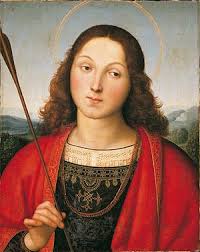
As far as I know the most important iconographical detail in Giorgione’s Boy with an Arrow has largely been ignored. I must confess that in an earlier post on the painting, I also failed to see it. It is the color of the young man’s tunic. Why did Giorgione deliberately choose to clothe him in red? In that earlier post I agreed with those who identified the subject of Giorgione’s painting as the Christian martyr St. Sebastian. I was struck especially by the resemblance of Giorgione’s painting to an earlier St. Sebastian by Raphael. 
Giorgione: Boy with an Arrow
Poplar, 48x42 cm
Kunsthistorisches Museum, Vienna

Boy with and Arrow is another of Giorgione’s mysterious paintings and a number of different interpretations have been put forward. The exhibition catalog for the 2004 Giorgione exhibition jointly held in Venice and Vienna provided a full discussion of the interpretive history of the painting. Marianne Koos, the author of the catalog entry, noted that the painting was not always attributed to Giorgione and that his authorship was only generally accepted after 1955. She also noted that “it is usually dated to his mature period, between 1506 and 1508.” *
Koos, whose essay derived from her own doctoral dissertation, did a very nice job of summarizing and analyzing the different views. She indicated that Bernard Berenson accepted the Sebastian identification in 1957, but noted that most scholars since have supported a mythological reading such as Apollo or Eros. However, after pointing out the shortcomings of each interpretation, she offered one of her own to which she devoted most of her catalog entry.
Giorgione’s youth remains primarily a subject in the discourse of love, an ideal male figure, with whom the male observer may also form an alliance in thought. The ideal-boy picture is not only a painting of…desire, but also of narcissistic identification and a homosocial avowal of brotherhood. [186]
Her interpretation is what one might expect from a modern art historian but I do not believe that her argument against the St. Sebastian interpretation is very strong. It is certainly true that most depictions of the martyr show a full-length nude figure riddled with arrows. Yet it is also true that a fully clothed, half-length figure of a doleful young man holding an arrow was popular at the time. 
As mentioned above, there is a great similarity between Giorgione’s painting and an earlier depiction of St. Sebastian by Raphael. Both depicted a soulful looking young man with head tilted to one side and holding one arrow in his hand. Raphael also departed from the traditional version of a partially nude man tied to a tree or column and riddled with arrows symbolic of the plague.


Raphael: St. Sebastian

Giovanni Antonio Boltraffio, a follower of Leonardo da Vinci in Milan, also produced a number of half-length versions of St. Sebastian in which he depicted a soulful fully clothed young man holding an arrow in his hand. Like Raphael, Boltraffio included the traditional halo.


Boltraffio: St. Sebastian


The similarities between Raphael’s and Boltraffio’s versions of St. Sebastian and Giorgione’s Boy with an Arrow greatly outweigh the dissimilarities. Typically, Giorgione removes an obvious iconographical sign like the halo and replaces it with something that I have come to believe characterizes much of his work. He uses color to identify the subject.
Red is the symbol of martyrdom. It is the color of the vestment of the priest at every Mass that commemorates a martyr. In an essay on Giorgione’s Three Ages of Man I have argued that the color of the garments of the three figures in that mysterious painting identifies them as Jesus, Peter, and the rich young man of the Gospel of Matthew. Peter’s robe is bold red, a symbol of his eventual martyrdom. Christ is shown in green, in what looks like the vestment that a priest commonly wears on most Sundays of the liturgical year. The gold lapels of the young man indicate his wealth.
I have also argued that the colors of the garments worn by the three men in Giorgione’s Three Philosophers support those who interpret that mysterious painting as the Three Magi. The color of their garments refers to their gifts of gold, frankincense and myrrh. 
Anyone looking at Giorgione’s painting side-by side with Raphael’s and Boltraffio’s would be hard pressed not to see the saint in the young man. The small size of the three paintings would indicate that they were all made for private devotion. There was a real market for St. Sebastian in the days of recurring plague.
Scholars do not like to recognize Giorgione’s boy with an arrow as the martyr, St. Sebastian. I have come to believe that in addition to the color of his garment, the face of the young man has an angelic quality that can also be observed in the paintings by Raphael and Boltraffio. This face would be appropriate for a martyr. In the account of the persecution and death of St. Stephen, the first martyr, we are told that his face appeared to his accusers as the face of an angel.
And all that sat in the council, looking at him, saw his face as if it had been the face of an angel.


Giorgione dressed the young man in the Boy with an Arrow in the color of a martyr. There is perhaps an insight contained in the metaphorical interpretation of Marianne Koos. Neoplatonic discussions of love and desire were not regarded as antithetical to Christian belief. On the contrary, in many respects they brought, if only for a brief moment, Christian beliefs to a new level on the eve of the Reformation. 
Where it had been common to invoke St. Sebastian as a protector against the plague, now it would appear that Giorgione and others were seeing him again in his original guise; as one who gave his life for his fellow man. In this respect, he was truly a symbol of Christ-like love. No wonder his story inspired Christians throughout the Middle Ages, the Renaissance and even beyond.
###

* Ferino-Pagden, Sylvia, and Nepi-Scire, Giovanna: exh. Cat. Giorgione, Myth and Enigma, Vienna, 2004.

Hasan Niyazi


Note: I reprise this post on the fifth anniversary of the death of my blogging friend Hasan Niyazi who passed away suddenly and tragically alone in his apartment late in October, 2013. Hasan was the son of a Moslem family that had migrated from Cyprus to Australia when he was a child. Like the children of many traditional immigrants he broke away from the traditional religion of his family and became an avowed secularist. Somehow, he developed a passion for the art of the Italian Renaissance, especially for Raphael. 

He was obviously an outsider in every respect and so turned to blogging. His blog, Three Pipe Problem, quickly became a web sensation. To his passion for art, he added his scientific background, as well as technical proficiency in mastering blogging technology. Through social media he developed so many friends and contacts that he became a kind of sun around which they orbited. 

I first met him on the web in 2010 when Three Pipe Problem was just beginning to make traction. In the next three years he went from an obscure blogger to a presence in the art history world. Six months before his death he wrote me about his plans.

I am increasingly busy. I have a few interviews coming up, including one with a prominent Florentine restorer, Dr Goldberg and some other scholars. Work on Raphael continues and many other things in the offing. My blog received its millionth viewing the other week, which was pleasant - and I hope to commemorate it with a prize in the near future. I have started learning Italian, and am also still working as a clinician. Blogging has become more than a curious pastime, yet there is still no easy way to make it viable financially, so I must continue in my dual mode! (4/18/2013)

Then, like his beloved Raphael and my beloved Giorgione he was gone in his mid-thirties. He may not have had the face of a Renaissance angel and I don’t know what arrow took his life, but I will always think of him when looking at The Boy with an Arrow.

Thursday, October 27, 2016

Giorgione: "Boy with an Arrow" or St. Sebastian


In earlier posts I have agreed with those who have claimed that the small painting by Giorgione called “Boy with an Arrow” is an image of St. Sebastian, one of the most popular male saints of the Middle Ages and Renaissance. For almost 1000 years the third century martyr had been recognized as a protector against the plague. During the Renaissance his popularity was especially great in Venice and the Adriatic coast because of the frequent occurrences of plague.

Giorgione: Boy with an Arrow
Oil on wood, 48 x 42 cm
c. 1506
Kunsthistorisches Museum, Vienna

In one of my first posts at Giorgione et al… I pointed to the great similarity between Giorgione’s “Boy with an Arrow” and Raphael’s earlier depiction of the saint. Both showed a soulful looking young man with head tilted to one side and holding one arrow in his hand. Both artists departed from the traditional version of a partially nude man tied to a tree or column riddled with arrows, symbols of the plague.

Raphael: St. Sebastian
Oil on wood, 43 X 34 cm
1501-2
Accademia Carrara, Bergamo

Giovanni Antonio Beltraffio, a follower of Leonardo da Vinci’s in Milan, also produced a number of half-length versions of St. Sebastian that antedate the work of Giorgione and Raphael. He also depicted a soulful fully clothed young man holding one arrow in his hand. His saint has a halo.
There is no mistaking the subject of Raphael’s or Beltraffio’s versions of St. Sebastian. 


Beltraffio: St. Sebastian
Oil on canvas, 48 x 36 cm
1490s
Pushkin Museum, Moscow

Characteristically, Giorgione departed from using traditional iconographical symbols like the halo. He did keep the arrow but in another post I argued that he used color to identify the young man. His tunic is red, the color associated with martyrs in the liturgy of the Mass.

Anyone looking at Giorgione’s painting side-by-side with Raphael’s and Beltraffio’s would be hard pressed not to see the saint in the “Boy”. The small size of the three paintings would indicate that they were all made for private devotion. There must have been a real market in the days of recurring plague. Beltraffio made a number of depictions and we know that one Venetian patrician had two copies of the Giorgione in his possession.

Scholars do not like to recognize Giorgione’s “Boy with an Arrow” as St. Sebastian. They have proposed divine figures like Apollo and Eros. I have come to believe that, more than anything else, the facial expressions in these three paintings indicate a martyr. In the account of the persecution and death of St. Stephen, the first martyr, the face of the young man about to be martyred appeared to his accusers like the face of an angel.  Here are the words of the Latin Vulgate, 6:15.

Et intuentes eum omnes qui sedebant in concilio viderunt faciem eius tamquam faciem angeli.
And all that sat in the council, looking on him, saw his face as if it had been the face of an angel.
###

Note: I wrote this post in part to commemorate the third anniversary of the death of my blogging friend Hasan Niyazi who passed away suddenly and tragically alone in his new apartment late in October, 2013. Hasan was the son of a Moslem family that had migrated from Cyprus to Australia when he was a child. Like the children of many traditional immigrants he broke away from the traditional religion of his family and became an avowed secularist. Somehow, he developed a passion for the art of the Italian Renaissance, especially for Raphael.

He was obviously an outsider in every respect and so turned to blogging. His blog, Three Pipe Problem, quickly became a web sensation. To his passion for art, he added his scientific background, as well as technical proficiency in mastering blogging technology. Through social media he developed so many friends and contacts that he became a kind of sun around which they orbited.

I first met him on the web in 2010 when Three Pipe Problem was just beginning to make traction. In the next three years he went from an obscure blogger to a presence in the art history world. Six months before his death he wrote me about his plans.

I am increasingly busy. I have a few interviews coming up, including one with a prominent Florentine restorer, Dr Goldberg and some other scholars. Work on Raphael continues and many other things in the offing. My blog received its millionth viewing the other week, which was pleasant - and I hope to commemorate it with a prize in the near future. I have started learning Italian, and am also still working as a clinician. Blogging has become more than a curious pastime, yet there is still no easy way to make it viable financially, so I must continue in my dual mode! (4/18/2013)


Then, like his beloved Raphael and my beloved Giorgione he was gone in his mid-thirties. He may not have had the face of a Renaissance angel and I don’t know what arrow took his life, but I will always think of him when looking at the above paintings.

Hasan Niyazi in Florence