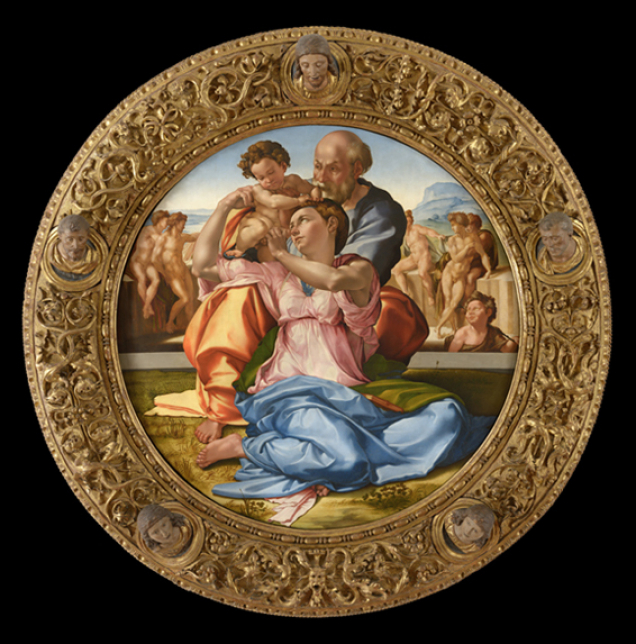
Since 2010 I have been using this site to discuss my interpretations of famous Renaissance paintings including Giorgione's "Tempest" as "The Rest on the Flight into Egypt"; his "Three Ages of Man" as "The Encounter of Jesus with the Rich Young Man"; Titian's, "Sacred and Profane Love" as "The Conversion of Mary Magdalen"; Titian's "Pastoral Concert" as his "Homage to Giorgione", and Michelangelo's"Doni Tondo." The full papers can now be found at academia.edu.

Saturday, July 25, 2026

Giorgione: The Three Ages of Man

 Old age and diminished eyesight have practically brought my art history career to an end. As a result,  I have decided to reproduce my various interpretive discoveries once again on Giorgione et al... as a kind of archive. So far this year I have republished condensed versions of my interpretations of Giorgione's Tempest, Titian's Sacred and Profane Love, and Michelangelo's Doni Tondo. Below find my interpretation of Giorgione's Three Ages of Man  that originally appeared here on October 11, 2011. The full paper can be found on academia.edu. 


**************

 Giorgione’s Three Ages of Man is another one of his paintings that has so far eluded identification. The name of the painting that now hangs in the Pitti Palace is pure guesswork stemming only from the obvious disparity in ages of the three men. One appears to be about 60, another in his early thirties, and the last a young man in his teens.


Giorgione: Three Ages of Man
Pitti Palace, Florence
Oil on wood, 62 cm  x 77.5 cm

Scholars today object to the popular title. Some think it represents a music lesson and that the man on the viewer’s right is pointing to musical notes on the paper held by the young man. Others claim that it represents the education of the young emperor/philosopher Marcus Aurelius. Others just throw up their hands and claim that it contains, like other Giorgione works, multiple levels of meaning.

However, the most spectacular element in this mysterious painting has so far received little notice. Venetian painters were known for their coloration. Just look at the garments of the three men. Nothing in a Renaissance painting is there by accident or whim. The colors in this painting provide a real clue to its subject.

As far as I know no one has suggested that the painting has a “sacred” subject, but yet, it appears that Giorgione has depicted a scene from the nineteenth chapter of the Gospel of St. Matthew. It is the story of the encounter of Jesus with the young man of great wealth. (See below for full text)

In Matthew’s account the young man asked Jesus what he could do to attain eternal life. Jesus told him to keep the Commandments, and specifically named the most important. The man replied that he had done so but still felt that something was wanting. Jesus then uttered the famous words, “If thou wilt be perfect, go, sell what thou hast, and give to the poor, and thou shalt have treasure in heaven; and come, follow me.” The gospel relates that the young man went away sad for he had many possessions.

How has Giorgione depicted this story and who is the third man? The man in the middle is obviously young and the golden lapels of his garment as well as his fashionable hat indicate that he is well to do. He is holding a piece of paper or parchment that contains some indecipherable writing that under magnification hardly looks like Renaissance musical notation.

On the right most Venetians would have immediately recognized the visage of Jesus. There is no halo or nimbus but Giorgione never employed that device. The pointed finger is certainly characteristic of Jesus. Here he points not at a sheet of music but at the Commandments, which the gospel account has just enumerated.

Jesus wears a green garment or vestment, certainly an unusual color for him. In fact, it looks like the robe or chasuble worn by a priest during Mass. At the hand of Jesus we can also see the white sleeve of the “alb", a long white robe always worn under the chasuble. Green is the color used by the Catholic Church during Ordinary time, that part of the Church year not identified with any of the great feasts.

The third man is St. Peter. He is the only other person identified in Matthew’s account of this incident. He stands on the left, head turned toward the viewer. Giorgione uses Peter as an interlocutor, a well-known Renaissance artistic device designed to draw the viewer into the painting and encourage emotional participation. The old man’s face is the traditional iconographical rendering of Peter with his baldhead and short stubby beard. As Anna Jameson noted many years ago, Peter is often portrayed as ”a robust old man, with a broad forehead, and rather coarse features.” **


Durer: St. Peter detail

Giovanni Bellini and Albrecht Durer, both Giorgione contemporaries, depicted Peter’s head in this fashion. About a hundred years later Caravaggio still used it in striking fashion in the "Martyrdom of St. Peter" in S. Maria del Popolo in Rome, and in the "Denial of Peter" now in New York’s Metropolitan Museum.

Caravaggio: Denial of Peter

The color of Peter’s robe is also liturgically significant. Peter is rarely shown wearing red, but Giorgione has chosen to show him wearing the color reserved for the feast days of the martyrs. In the gospel account immediately after the young man went away sad, Peter, speaking for the other disciples as well as for the viewer of Giorgione’s painting, had asked, “Behold we have left all and followed thee: what then shall we have?”

In the first decade of the sixteenth century Venice was at the apex of its glory. It would suffer a great defeat at the end of the decade during the War of the League of Cambrai but until that time it was arguably the wealthiest and most powerful of all the European nations. It was certainly the only one that dared confront the mighty Ottoman Empire.

Nevertheless, some young Venetian patricians were wondering whether the whole life of politics, commercial rivalry, and warfare was worthwhile. One of them, Tommaso Giustiniani, a scion of one of the greatest families, did actually sell all his possessions, including his art collection, in order to live as a hermit in a Camaldolensian monastery. At one point he wrote to a few friends, who were also considering a similar move, about the futility of their daily lives. He argued that Venetian life was agitated, completely outward, and continually dominated by ambition. It was the reason for all their worry.

“If, then, a Stoic philosopher appeared to free their minds from all these disturbances, his efforts would be in vain, so completely does agitation dominate and enfetter their whole lives. How can anyone not feel disgust for such an empty existence.”? ***

Peter and the other disciples were shocked when Jesus said that it would be harder for a rich man to enter the kingdom of heaven, than for a camel to pass through the eye of a needle. “Who then can be saved,” they asked? The response of Jesus was full of hope: “With men this is impossible, but with God all things are possible.” Green, the liturgical color used throughout the Church year, is also the color of hope.

“The Encounter of Jesus with the Rich Young Man,” the name we can now give to the painting in the Pitti Palace, would certainly appear to have an historical context in Giorgione’s time. Five hundred years after the death of this short-lived genius perhaps we can begin to understand that Giorgione was a unique and original painter of sacred subjects.

###

Full text of Matthew 19:16-27.

And behold, a certain man came to him and said, “Good Master, what good work shall I do to have eternal life?” He said to him, “Why dost thou ask me about what is good? One there is who is good, and he is God. But if thou wilt enter into life, keep the commandments.” He said to him, “Which?” And Jesus said,

Thou shalt not kill,
Thou shalt not commit adultery,
Thou shalt not steal,
Thou shalt not bear false witness,
Honor thy father and mother, and,
Thou shalt love thy neighbor as thyself.”

The young man said to him, “All these I have kept; what is yet wanting to me?” Jesus said to him, “If thou wilt be perfect, go, sell what thou hast, and give to the poor, and thou shalt have treasure in heaven; and come, follow me.” But when the young man heard the saying, he went away sad, for he had great possessions.

But Jesus said to his disciples, “Amen I say to you, with difficulty will a rich man enter the kingdom of heaven. And further I say to you, it is easier for a camel to pass through the eye of a needle, than for a rich man to enter the kingdom of heaven.” The disciples hearing this, were exceedingly astonished, and said, “who then can be saved?” And looking upon them, Jesus said to them, “With men this is impossible, but with God all things are possible.”

Then Peter addressed him, saying, “Behold we have left all and followed thee: what then shall we have?”


* Note: This article first appeared in Giorgione et al... on Oct. 8, 2011. It followed upon my interpretations of Giorgione's Tempest, and Titian's Sacred and Profane Love as sacred subjects. 

** Anna Jameson, "Sacred and Legendary Art," Boston, 1896, Vol. 1, p. 191.

*** Dom Jean LeClercq, Camaldolese Extraordinary, The Life, Doctrine, and Rule of Blessed Paul Giustiniani, Bloomingdale, Ohio, 2003, pp. 61-62.

Thursday, July 9, 2026

Michelangelo's Don Tondo: the Nudes


I published my interpretation of Michelangelo's Doni Tondo in installments on this site back in 2015. The complete paper can now be read or downloaded at academia.edu. I have decided to re-post it this year win order to bring together all of my interpretive discoveries. In the two previous posts I argued that in the foreground of the painting Michelangelo depicted the Madonna offering her Son in the same way that a priest offers the Eucharistic host during the Consecration of the Mass. The second post  discussed the role of the young John the Baptist in the mid-ground. Today, I reprise the third part of that paper that identified the nudes in the background as the Nephilim of the Hebrew scriptures at the time of Noah.

***

In recent years the five nude young men in the background of Michelangelo’s Doni Tondo have received as much, if not more, attention than the Holy Family in the foreground. There would appear to be no agreement as to who they are or what they represent. Among other things, they have been variously interpreted as angels without wings, sinners, penitents awaiting Baptism, figures from pagan antiquity, or figures from the Old Testament.


In a paper, entitled “Michelangelo’s Doni Tondo: Holy Family and Family Myth,” Andree Hayum concentrated on the scene in the background. She noted the many different interpretations offered for the five nude men, but found the source in the Old Testament account of the drunkenness of Noah. She saw an obvious connection between the young men and Michelangelo’s famous depiction of the Noah story on the ceiling of the Sistine chapel.

But if one thinks of them as a constellation of three, the figures they recall are Michelangelo’s sons of Noah in the Sistine fresco of Noah’s Drunkenness. The most notable feature of Michelangelo’s sons of Noah is their nudity.*


Michelangelo: Drunkenness of Noah

In her interpretation the three men on the viewer’s right in the Doni Tondo would be Noah’s sons Ham, Seth, and Japheth before the incident of their father’s humiliating drunkenness. After drinking of the fruit of the vine, Noah had fallen naked into a stupor in his tent. Ham looked upon his father’s nakedness but the other two averted their faces and covered him. When Noah awoke and realized what had happened, he cursed Ham. Hayum argued that the two innocent or sinless sons are therefore depicted after the episode on the viewer’s left.

There is a connection between the young John the Baptist in the midground of the Doni Tondo and the story of Noah. Not only did theologians and artists see the Baptist, the last and greatest of the Hebrew prophets, as a link between the Old and New Covenants, but also they had related the story of Noah to Baptism.

In the First Letter of St. Peter the saving of Noah and his family are seen as prefiguring Baptism. Just as the waters of the Flood wiped away sin, so too do the waters of Baptism. There can be no doubt of the prominence of the Noah story during Michelangelo’s time. Savonarola, his favorite preacher, had given perhaps his most famous series of sermons on Noah and the Flood right before the French invasion of Italy in 1494. Michelangelo featured the Noah story on the ceiling of the Sistine chapel only a few years after the completion of the Doni Tondo.

Nevertheless, I have some questions about Hayum’s hypothesis. In the first place, where is Noah in the Doni Tondo? For Hayum this question was not a problem because she saw Noah in the figure of St. Joseph.

As in the sacrifice of Noah, the Holy Family alludes to Noah and his sibylline daughter-in-law. They have come to rest holding up the future male child. Like the ritual of sacrifice, the thanksgiving and the gift are one, and a sense of celebration prevails. **

Noah’s daughter-in-law was reputed to be a sibyl and given the sibyls in the Sistine chapel, it was easy for Hayum and others to recognize a sibyl in Mary’s posture. Nevertheless, I believe it would be impossible to find another reference to Joseph as Noah. If anything, Noah is a type of Christ, not of St. Joseph. Noah’s salvation of mankind from destruction at the time of the Flood prefigured the salvation effected by Christ on the Cross.

My second question relates to the postures of the nude figures in the Doni Tondo. Rather than participating in the scene of their father’s drunkenness, they lounge about like modern Italian men on a street corner ogling passing young women. A similar posture can be seen in an earlier devotional tondo by Luca Signorelli that is usually called the Medici Madonna. Hayum and others have seen a connection between the five nudes in Michelangelo’s tondo and the four practically nude young men in Signorelli’s painting.

Luca Signorelli: Medice Madonn

In the foreground of Signorelli’s painting the Madonna sits on the ground while her son appears to be taking his first step. St. Joseph and John the Baptist are absent but a bust of the Baptist as a man appears in the fictive frame above the tondo with a banner reading “Ecce Agnius Dei”. However, the four young men in Signorelli’s tondo also appear to be idlers. It is hard to see how they could be the sons of Noah either before or after the incident of his drunkenness.


I would like to suggest that the nudes in both paintings are related to the story of Noah but that they are not his sons. In the Book of Genesis there is a brief reference to giants upon the earth. Here is an English translation of the Vulgate Latin.

Now giants (gigantes) were upon the earth in those days. For after the sons of God went in to the daughters of men, and they brought forth children, these are the mighty men of old, men of renown. [Genesis 6:4]

The Golden Legend embellished the biblical account of the time of Noah.

This time men began to multiply upon the earth, and the children of God, that is to say of Seth, as religious, saw the daughters of men, that is to say of Cain, and were overcome by concupiscence and took them to their wives. This time was so much sin on earth in the sin of lechery, which was misused against nature, wherefore God was displeased…
A fuller account can be found in the apocryphal legends of the Jews.

Unlike Istehar, the pious maiden, Naamah, the lovely sister of Tubal-cain, led the angels astray with her beauty, and from her union with Shamdon sprang the devil Asmodeus. She was as shameless as all the other descendants of Cain, and as prone to bestial indulgences. Cainite women and Cainite men alike were in the habit of walking abroad naked, and they gave themselves up to every conceivable manner of lewd practices. Of such were the women whose beauty and sensual charms tempted the angels from the path of virtue. The angels, on the other hand, no sooner had they rebelled against God and descended to earth than they lost their transcendental qualities, and were invested with sublunary bodies, so that a union with the daughters of men became possible. The offspring of these alliances between the angels and the Cainite women were the giants, known for their strength and their sinfulness… ***

The legends of the Jews ascribed a number of names to these giants but one was Nephilim, “because bringing the world to its fall, they themselves fell.” The modern Jerusalem bible does use the word Nephilim instead of giants to describe these troublemakers whose sins were so great that it took a flood to wipe them out. In addition to walking about naked, the Nephilim were noted for their arrogance and wantonness.

They knew neither toil nor care, and as a consequence of their extraordinary prosperity they grew insolent. In their arrogance they rose up against God…. It was their care-free life that gave them space and leisure for their infamies. ***


The description of the Nephilim in the Jewish legends fits the depiction of the nude young men in the background of both Signorelli’s Medici Madonna and Michelangelo’s Doni Tondo. The painter of the ceiling of the Sistine chapel certainly had knowledge of the Book of Genesis. Scholars have demonstrated that he could have read the text in Italian because of the publication of the vernacular Malerbi bible in 1490. He obviously used the Malerbi woodcuts in his work in the Sistine chapel.

Could he have been familiar with the folklore and legends of the Jews? Michelangelo grew up in a Florence that was a center of Hebraic studies. Michelangelo trained at the Medici court where Pico della Mirandola was known for his knowledge of the Hebrew lore and traditions that were all lumped together under the heading of Cabala. Most of Savonarola’s sermons were based on the books of the Old Testament. Also, Sante Pagnini, who succeeded Savonarola as Prior of San Marco, was a Dominican specialist in Hebrew language and grammar. He spent practically his entire career translating the Hebrew Scriptures into Latin.

Finally, another source for the Nephilim was readily available in a book published only a decade before Michelangelo painted the Doni Tondo. David Whitford’s 2009 study, The Curse of Ham in the Early Modern Era, included a chapter devoted to the Giants or Nephilim. In particular, he discussed the Commentaria of Annius of Viterbo, a Dominican friar, whose book containing alleged writings and fragments of pre-Christian Greek and Latin authors appeared in 1498. Contemporary humanists suspected that the Commentaria and its author were frauds. Annius claimed linguistic knowledge that he did not possess, and even planned a fake archaeological discovery. Nevertheless, the book became very popular and was reprinted in 1515 with only minor corrections.

Here is Whitford’s account of Annius on Noah and the Nephilim.


Book One begins by stating that before the “famous catastrophe of the waters, by which the entire world perished, many ages passed.” In these ages, giants ruled the world from their great city, Enos. The giants were corrupt and prone to tyranny, lechery, and debauchery. They devoted themselves to sexual immorality such that, “they had intercourse with their mothers, their daughters, their sisters, with other men and with wild beasts.” They also despised religion and the gods. Despite warnings and prophecies that the world would be destroyed because of this wickedness, the giants continued their impiety. Only one giant, who was more “reverential to the gods and wiser than the rest,” paid any attention to the prophecies; because of this he survived. His name was Noa “and he had three sons, Samus, Japetus, and Chem.” Noa (or Noah) survived because he could read the stars and foresaw the deluge to come. Thus, beginning 78 years before the Flood, he built an ark. When the floods came, the whole human race was drowned, except for Noa and his family. From this family sprang all the peoples of the earth. #

Despite the spurious nature of the Commentaria, it would appear that the story of the Nephilim was in the air even before its publication in 1498, and that the Commentaria of Annius only added to its popularity.

Why would Michelangelo place the proud giants or Nephilim in the Doni Tondo? I can only offer the following suggestion. The painting is a devotional image. The Madonna elevates her infant Son in the way a priest elevates the Host at Mass. John the Baptist looks at the Host and utters the words of the Agnus Dei: Behold the Lamb of God…. But the full version of the ancient prayer is “Behold the Lamb of God, who takes away the sins of the world, have mercy on us.

The Nephilim represent the sins of the world. I suggest that they are the nudes in the background of both the Doni Tondo and Signorelli’s Medici Madonna. In both paintings the Madonna and Child have turned their backs on the nudes in the background. Instead of a Flood, the Lord has sent his only Son to take away the sins of the world.

###


*Andree Hayum, "Michelangelo’s Doni Tondo: Holy Family and Family Myth". Reprinted in Michelangelo, Selected Scholarship in English, edited with Introduction by William E. Wallace, New York and London, 1995, V. 1.Life and Early Works, p. 421-424.

** Hayum, op. cit., p. 427.

*** Louis Ginzberg, The Legends of the Jews, 1909, V. 1, c. 4. Available online.

# David Whitford, The Curse of Ham in the Early Modern Era. 2009.