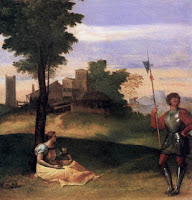
Since 2010 I have been using this site to discuss my interpretations of famous Renaissance paintings including Giorgione's "Tempest" as "The Rest on the Flight into Egypt"; his "Three Ages of Man" as "The Encounter of Jesus with the Rich Young Man"; Titian's, "Sacred and Profane Love" as "The Conversion of Mary Magdalen"; Titian's "Pastoral Concert" as his "Homage to Giorgione", and Michelangelo's"Doni Tondo." The full papers can now be found at academia.edu.
Showing posts with label Salvatore Settis. Show all posts

Saturday, August 30, 2025

Interpreting Giorgione's Tempest: Salvatore Settis

No painting has received more interpretations than Giorgione's Tempest. Back in 2005 I felt that the way was open to my new interpretation of the painting as "The Rest on the Flight into Egypt" because the many previous interpreters had cancelled each other out. Nevertheless, I had to deal with the most important of these interpretations. Many years ago I posted reviews of these interpretations on this site, and would like to re-visit them this year. I begin with a review of Giorgione's Tempest by Salvatore Settis, the essential starting point for any student of Giorgione.


In researching my interpretation of the Tempest as “The Rest on the Flight into Egypt,” no book has been of greater assistance than Giorgione’s Tempest, written by Salvatore Settis in 1990. In addition to providing an in depth analysis of practically every previous interpretation, Professor Settis also laid down a series of iconographical ground rules that should be used in any interpretation. 

For example, in his introduction he noted:

“Interpreting the Tempest means providing “a well documented explanation for each feature, and fitting all together into one persuasive framework.” (2)

Indeed, he came very close to identifying the subject of Giorgione’s most famous painting. At least he did see that the painting had a “sacred subject” but instead of seeing the Woman as Mary, the new or second Eve, he identified her as the original Eve nursing her first-born son, Cain. The Man in the painting is Adam in the guise of a Venetian aristocrat accompanying his wife after their expulsion from the Garden of Eden.

Even though his book is a must for anyone interested in Giorgione, his ingenious and painstaking interpretation came under serious criticism and was accepted by virtually no one. He argued that the famous painting must be treated like a puzzle and that in any interpretation all the pieces must fit, and fit easily without being squeezed into position. 

Unfortunately, he often violated his own maxim. The major pieces of the puzzle are the Man, the Woman and Child, the broken columns, the plant in the foreground, and the storm and city in the background. 


For Settis, the Man is Adam after the expulsion from the Garden of Eden. The nude Woman is Eve nursing her newborn son, Cain. The broken columns are a symbol of death which has entered the world as a result of sin. The plant is there to cover Eve’s nakedness, although obviously doing a very poor job. The city in the background is the lost Paradise forever barred to the Man and Woman who are doomed to a life of toil and hardship. The storm and lightning represent the wrath of God not only on the erring couple but also on what he called a serpent slithering into the rock beneath the heel of the woman. 

Here are his words concerning the Man and the Woman:


 “Adam leans, not on the short-handled spade of his Bergamo counterpart, but on a singularly long staff: various interpreters have agreed that this could be a soldier’s lance, a traveler’s wand or simply a generic tool. The allusion to the manual labor prescribed in the biblical text is underplayed, almost fleeting, for this Adam is an elegant Venetian…The medieval tradition portraying Adam at work…has evolved to show Adam at rest, with Eve as mother at his side….” (113)

 “The handsome clothes belong to a Venetian gentleman, not to a peasant or a fisherman, and are appropriate with the attenuated image of the tool:  in the hands of this meditative, or resting, figure the staff must allude to manual labour. Neither spade nor hoe, it has a point at one end but so hidden in the grass that it is only visible on a close and careful examination.” (114)


 “Eve is seated opposite him a white wrap that barely covers her. (sic) The baby in her lap and her own nakedness indicate recent childbirth, a familiar schema in earlier art. The slender bush that grows out in front of her cannot be a simple decoration in this painting of such deliberate construction: its compositional importance has already been noted by other interpreters…who have tried in vain to establish its meaning.” (115)


In chapter 4 Settis provided a number of images of Adam and Eve after their expulsion from the Garden of Eden. It was an impressive feat but in every image the Man and the Woman do not exhibit the disparity of clothed and unclothed figures found in the Tempest. 

For example, in Amadeo’s, Bergamo bas-relief, both Adam and Eve are nude, just as they are in Jacopo della Quercia’s relief in St Petronio in Bologna. In all the other images it is the same. Either Adam and Eve are both nude, or both clothed. 

The Adam in these images is always a rustic laborer, and not the poised Venetian aristocrat of Giorgione’s painting. This development is one of the main props for the “hidden subject” thesis proposed by Settis. Moreover, the Adam in these images is usually the central or focal point, but in the Tempest the Man directs the viewer’s attention to the Woman and Child.

The Woman’s nudity is only explained as a sign of “recent childbirth,” but the child in the Tempest is obviously almost a year old. He holds himself up nicely while nursing. Settis did not identify the plant in the Tempest, but he did argue that it is there to cover the Woman’s nakedness. He also argued that the dead root beneath the woman’s heel was not part of the plant but the “serpent” slithering into the rock fleeing God’s wrath.

Settis, like some others, argued that the lightning bolt in the background was a symbolic representation of God, and that it and the storm were hovering over the couple forever banished from Paradise. The gates of Paradise have forever been closed to them and the broken columns are symbolic of death. Yet according to the rules of perspective the storm and lightning bolt are miles in the distance. Moreover, in the foreground the couple is bathed in sunlight. They show no trace of fear, anxiety, or loss.

Speaking of Paradise, why would one of the buildings show an emblematic representation of Padua’s Carrara family? 

Salvatore Settis, Giorgione’s Tempest, Interpreting the Hidden Subject, Chicago, 1990.

Dr. Francis P. DeStefano

5/6/2011

Note: Below are some relevant notes from Settis' text.

Chapter 1. Subject and Non-Subject.

p.2. “If we can perceive the beauty of an object within its meaning and not outside it, within its history and not outside it, and if we can comprehend and not simply admire, attribute and acquire, perhaps then we can really slaughter the ‘art’ which we have invented and free it from a contrived immortality.”

p.2. “In the study of art…the history of form has gradually parted company from the history of content: ‘art criticism’ elaborates lists of attributions and comments on aesthetic value and is thus de facto opposed to iconology, which attempts to decipher the meaning of inherited images.”

p.3. “The great, regal, public museum,…the bourgeois drawing-room…In both of them statues and pictures are snatched from their original context, in which co-ordinates of meaning were mapped our around them, and are offered to the visitor for their aesthetic value only.”

p.4. “Art criticism has thus produced pages of exquisitely artistic prose which deliberately competes in stylistic effect with the picture it describes, as well as pages of awkwardly-phrased enthusiasm. But in both cases the cost has been a high one: by favoring form, the function of a statue or painting as bearer of a message…has been completely overshadowed.”

p.10. “A complete understanding of a statue or a painting should place the question of style within the framework of careful research on its meaning as a vehicle of communication, and on its ways of expressing that meaning. For form and content…are born at the same time…”

p.13. “Vasari’s words bear witness to the difficulties of understanding Giorgione’s subjects, even a few decades after his death….Bur Vasari must have momentarily lost his concentration when he looked at the four facades of the Fondaco….The few things we do know about the decoration of the Fondaco indicate a precise iconographical Programme, however disjointed its features may seem to be.”

C. 4.  Interpreting the Tempest,

p.82. “it is usually the case that we instantly recognize a picture  of a woman and child as Mary and Jesus….We recognize Virgin and Child above all by means of the many different images in our memory and form, as it were, a single type. It is visual experience itself, repeated over and over again, but always receptive, that tells us the title of the picture.” …

p.82. “But that memory can be lost; and when this happens an image that was created for a public that could understand it becomes incomprehensible to observers who are alien to that particular figurative culture. This can give rise to absurd and fantastic interpretations.”

c. 5. The Hidden Subject

p. 129. “In choosing a painting as a vehicle for expressing personal feelings, ‘inventiveness’ must have been severely hampered by the inescapable weight of authority represented by previous iconographic tradition. The transformation of an ‘interior subject’ into something less comprehensible entailed searching out an unusual iconography, and also perhaps attenuating its meaning by eliminating or toning down its essential features.”

p. 129/130. “Even more complex and difficult was the task of fitting a religious theme into this ‘closed’ and private use of art….But to a painter in the time of Palma il Vecchio and Giorgione, a Christian subject would have had a different weight….The codification of iconography for religious subjects must have been that much more forceful for being accepted as serving the true Christian faith. Equally, it was that more difficult to dare to choose a Christian theme as a way of expressing personal thoughts.”

Wednesday, July 10, 2024

Review. Salvatore Settis: Castlefranco Altarpiece


Commentators have always regarded Giorgione’s “Castelfranco Altarpiece” as a unique and original work of art. It is Giorgione’s only known altarpiece, and although he used a traditional subject, he characteristically brought it to a new level. In their 1999 Giorgione catalog Teriseo Pignatti and Filoppo Pedrocco pointed to the extraordinary color scheme compared to other contemporary works.

These are all objective pieces of evidence, but they do not explain the unmistakable uniqueness of Giorgione’s altarpiece, which we feel constitutes the first attempt to convey true atmospheric effects through pure vibrations of color, both in the figures and in the distant landscape. There is a profusion of velvet crimsons in the figures, grass greens and gilded damascenes, the likes of which had never before been seen in Emilia or Venice. This consistent development and reshaping of Bellini’s premises and skilled application of Carpaccio’s fracturing of color is fundamental to Giorgione’s extremely personal work.* (128)


In a 2009 study of Giorgione, written in conjunction with the exhibition in Giorgione’s home town of Castelfranco Veneto that commemorated the 500th anniversary of the painter’s death, Enrico Maria dal Pozzolo wrote:

it would be unjust to diminish the importance of the very personal reworking that this young talent dared to express when he found himself standing before the great blank spaces of the panel,…[His] lifting the Madonna up to the highest possible height…but at the same time using that ‘emblematic” green cloth to tie them together and taking the back out of the chapel so that a preponderant landscape element might be added…is indicative of an approach that was totally original and free of conditioning.** (167)


My wife and I saw the Altarpiece in the spring of 2010. We had attended the annual meeting of the Renaissance Society of America that had been held that year in Venice, and decided to take the train to Castelfranco to see if we could get into the Giorgione exhibition. That Sunday was the closing day and the exhibition was sold out but we were able to see the Altarpiece on display in the Cathedral next door.

The first thing I noticed was the relatively small size of this extraordinarily beautiful painting that had been so carefully cleaned and restored in Venice only a few years before. It would certainly be dwarfed by Giovanni Bellini’s famed Venetian altarpiece in the church of S. Zaccaria that was also completed in 1505. The small size of the “Castelfranco Altarpiece” stems from the fact that it was meant not for the high altar in the Cathedral but for a small funerary chapel.

The whole story of the altarpiece is told best by Salvatore Settis in an extremely well researched essay that appeared in the exhibition catalog for the 2004 Giorgione exhibition that had been jointly sponsored by the Accademia in Venice and the Kunsthistorisches Museum in Vienna. For obvious reasons the Altarpiece was not included in the exhibition, but the essay by Settis was one of the highlights of the catalog.***

Settis related the history of Tuzio Costanzo, a Sicilian adventurer, in the service of the King and Queen of Cyprus toward the end of the 15th century. After the death of the King the threat of succession problems led the Venetian Signory to recall the Queen, the famed Caterina Cornaro, to the Veneto and take the government of the island into its own hands. She established herself in Asolo where her home became a humanist center. Always faithful to Caterina, Tuzio Costanzo became a Venetian condotierre and established his residence in Castelfranco.

In 1504 the death of his son, Matteo, himself serving with Venetian forces in Ravenna, led Tuzio to establish a funerary chapel in the Castelfranco cathedral for Matteo, and eventually for himself. Settis agrees with those who believe that the death of Matteo occasioned Giorgione’s commission.

Not only does the death of Matteo help to establish the dating of the Altarpiece, but it also helps to solve some of the mystery that has surrounded this unusual altarpiece. For example, Settis argued that that the large rectangular box at the bottom with the Costanzo coat of arms was a “Sarcophagus of Porphyry,” a material that had “symbolic connotations that were markedly funerary.” Moreover, such sarcophagi were extremely rare. “In Italy they were found only in Rome and in Sicily, especially in the cathedrals in Monreale…and in Palermo...” (142).

The Sicilian connection also helps to establish the identity of the armored saint. It’s neither St. George nor St. Liberalis, the patron saint of the Cathedral, but St. Nicasius, a popular Sicilian saint holding the banner of the Order of Jerusalem.
“In this case, the only candidate is St. Nicasius, venerated in Palermo and Messina, where his cult is associated with that of St. Francis (exactly as in the Altarpiece).” (p. 144).

The Sicilian heritage and connections of Tuzio Costanzo explain the rare appearance of St. Nicasius so far from home.“The St Nicasius of the Castelfranco Altarpiece is one of those described by Fabio Bisogni as “displaced saints (santi fouri posto)”, common only in one part of Italy and very rare (and therefore very difficult to recognize) in others…” (144).

Above the sarcophagus the very unusual direction of the gazes of both Madonna and Child derives from the nature of the composition.


But the sad gaze of the mourning Madonna from Castelfranco: is not directed at the Son…, and the Son is not looking at the shining armor of the warrior saint. Both mother and child focus on the sarcophagus with the Costanzo coat of arms, and their gazes are the only visual link between the upper and lower parts of the painting; their sad and self-absorbed attitude must be related to a recent death, and the coat of arms on the sarcophagus reveals whose death they mourn, in a reference to the tombstone on the wall close by that bears the name of Matteo Costanzo. (146)


I would just like to add an observation that has been inspired by Settis’ study. Above the sarcophagus there is a white marble altar on which the Madonna’s throne rests. But Franciscan spirituality regarded the Madonna herself as an altar on which her Son, the Eucharist, is placed. For confirmation we need only look at the white cloth underneath the Infant that also covers Mary’s head. It is the corporale that always covers an altar. Giorgione would later use the corporale in his famous “Tempest” where it winds around Mother and Child in much the same way.

But why two altars? On occasion, a funerary chapel is opened for Mass. At the height of the Mass, immediately after the consecration, the priest utters an ancient formula: “Lord, let your angel take this sacrifice to your Altar in Heaven.” At every Mass the sacrifice offered at the earthly altar would be merged with the eternal sacrifice of the Heavenly Altar. In Giorgione’s painting we see the Heavenly Altar (Mary) right on top of the earthly altar.

This concept, that seems so strange to viewers today, is reinforced by Giorgione’s artistic genius. Where is the viewer in this painting? We are not at floor level with the saints. We seem to look down on them. How is it possible for us to see the landscape in the background behind the curtain? The landscape in which we live is in the background. The figures in the foreground are in another world.


*Pignatti, Terisio, and Pedrocco, Filippo: Giorgione, Rizzoli, NY, 1999.

** Enrico Maria dal Pozzolo: Giorgione, Milan, 2009.

***Salvatore Settis: “Giorgione in Sicily–On the Dating and Composition of the Castelfranco Altarpiece.” In Ferino-Pagden, Sylvia, and Nepi-Scire, Giovanna: exh. Cat. Giorgione, Myth and Enigma, Vienna, 2004.

Thursday, April 25, 2024

Review: Salvatore Settis: The Tempest

Here is another in a series of review articles of studies that have helped me in my work on Giorgione and the Venetian Renaissance. In the case of Professor Settis I feel like the proverbial dwarf sitting on the shoulders of a giant.


In researching my interpretation of the Tempest as “The Rest on the Flight into Egypt,” no book has been of greater assistance than Giorgione’s Tempest, written by Salvatore Settis in 1990. In addition to providing an in depth analysis of practically every previous interpretation, Professor Settis also laid down a series of iconographical ground rules that should be used in any interpretation. 

For example, in his introduction he noted:

“Interpreting the Tempest means providing “a well documented explanation for each feature, and fitting all together into one persuasive framework.” (2)

Indeed, he came very close to identifying the subject of Giorgione’s most famous painting. At least he did see that the painting had a “sacred subject” but instead of seeing the Woman as Mary, the new or second Eve, he identified her as the original Eve nursing her first-born son, Cain. The Man in the painting is Adam in the guise of a Venetian aristocrat accompanying his wife after their expulsion from the Garden of Eden.

Even though his book is a must for anyone interested in Giorgione, his ingenious and painstaking interpretation came under serious criticism and was accepted by virtually no one. He argued that the famous painting must be treated like a puzzle and that in any interpretation all the pieces must fit, and fit easily without being squeezed into position. 

Unfortunately, he sometimes violated his own maxim. The major pieces of the puzzle are the Man, the Woman and Child, the broken columns, the plant in the foreground, and the storm and city in the background. 


For Settis, the Man is Adam after the expulsion from the Garden of Eden. The nude Woman is Eve nursing her newborn son, Cain. The broken columns are a symbol of death which has entered the world as a result of sin. The plant is there to cover Eve’s nakedness, although obviously doing a very poor job. The city in the background is the lost Paradise forever barred to the Man and Woman who are doomed to a life of toil and hardship. The storm and lightning represent the wrath of God not only on the erring couple but also on what he called a serpent slithering into the rock beneath the heel of the woman. 

Here are his words concerning the Man and the Woman:


 “Adam leans, not on the short-handled spade of his Bergamo counterpart, but on a singularly long staff: various interpreters have agreed that this could be a soldier’s lance, a traveler’s wand or simply a generic tool. The allusion to the manual labor prescribed in the biblical text is underplayed, almost fleeting, for this Adam is an elegant Venetian…The medieval tradition portraying Adam at work…has evolved to show Adam at rest, with Eve as mother at his side….” (113)

 “The handsome clothes belong to a Venetian gentleman, not to a peasant or a fisherman, and are appropriate with the attenuated image of the tool:  in the hands of this meditative, or resting, figure the staff must allude to manual labour. Neither spade nor hoe, it has a point at one end but so hidden in the grass that it is only visible on a close and careful examination.” (114)


 “Eve is seated opposite him a white wrap that barely covers her. (sic) The baby in her lap and her own nakedness indicate recent childbirth, a familiar schema in earlier art. The slender bush that grows out in front of her cannot be a simple decoration in this painting of such deliberate construction: its compositional importance has already been noted by other interpreters…who have tried in vain to establish its meaning.” (115)


In chapter 4 Settis provided a number of images of Adam and Eve after their expulsion from the Garden of Eden. It was an impressive feat but in every image the Man and the Woman do not exhibit the disparity of clothed and unclothed figures found in the Tempest. 

For example, in Amadeo’s, Bergamo bas-relief, both Adam and Eve are nude, just as they are in Jacopo della Quercia’s relief in St Petronio in Bologna. In all the other images it is the same. Either Adam and Eve are both nude, or both clothed. 

The Adam in these images is always a rustic laborer, and not the poised Venetian aristocrat of Giorgione’s painting. This development is one of the main props for the “hidden subject” thesis proposed by Settis. Moreover, the Adam in these images is usually the central or focal point, but in the Tempest the Man directs the viewer’s attention to the Woman and Child.

The Woman’s nudity is only explained as a sign of “recent childbirth,” but the child in the Tempest is obviously almost a year old. He holds himself up nicely while nursing. Settis did not identify the plant in the Tempest, but he did argue that it is there to cover the Woman’s nakedness. He also argued that the dead root beneath the woman’s heel was not part of the plant but the “serpent” slithering into the rock fleeing God’s wrath.

Settis, like some others, argued that the lightning bolt in the background was a symbolic representation of God, and that it and the storm were hovering over the couple forever banished from Paradise. The gates of Paradise have forever been closed to them and the broken columns are symbolic of death. Yet according to the rules of perspective the storm and lightning bolt are miles in the distance. Moreover, in the foreground the couple is bathed in sunlight. They show no trace of fear, anxiety, or loss.

Speaking of Paradise, why would one of the buildings show an emblematic representation of Padua’s Carrara family? 

Salvatore Settis, Giorgione’s Tempest, Interpreting the Hidden Subject, Chicago, 1990.

Dr. Francis P. DeStefano

Note: This post originally appeared on this site on 5/6/2011.

Note: Below are some relevant notes from Settis' text.

Chapter 1. Subject and Non-Subject.

p.2. “If we can perceive the beauty of an object within its meaning and not outside it, within its history and not outside it, and if we can comprehend and not simply admire, attribute and acquire, perhaps then we can really slaughter the ‘art’ which we have invented and free it from a contrived immortality.”

p.2. “In the study of art…the history of form has gradually parted company from the history of content: ‘art criticism’ elaborates lists of attributions and comments on aesthetic value and is thus de facto opposed to iconology, which attempts to decipher the meaning of inherited images.”

p.3. “The great, regal, public museum,…the bourgeois drawing-room…In both of them statues and pictures are snatched from their original context, in which co-ordinates of meaning were mapped our around them, and are offered to the visitor for their aesthetic value only.”

p.4. “Art criticism has thus produced pages of exquisitely artistic prose which deliberately competes in stylistic effect with the picture it describes, as well as pages of awkwardly-phrased enthusiasm. But in both cases the cost has been a high one: by favoring form, the function of a statue or painting as bearer of a message…has been completely overshadowed.”

p.10. “A complete understanding of a statue or a painting should place the question of style within the framework of careful research on its meaning as a vehicle of communication, and on its ways of expressing that meaning. For form and content…are born at the same time…”

p.13. “Vasari’s words bear witness to the difficulties of understanding Giorgione’s subjects, even a few decades after his death….Bur Vasari must have momentarily lost his concentration when he looked at the four facades of the Fondaco….The few things we do know about the decoration of the Fondaco indicate a precise iconographical Programme, however disjointed its features may seem to be.”

C. 4.  Interpreting the Tempest,

p.82. “it is usually the case that we instantly recognize a picture  of a woman and child as Mary and Jesus….We recognize Virgin and Child above all by means of the many different images in our memory and form, as it were, a single type. It is visual experience itself, repeated over and over again, but always receptive, that tells us the title of the picture.” …

p.82. “But that memory can be lost; and when this happens an image that was created for a public that could understand it becomes incomprehensible to observers who are alien to that particular figurative culture. This can give rise to absurd and fantastic interpretations.”

c. 5. The Hidden Subject

p. 129. “In choosing a painting as a vehicle for expressing personal feelings, ‘inventiveness’ must have been severely hampered by the inescapable weight of authority represented by previous iconographic tradition. The transformation of an ‘interior subject’ into something less comprehensible entailed searching out an unusual iconography, and also perhaps attenuating its meaning by eliminating or toning down its essential features.”

p. 129/130. “Even more complex and difficult was the task of fitting a religious theme into this ‘closed’ and private use of art….But to a painter in the time of Palma il Vecchio and Giorgione, a Christian subject would have had a different weight….The codification of iconography for religious subjects must have been that much more forceful for being accepted as serving the true Christian faith. Equally, it was that more difficult to dare to choose a Christian theme as a way of expressing personal thoughts.”

###

Tuesday, June 1, 2021

Giorgione's Tempest: Bernard Aikema's Interpretation

In December 2010 I attended a symposium at Princeton University honoring Patricia Fortini Brown, Professor Emeritus of Art and Archaeology at Princeton, on her retirement this year after 27 years at Princeton. The symposium entitled, "Giorgione and His Times: Confronting Alternate Realities," was also intended to commemorate the 500th anniversary of Giorgione's death. 


 The Symposium produced some thoughtful and even provocative sessions. The organizers at Princeton had assembled an all star cast. The four main speakers, Bernard Aikema, professore ordinario of Art History at the University of Verona; Deborah Howard, Professor of Architectural History in the Faculty of Architecture and History of Art and a Fellow of St. John’s College, Cambridge; Sarah Blake McHam, Professor of Italian Renaissance Art at Rutgers University; and Salvatore Settis, Chair of Art History at the Museo del Prado in Madrid and Director of the Scuola Normale Superiore di Pisa, all had international reputations. I was particularly interested to hear Aikema and Settis both of whom have written extensively on the Tempest. As it turned out most of the fireworks at the symposium were produced by these two speakers. Both tried to deal with a very basic question. What can explain the obvious differences in the works attributed to Giorgione, differences in style, technique, size, and subject? 


Aikema indicated at the outset of his paper, “Giorgione: Myth and Reality” that he planned a very provocative presentation. He divided his talk into two sections. In the first, he presented a long analysis of Carlo Ridolfi’s seminal seventeenth century study of Venetian Renaissance artists, "Le maraviglie dell’ Arte ovvero, Le vite degli Illustri Pittori Veneti and dello Stato." Aikema claimed that Ridolfi was largely responsible for the myth of Giorgione. Ridolfi, Aikema argued, saw a dramatic change in Venetian art from Giovanni Bellini to Titian. It was a change from an old, traditional manner to a new or modern manner. Ridolfi then made Giorgione the pivotal link or transition between the two manners. To establish his claim Ridolfi had to attribute an extraordinary number of paintings, about 65, to the short-lived Giorgione. These works fell into four major areas: fresco, portraits, mythological, and large figures like the "Three Ages of Man." 

Aikema agreed with those scholars who have over the last century whittled Ridolfi’s attributions down to a handful. Nevertheless, the myth of Giorgione persists. He also argued that Ridolfi was wrong in seeing Giorgione as the bridge between the old and the new manner. Giorgione represented the “end of an epoch.” In the second part of his talk Aikema pointed out that Ridolfi did not mention the Tempest because it did not fit into his elaborate scheme. The Tempest with its finely painted figures in a landscape was omitted by Ridolfi because of what Aikema considered its obvious “northern” influences.  In this session Aikema went over much the same ground that he had covered in a 2004 paper, “Giorgione: Relationships with the North and a New Interpretation of La Vecchia and La Tempesta,” published in Giorgione, Myth and Enigma, the catalog of the groundbreaking 2004 Giorgione exhibition sponsored jointly by the Kunsthistorisches Museum in Vienna, and the Accademia in Venice.

 In that catalog Aikema’s was one of three different interpretations of the Tempest. For Aikema there are obvious “northern” influences in Giorgione’s work, especially in a small landscape like the Tempest with its carefully depicted figures in the foreground. In particular, Aikema believes that a group of artists from various centers along the Danube, the so-called “Donauschule”, holds the key to the Tempest. In 2004 he wrote,“ the Giorgionesque  innovations share quite a few correspondences with the landscapes formulated around 1500 in the drawings and paintings of a group of artists, including Lucas Cranach the Elder, Albrecht Altdorfer, Wolf Huber, as well as Durer, who all were active in various centers of the Danube valley and whose work is known as the Donauschule.” [88]

 Although Aikema pointed to some sacred subjects depicted by these Danube artists, he believed that Giorgione was mainly interested in their depictions of primitives living in the wilds. Indeed, he argued that the subject of the Tempest is a deliberate response to these German primitives. His view had not changed since 2004 where he wrote, “ If our hypothesis is correct,…the painting presents itself as a kind of Venetian reaction to the images of a primitive German world, which claimed superiority to the Mediterranean one…” [96]

In Aikema’s opinion it would be useless to search for an underlying text for the Tempest or to attempt to identify any of the iconographical elements. The Woman could be a gypsy but there is no need to explain her nudity. The Man is not a soldier but so what. The broken columns refer to nothing else than the classical world. Why they are broken doesn’t matter. The city in the background refers to no specific event, certainly not the Cambrai war. He doesn’t even consider the prominent plant in the foreground. Finally, Aikema maintained his hypothesis even though he himself had pointed out the obvious differences between the Danubian works and the Tempest. Giorgione was just reacting against them. In 2004 he also admitted that there was no evidence that any of these Danube “primitives” ever found their way into Venetian homes.

In his 2004 essay, he regarded the Tempest is “the most original artistic expression of the fundamental historical-philosophical and ideological debate about the origins of humanity and the superiority of the Mediterranean civilizations and, more specifically, that of the Veneto….” Stylistically, the Tempest, a “unicum, a work effectively without successor in Venetian painting…”, is a finely executed landscape which marks the end of an era and which has no impact on the future of painting. “In the final analysis it seems particularly significant that the painting presents itself as a work sui generis that cannot be classified in any of the conventional typological categories.” 

Settis, the last speaker of the day, would have none of Aikema’s thesis. He attributed the obvious differences in Giorgione’s work to the traditional process of negotiation between painter and patron. The title of his presentation, “Format and Purpose in Giorgione’s Paintings,” says it all. The differences in format that are obvious in Giorgione’s work can be attributed to the purpose for which they were done. He also said nothing about “northern’ influence tacitly suggesting that Aikema was trying to concoct a myth of his own. In the Q and A that followed it was obvious that no consensus would be reached between the “northerner”, Aikema, and the Italian, Settis. 

Finally, I would just like to point out that in his talk at Princeton, Aikema failed to mention three paintings with similarities to the Tempest that he had mentioned in his 2004 essay. 

David Teniers: Copy of a lost Giorgione


“ It must be noted that the figurative elements in the Tempesta somehow resemble those we can discover in a painting by David Teniers the Younger…depicting “the birth of Paris.”… The question of the nature of the relationship between this lost painting by Giorgione…and the Tempesta cannot feasibly be resolved except by pure speculation.” [p, 102, n. 80.]  Only two paintings from the early 16th century inequivocably reflect the Tempesta; one is on loan to the Fogg Art Museum in Cambridge, Mass., while the other is preserved at the Philadelphia Museum of Art….”[p. 103, n.99]

Rustic Idyll: Fogg Art Museum


Allegory: Philadelphia Museum


On my website I have presented my interpretation of the Tempest as "The Rest on the Flight into Egypt." I have also have also discussed the three paintings mentioned by Aikema. The first, formerly called, "Discovery of Paris," is actually "The Encounter with the Robbers on the Flight into Egypt." The second with three figures in a landscape by a "follower" of Giorgione is a "Rest on the Flight into Egypt," with Joseph's staff replaced by a halbred. The third depicts the meeting of the Holy Family with the young John the Baptist on their return from Egypt. If these three paintings are all "sacred" subjects what does that say about the Tempest, and what does it do to Aikema’s thesis?

###

Note: This post is a reprise of a earlier post on Giorgione et al... that appeared shortly after the Princeton symposium. 


Thursday, January 14, 2021

Interpreting the Tempest: Salvatore Settis, Adam and Eve.

Last year the posts on Giorgione et al... were all devoted to the various interpretive discoveries that followed upon my initial intuition that Giorgione's Tempest had a sacred subject, "The Rest of the Holy Family on the Flight into Egypt." This year I intend to reprise some of the review articles that have appeared on this site since its inception in 2010. I begin with a review of Giorgione's Tempest by Salvatore Settis, the essential starting point for any student of Giorgione.


In researching my interpretation of the Tempest as “The Rest on the Flight into Egypt,” no book has been of greater assistance than Giorgione’s Tempest, written by Salvatore Settis in 1990. In addition to providing an in depth analysis of practically every previous interpretation, Professor Settis also laid down a series of iconographical ground rules that should be used in any interpretation. 

For example, in his introduction he noted:

“Interpreting the Tempest means providing “a well documented explanation for each feature, and fitting all together into one persuasive framework.” (2)

Indeed, he came very close to identifying the subject of Giorgione’s most famous painting. At least he did see that the painting had a “sacred subject” but instead of seeing the Woman as Mary, the new or second Eve, he identified her as the original Eve nursing her first-born son, Cain. The Man in the painting is Adam in the guise of a Venetian aristocrat accompanying his wife after their expulsion from the Garden of Eden.

Even though his book is a must for anyone interested in Giorgione, his ingenious and painstaking interpretation came under serious criticism and was accepted by virtually no one. He argued that the famous painting must be treated like a puzzle and that in any interpretation all the pieces must fit, and fit easily without being squeezed into position. 

Unfortunately, he often violated his own maxim. The major pieces of the puzzle are the Man, the Woman and Child, the broken columns, the plant in the foreground, and the storm and city in the background. 


For Settis, the Man is Adam after the expulsion from the Garden of Eden. The nude Woman is Eve nursing her newborn son, Cain. The broken columns are a symbol of death which has entered the world as a result of sin. The plant is there to cover Eve’s nakedness, although obviously doing a very poor job. The city in the background is the lost Paradise forever barred to the Man and Woman who are doomed to a life of toil and hardship. The storm and lightning represent the wrath of God not only on the erring couple but also on what he called a serpent slithering into the rock beneath the heel of the woman. 

Here are his words concerning the Man and the Woman:


 “Adam leans, not on the short-handled spade of his Bergamo counterpart, but on a singularly long staff: various interpreters have agreed that this could be a soldier’s lance, a traveler’s wand or simply a generic tool. The allusion to the manual labor prescribed in the biblical text is underplayed, almost fleeting, for this Adam is an elegant Venetian…The medieval tradition portraying Adam at work…has evolved to show Adam at rest, with Eve as mother at his side….” (113)

 “The handsome clothes belong to a Venetian gentleman, not to a peasant or a fisherman, and are appropriate with the attenuated image of the tool:  in the hands of this meditative, or resting, figure the staff must allude to manual labour. Neither spade nor hoe, it has a point at one end but so hidden in the grass that it is only visible on a close and careful examination.” (114)


 “Eve is seated opposite him a white wrap that barely covers her. (sic) The baby in her lap and her own nakedness indicate recent childbirth, a familiar schema in earlier art. The slender bush that grows out in front of her cannot be a simple decoration in this painting of such deliberate construction: its compositional importance has already been noted by other interpreters…who have tried in vain to establish its meaning.” (115)


In chapter 4 Settis provided a number of images of Adam and Eve after their expulsion from the Garden of Eden. It was an impressive feat but in every image the Man and the Woman do not exhibit the disparity of clothed and unclothed figures found in the Tempest. 

For example, in Amadeo’s, Bergamo bas-relief, both Adam and Eve are nude, just as they are in Jacopo della Quercia’s relief in St Petronio in Bologna. In all the other images it is the same. Either Adam and Eve are both nude, or both clothed. 

The Adam in these images is always a rustic laborer, and not the poised Venetian aristocrat of Giorgione’s painting. This development is one of the main props for the “hidden subject” thesis proposed by Settis. Moreover, the Adam in these images is usually the central or focal point, but in the Tempest the Man directs the viewer’s attention to the Woman and Child.

The Woman’s nudity is only explained as a sign of “recent childbirth,” but the child in the Tempest is obviously almost a year old. He holds himself up nicely while nursing. Settis did not identify the plant in the Tempest, but he did argue that it is there to cover the Woman’s nakedness. He also argued that the dead root beneath the woman’s heel was not part of the plant but the “serpent” slithering into the rock fleeing God’s wrath.

Settis, like some others, argued that the lightning bolt in the background was a symbolic representation of God, and that it and the storm were hovering over the couple forever banished from Paradise. The gates of Paradise have forever been closed to them and the broken columns are symbolic of death. Yet according to the rules of perspective the storm and lightning bolt are miles in the distance. Moreover, in the foreground the couple is bathed in sunlight. They show no trace of fear, anxiety, or loss.

Speaking of Paradise, why would one of the buildings show an emblematic representation of Padua’s Carrara family? 

Salvatore Settis, Giorgione’s Tempest, Interpreting the Hidden Subject, Chicago, 1990.

Dr. Francis P. DeStefano

5/6/2011

Note: Below are some relevant notes from Settis' text.

Chapter 1. Subject and Non-Subject.

p.2. “If we can perceive the beauty of an object within its meaning and not outside it, within its history and not outside it, and if we can comprehend and not simply admire, attribute and acquire, perhaps then we can really slaughter the ‘art’ which we have invented and free it from a contrived immortality.”

p.2. “In the study of art…the history of form has gradually parted company from the history of content: ‘art criticism’ elaborates lists of attributions and comments on aesthetic value and is thus de facto opposed to iconology, which attempts to decipher the meaning of inherited images.”

p.3. “The great, regal, public museum,…the bourgeois drawing-room…In both of them statues and pictures are snatched from their original context, in which co-ordinates of meaning were mapped our around them, and are offered to the visitor for their aesthetic value only.”

p.4. “Art criticism has thus produced pages of exquisitely artistic prose which deliberately competes in stylistic effect with the picture it describes, as well as pages of awkwardly-phrased enthusiasm. But in both cases the cost has been a high one: by favoring form, the function of a statue or painting as bearer of a message…has been completely overshadowed.”

p.10. “A complete understanding of a statue or a painting should place the question of style within the framework of careful research on its meaning as a vehicle of communication, and on its ways of expressing that meaning. For form and content…are born at the same time…”

p.13. “Vasari’s words bear witness to the difficulties of understanding Giorgione’s subjects, even a few decades after his death….Bur Vasari must have momentarily lost his concentration when he looked at the four facades of the Fondaco….The few things we do know about the decoration of the Fondaco indicate a precise iconographical Programme, however disjointed its features may seem to be.”

C. 4.  Interpreting the Tempest,

p.82. “it is usually the case that we instantly recognize a picture  of a woman and child as Mary and Jesus….We recognize Virgin and Child above all by means of the many different images in our memory and form, as it were, a single type. It is visual experience itself, repeated over and over again, but always receptive, that tells us the title of the picture.” …

p.82. “But that memory can be lost; and when this happens an image that was created for a public that could understand it becomes incomprehensible to observers who are alien to that particular figurative culture. This can give rise to absurd and fantastic interpretations.”

c. 5. The Hidden Subject

p. 129. “In choosing a painting as a vehicle for expressing personal feelings, ‘inventiveness’ must have been severely hampered by the inescapable weight of authority represented by previous iconographic tradition. The transformation of an ‘interior subject’ into something less comprehensible entailed searching out an unusual iconography, and also perhaps attenuating its meaning by eliminating or toning down its essential features.”

p. 129/130. “Even more complex and difficult was the task of fitting a religious theme into this ‘closed’ and private use of art….But to a painter in the time of Palma il Vecchio and Giorgione, a Christian subject would have had a different weight….The codification of iconography for religious subjects must have been that much more forceful for being accepted as serving the true Christian faith. Equally, it was that more difficult to dare to choose a Christian theme as a way of expressing personal thoughts.”


Friday, November 16, 2018

Giorgione: The Three Magi behold the Star


The Giorgione painting known as The Three Philosophers is one of a handful now definitively attributed to the great Venetian Renaissance master. It depicts three men on a hilltop overlooking a beautiful valley with the sun setting in the West behind a range of mountains. They are dressed in colorful robes and face a dark rock formation or cave. They and the cave are illuminated by another source of light. Who are they and what are they doing there?


In 1525 Marcantonio Michiel, a Venetian patrician and connoisseur, listed the paintings in the collection of Taddeo Contarini, another Venetian aristocrat, and described this one as "three philosophers in a Landscape." Two hundred and fifty years later the painting had found its way to the Kunsthistorisches Museum in Vienna, its current home. In a 1783 catalog it was called, "Three Magi." Since then, scholars have debated whether the men are philosophers, astronomers, surveyors, representatives of the three ages of man, representatives of three religions, or the Wise Men or Magi of the Biblical account.

Today, most scholars accept the "philosopher" interpretation even though they find it difficult to identify which ones. However, recent findings suggest that the Magi are making a comeback.

In the catalog of the unprecedented Giorgione exhibition in 2004, Mino Gabriele argued that in this painting Giorgione depicted the Magi not at the end of their journey but at the beginning, when they first saw the Star of Bethlehem. His most compelling point had to do with the lighting of the painting. If we look carefully, we can see the sun setting in the West behind the mountains, but the three men and the rock formation in the foreground are being illuminated by another source. According to the medieval legend the light of the Star, which rose in the East, was even brighter than the sun at midday. *

Moreover, at the conclusion of a symposium, that ended the “Bellini, Giorgione, Titian” exhibition at the National Gallery in Washington in 2006, Salvatore Settis offered a striking piece of evidence in support of the Magi. 

The exhibition itself had done an excellent job of educating the public on the value of using scientific techniques to evaluate the "underpainting" of some of these Renaissance masterpieces. X-rays and other techniques show many "pentimenti" or changes of mind on the part of the artists. When working with oils, the artists would frequently alter their paintings by painting over the original. 

In the original version the old man on the right dressed in gold is wearing an elaborate headpiece crowned with a kind of solar disk. For some reason Giorgione decided to discard it in favor of a simple hood. Nevertheless, when Settis projected an image on a huge screen of a painting by Vittore Carpaccio of the Magi on horseback approaching the Holy Family, the old man in that painting was wearing the kind of headpiece discarded by Giorgione. 


Carpaccio: Holy Family with Magi in Background
detail provided by Dr. Settis

In a 2010 post at Giorgione et al… I added my two cents to the question and argued that the colors of the garments of the three men are symbolic of the gifts of the Magi: gold, frankincense, and myrrh. The most obvious, but usually overlooked, feature in the painting is the brilliant color of the costumes. In the medieval legend, the oldest of the Magi was the bearer of the gold; the middle-aged man carried the myrrh; and the youngest brought the frankincense. The golden garment of the oldest man needs no explanation. In my encyclopedia the color of myrrh is a dark red, while the color of frankincense can be white or green, the colors of the clothing of the sitting young man. 

In other versions of the Adoration of the Magi, gold is almost invariably the color of the oldest man’s garb, but there is no one color scheme for the other two. However, there is a version of the Adoration of the Magi done around 1499 by Francesco Raibolini, known all over Italy as Francia, where he used a similar color scheme for the three Magi. In Francia’s painting, that I believe is now in the Dresden Gemaldegalerie, the eldest man is clothed in gold, the middle-aged one in red, and the youngest in green.


Francia: Adoration of the Magi


I also believe that The Three Philosophers was not the only instance in which Giorgione used colors symbolically to identify his religious figures rather than resorting to stock symbols. In the so-called Three Ages of Man, that now hangs in the Pitti Palace, the colors of the garments of the three men are more than enough to identify them. St. Peter, in particular, is identified by his bright red robe; red being the color of martyrdom. The green of Christ’s garment is the color of the vestment used by a priest during most of the liturgical year, and the purple and gold of the young man are a sign of his wealth.


Giorgione also used red for the tunic of the young man in the so-called Boy with an Arrow. Red should help to identify this mysterious figure holding an arrow as the martyr, St. Sebastian. 


Perhaps Giorgione, Carpaccio and Francia took their inspiration from the elaborate public processions honoring the Magi, which were common in the later Medieval world. Nowhere were they more elaborate than in Venice. More than any other city, Venice was aware of the styles and costumes of the Orient. 


Could it be that Giorgione hid his subject by making it obvious? I think it more likely that most contemporary Venetians would have seen the Magi in this great masterpiece. 

###


*Mino Gabriele, “The Three Philosophers”, the Magi and the Nocturnal.” Giorgione, Myth and Enigma, ed. Sylvia Ferino-Pagden and Giovanna Nepi Scire, 2004. Pp.79-85.


Addendum:

Credit must be given here to Anna Jameson, the popular British art maven of the nineteenth century. Neglected today by most art historians, I believe that she was one of the few who worked to restore the original meaning and significance of Medieval and Renaissance art from the ignorance of the Enlightenment.  In her discussion of the Adoration of the Magi she paused to discuss Giorgione’s painting. 

I must mention a picture by Giorgione in the Belvedere Gallery, well known as one of the few undoubted productions of that rare and fascinating painter, and often referred to because of its beauty. Its significance has hitherto escaped all writers on art, as far as I am acquainted with them, and has been dismissed as one of his enigmatical allegories. It is called in German, Die Feldmasser (the Land Surveyors), and sometimes styled in English the Geometricians, or the Philosophers, or the Astrologers. …I have myself no doubt that this beautiful picture represents the “three wise men of the East,” watching on the Chaldean hills the appearance of the miraculous star, and that the light breaking in the far horizon, called in the German description, the rising sun, is intended to express the rising of the star of Jacob.” #

In a footnote, Jameson mentioned a print by Giulio Bonasoni, “which appears to represent the wise men watching for the star.” 

#Anna Brownell Jameson, Legends of the Madonna, as Represented in the Fine Arts, Boston and New York, 1885, pp. 347-8.

Thursday, December 1, 2016

Giorgione: Castelfranco Altarpiece


Commentators have always regarded Giorgione’s Castelfranco Altarpiece as a unique and original work of art. It is Giorgione’s only known altarpiece, and although he used a traditional subject, he characteristically brought it to a new level.

Giorgione: Castelfranco Altarpiece
Oil on panel, c. 1504
200.5 cm x 144.5 cm
Castelfranco Veneto


In a 2009 study of Giorgione, written in conjunction with the exhibition in Giorgione’s home town of Castelfranco Veneto that commemorated the five hundredth anniversary of the painter’s death, Enrico Maria dal Pozzolo wrote:
it would be unjust to diminish the importance of the very personal reworking that this young talent dared to express when he found himself standing before the great blank spaces of the panel,…[His] lifting the Madonna up to the highest possible height…but at the same time using that ‘emblematic” green cloth to tie them together and taking the back out of the chapel so that a preponderant landscape element might be added…is indicative of an approach that was totally original and free of conditioning. *
The story of the altarpiece was told best by Salvatore Settis in an extremely well researched essay that appeared in the catalog for the 2004 Giorgione exhibition, jointly sponsored by the Accademia in Venice and the Kunsthistorisches Museum in Vienna. For obvious reasons the Altarpiece was not included in the exhibition, but the essay by Settis was one of the highlights of the catalog.

I have reviewed the Settis article previously and would just note here that Settis argued that the donor’s connection to Sicily helped to establish the identity of the armored saint. It’s neither St. George nor St. Liberalis, the patron saint of the Cathedral, but St. Nicasius, a popular Sicilian saint holding the banner of the Order of Jerusalem.

In this case, the only candidate is St. Nicasius, venerated in Palermo and Messina, where his cult is associated with that of St. Francis (exactly as in the Altarpiece).**
In his essay Settis reproduced a journalist’s description of the painting from 1803 that I copy here as a model for seeing and understanding.
 “Above a floor covered in square tiles of marble of different colours rises a Sarcophagus of Porphyry, on which is painted the coat of arms of the noble family Costanzo. Tuzio, famous warrior, disconsolate because of the death of his son, having ordered the erection of the Altar, it appears that the painter has delicately tried to alleviate his pain, placing behind the Tomb in an elevated position, a throne of whitish marble, on which sits Our Lady, on her knees her small Divine Child, with his head turned to observe the Sarcophagus itself. Behind the Virgin and supporting her on one side is a piece of inlaid marble. The entire base of the Throne is covered by a most beautiful tapestry, which hangs down a little…so far as to cover the sarcophagus, emerging from beneath the folds of the rich crimson robe…Behind the Sarcophagus and at the height of the Throne the picture is framed by a most beautiful crimson velvet, descending to the floor, which gives a pyramidal layout and artificially divides the upper part of the foreground of the painting. On the right…stands St. George…Of his feet, the right rests on the floor, the left on a small step leading up to the Sarcophagus,…St. Francis stands with both feet on the lowest level of the floor…”  ***

My wife and I saw the Altarpiece in the spring of 2010. We had attended the annual meeting of the Renaissance Society of America that had been held that year in Venice, and decided to take the train to Castelfranco to see if we could get into the Giorgione exhibition. That Sunday was the closing day and the exhibition was sold out but we were able to see the Altarpiece on display in the Cathedral next door.

The first thing I noticed was the relatively small size of this extraordinarily beautiful painting that had been so carefully cleaned and restored in Venice only a few years before. It would certainly be dwarfed by Giovanni Bellini’s famed Venetian altarpiece in the church of S. Zaccaria that was completed in 1505. The small size of the “Castelfranco Altarpiece” stems from the fact that it was meant not for the high altar in a Cathedral but for a small funerary chapel.


I would just like to add an observation that has been inspired by Settis’ study. Above the sarcophagus there is a white marble altar on which the Madonna’s throne rests. But Franciscan spirituality regarded the Madonna herself as an altar on which her Son, the Eucharist, is placed. For confirmation we need only look at the white cloth underneath the Infant that also covers Mary’s head. It is the corporale that always covers an altar. Giorgione would later use the corporale in his famous “Tempest” where it winds around Mother and Child in much the same way.

But why two altars? On occasion a funerary chapel is opened for Mass. At the height of the Mass, immediately after the consecration, the priest utters an ancient formula: “Lord, let your angel take this sacrifice to your Altar in Heaven.” At every Mass the sacrifice offered at the earthly altar would be merged with the eternal sacrifice of the Heavenly Altar. In Giorgione’s painting we see the Heavenly Altar (Mary) right on top of the earthly altar.


This concept, that seems so strange to viewers today, is reinforced by Giorgione’s artistic genius. Where is the viewer in this painting? We are not at floor level with the saints. We seem to look down on them. How is it possible for us to see the landscape in the background behind the curtain? The landscape in which we live is in the background. The figures in the foreground are in another world.

###

*Enrico Maria dal Pozzolo: Giorgione, Milan, 2009, 167.

**Salvatore Settis: “Giorgione in Sicily–On the Dating and Composition of the Castelfranco Altarpiece.” In Ferino-Pagden, Sylvia, and Nepi-Scire, Giovanna: exh. Cat. Giorgione, Myth and Enigma, Vienna, 2004, 144.


***Settis, 135.