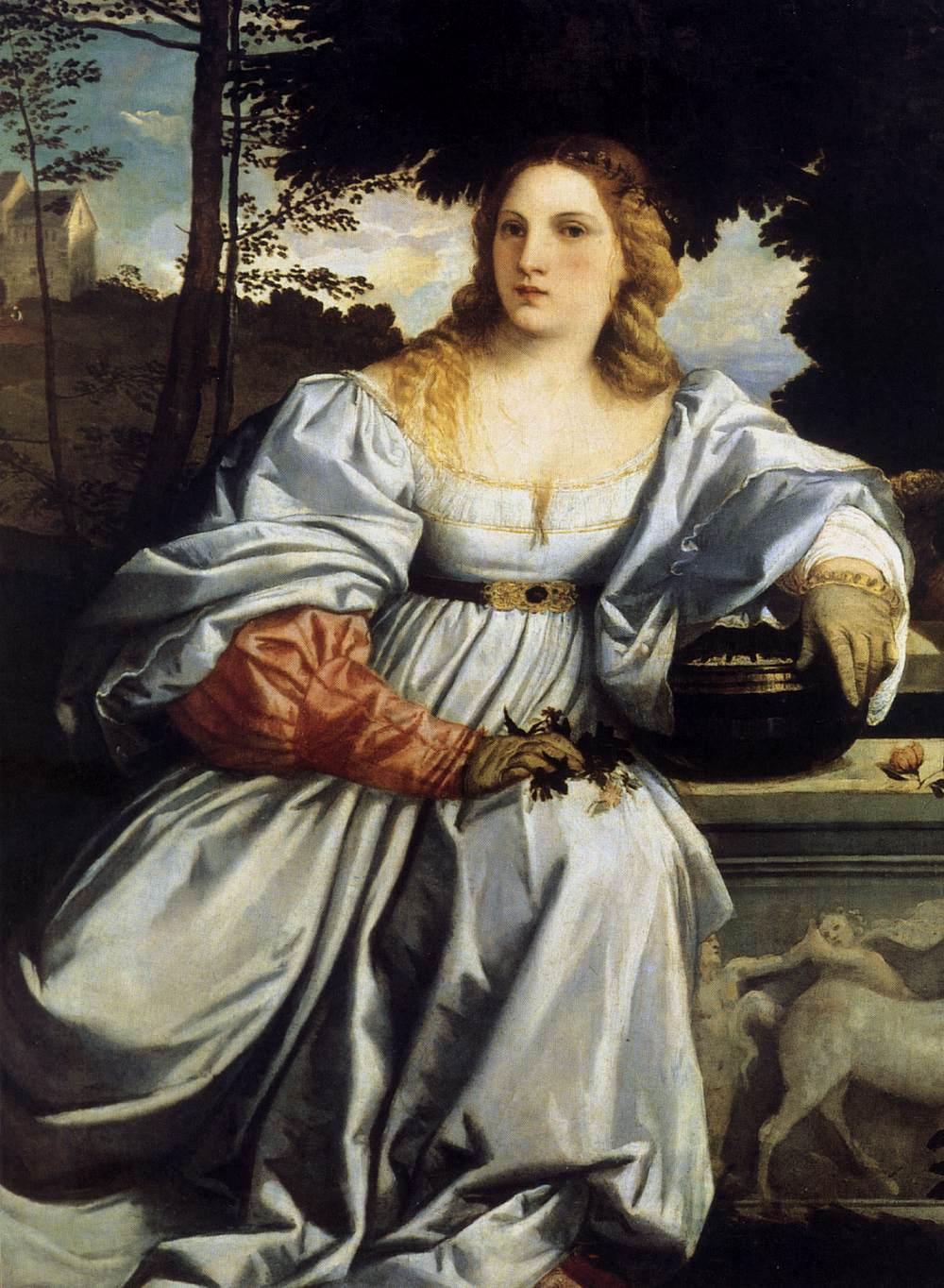
Since 2010 I have been using this site to discuss my interpretations of famous Renaissance paintings including Giorgione's "Tempest" as "The Rest on the Flight into Egypt"; his "Three Ages of Man" as "The Encounter of Jesus with the Rich Young Man"; Titian's, "Sacred and Profane Love" as "The Conversion of Mary Magdalen"; Titian's "Pastoral Concert" as his "Homage to Giorgione", and Michelangelo's"Doni Tondo." The full papers can now be found at academia.edu.

Thursday, April 16, 2020

Titian: Conversion of St. Paul

The meaning of the figures on the antique relief in the center of Titian’s Sacred and Profane Love has eluded scholars for centuries. In this post I would like to discuss the horse so prominently depicted on the left side of the relief. 


In my paper on the Sacred and Profane Love I argued that the subject of the mysterious painting is the “Conversion of Mary Magdalen,” and that the figures on the antique relief must not only refer to the subject of the painting, but also, must be depictions of great sinners. 

In my previous two posts I elaborated on my discussion in the paper and looked at the right side of the relief where we can now identify Adam and Eve as well as Cain and Abel. On the left side of the relief we can see a horse whose rider appears to be falling off. We can also make out two other men in front of and in back of the horse. *


Why has no one ever seen the conversion of St. Paul in this scene? Anytime, we see a riderless horse in a painting from the Renaissance we should suspect that the artist has attempted to depict the famous conversion on the road to Damascus. Here is the account of Paul’s conversion from chapter 9 of the Acts of the Apostles:

And as he went on his journey, it came to pass that he drew near to Damascus, when suddenly a light from heaven shone round about him; and falling to the ground, he heard a voice saying to him, “Saul, Saul, why dost thou persecute me?” And he said, “Who art thou, Lord?” And he said, “I am Jesus, whom thou art persecuting. It is hard for you to kick against the goad.” And he, trembling and amazed, said, “Lord, what wilt thou have me do?” And the Lord said to him, “Arise and go into the city, and it will be told thee what thou must do.” Now the men who journeyed with him stood speechless, hearing indeed the voice, but seeing no one. And Saul arose from the ground, but when his eyes were opened, he could see nothing. And leading him by the hand, they brought him into Damascus.

Although there is no mention of a horse in the scriptural account, it had become part and parcel of the story as early as the fourth century despite the objection of St. Augustine who argued that a Pharisee would never ride a horse. By the Renaissance the horse had become part of the common Catholic imagination and was usually included in artistic representations. 

For our purposes other important parts of the account would be the light from heaven that shone round Paul and forced him to fall to the ground. The voice of Jesus is heard but he does not appear. Also, Paul is accompanied by other men who hear the voice but stand by as speechless spectators.

In Titian's relief Paul is actually falling off the horse's hind quarters. One attendant can be seen in front of the horse, and another tries to prevent Paul's fall at the rear. 

Everyone is familiar with Caravaggio’s famous depiction of the event that still remains in its original location in the Cerasi chapel of S. Maria del Popolo in Rome. Paul lies on the ground, arms upraised toward the light and the horse towers over him.
  
Caravaggio: Conversion of Paul

Other depictions of the event often present a more tumultuous scene but still include the light, the other men, and the horse. These elements must have been commonplace even before the sixteenth century. Here is a famous tapestry made from a Raphael cartoon.

Tapestry from Raphael cartoon

Early in his career Giovanni Bellini also depicted the conversion of Paul.

Giovanni Bellini: Conversion of Paul

I know that Renaissance artists loved to depict horses but when we see a riderless horse in a seemingly inexplicable scene, we should at least consider the possibility of the conversion of Paul.

There is more than one reason why Titian or his patron might have wanted to include St. Paul in a painting representing the conversion of Mary Magdalen. The conversion stories of both saints were equally famous. At the same time, they were both symbols of sinners converted by divine love.

In researching this piece I turned to the always reliable Emile Male. In his magisterial study of later Medieval art Male re-discovered two extremely popular books of the fifteenth century that have subsequently slipped back into oblivion. The first was the Ars moriendi (the Art of dying):** 
The text was often striking, but it is the astonishing woodcuts above all that spread its fame throughout Europe….death appears not as a farcical dance, but as a serious drama played around the bed of the dying man; angel and devil stand at his side, contending for the soul that will soon depart...
The success of the Ars moriendi was even more extraordinary than the success of the Danse Macabre. Printed editions began to appear after the woodcut editions. Each country had its own… It appeared in turn in French, German, English, Italian, and Spanish….Even Italy, where Gothic barbarity was so scorned, was influenced by the crude woodcuts of the Ars moriendi, although it is true it robbed them of most of their original character. 
The other book was a commentary on the Ars moriendi in an edition published by Verard entitled "L’Art de Bien Vivre et de Bien mourir (The Art of Good Living and Good dying)."  Male noted that a "book that edified all Europe is worth some study."

Verard's commentary includes a number of episodes with corresponding woodcuts where devils and angels compete for the soul of the dying man. In one episode Mary Magdalen and St. Paul appear with St. Peter and the Good Thief to console the dying man.
When the devil cannot shake the dying man’s faith, he changes tactics. He no longer denies God, but represents him as inexorable... Hideous monsters again rove around the sick man’s bed. One presents him with a large parchment document: this is the list “of all the evils that the poor creature has committed during his sojourn on earth.”…
The angel again descends from heaven, accompanied by four saints. They are St. Peter, who thrice denied his Master; Mary Magdalene, the sinner; St. Paul, the persecutor whom God struck down to convert him; and the good thief, who repented on the cross. These are the great witnesses of divine mercy….
The woodcut shows Mary Magdalene with her jar of ointment and St. Paul is shown atop the fallen horse. the woodcut is dated 1492. In the same year (1514) that Titian painted the Sacred and Profane Love Raphael painted his depiction of St. Cecilia surrounded by four saints. In front, flanking St. Cecilia, are St. Paul with his sword of truth, and Mary Magdalen with her jar of ointment. 

Raphael: St. Cecilia with St. Paul and  Mary Magdalen
###

*This series of posts first appeared on Giorgione et al... in the Spring of 2013.  The original paper was first published in 2011.

**Emile Male, Religious Art in France, The Late Middle Ages, Princeton, 1986, pp. 348-351.

Friday, April 3, 2020

Adam and Eve on Titian's Relief


In my interpretation of Titian’s “Sacred and Profane Love” I identified the subject of the mysterious painting as the “Conversion of Mary Magdalen.” Seeing the painting as a “sacred subject” opened the way to an explanation of the figures on the equally mysterious relief, a feature that even the greatest scholars have been unable to interpret. Some have even declined to deal with the figures on the relief. 

In my paper I discussed the two figures immediately to the right of center and identified them as Cain and Abel. It was not difficult to show that the image of a man in the act of delivering a blow to another man lying prone on the ground was the common way of depicting Cain’s murder of his brother. Titian himself used the same template years later.

In this post I will turn to the two nude figures to the right of Cain and Abel. How is it possible that scholars and others have never been able to identify the nude man and woman standing around a tree as Adam and Eve? What other woman is ever portrayed in full frontal nudity standing by a tree other than Eve. It is a little more difficult to see Adam but if we look closely we see him there on the other side of the tree.


The image of Adam and Eve standing around the tree at the moment of the Fall was probably ubiquitous during the Middle Ages and the Renaissance. It was sculpted on exterior walls and on the interiors of churches and baptistries. Here is an example from the exterior of the Doge’s palace in Venice. 


A quick search of the web will also reveal Adam and Eve around the tree on some famous paintings. In the Brancacci chapel Masaccio painted the  expulsion from the garden but Masolino, his associate, portrayed the first couple completely nude by the Tree of the Knowledge of Good and Evil right before the Fall.


Later Raphael used the same motif in the Stanze.


Finally, here is a Titian depiction of Adam and Eve around the tree from around 1550. (Prado)


How have scholars not been able to see Adam and Eve on the relief of the “Sacred and Profane Love”?  In his classic study of the art and iconography of the Middle Ages Emile Male noted a similar problem in his own time. He raised the issue in a discussion of carved calendars on famous Medieval cathedrals.
The most beautiful carved calendars are at Chartres, Paris, Amiens, and Reims. They are works of true poetry. In these small scenes, man appears in eternal attitudes. The artist probably intended to represent the peasant of France, but it is also a man of all time, bent toward the earth, the immortal Adam. In their universality, these thirteenth-century reliefs avoid banality. The artists, who themselves did not live far from nature, had experienced this life in all its detail, for just beyond the walls of small medieval towns lay the real country with its tilled fields, its meadows, the beautiful rhythm of its Virgilian labors…when sculptors were imagining scenes of rustic life, they had only to look around them for models….
It is hard to believe that the obvious meaning of these scenes escaped early nineteenth-century archeologists. In 1806, Lenoir interpreted the twelve scenes illustrating the calendar of the cathedral of Cambrai as the twelve labors of Hercules. Dupuis, author of L’Origine de tous les cultes, did identify the signs of the zodiac on the façade of Notre-Dame of Paris, but from this he concluded that the cult of the sun or of Mithra had survived into the thirteenth century. *
Even today scholars and students expend enormous amounts of time and energy trying to find the equivalents of Hercules and Mithra in some of the most beautiful paintings of the High Renaissance. I believe that they are often looking in the wrong place, and often fail to see what would have been obvious to any Venetian artist, patron and even man in the street.

###

* Emile Male: Religious Art in France, the Thirteenth Century, Princeton, 1986, p. 69. Male's great study is available in paperback under the title, The Gothic Image.

Wednesday, March 18, 2020

Titian: Sacred and Profane Love, the Relief


Titian’s so-called Sacred and Profane Love is one of the most important and mysterious paintings of the Renaissance. One of its most mysterious features is the relief on the front of the sarcophagus like fountain. 


Almost ten years ago, in my interpretation of the painting as the “Conversion of Mary Magdalen” I was able to identify the scenes depicted on the relief and fit them into the overall subject of the painting. The explanation of the relief, despite its central position, had defied even the greatest scholars.

Erwin Panofsky included a discussion of The Sacred and Profane Love in his long essay on the Neoplatonic Movement in Florence and North Italy. The essay was published in 1939 along with others in his classic work, “Studies in Iconology”. The essay explored the philosophical work of Marsilio Ficino, and Panofsky used Titian’s painting as an example of Neo-Platonic themes. His essay became the starting point for all future discussions of the painting, and his "Two Venus" interpretation was widely accepted.

However, he did not discuss the relief and just relegated this admission to a footnote. “The reliefs on the sarcophagus invented by Titian in the classical style, have not yet been explained.”*  In the 1962 paperback re-issue Panofsky noted some criticisms of his essay but he still did not attempt to discuss the relief or alter the footnote. He was still not able to fit this piece of the puzzle into the picture.

In 1978 David Rosand accepted Panofsky’s Neo-Platonic "Twin Venus" interpretation and did attempt an explanation of the relief.

a third type is depicted on Titian's invented sarcophagus relief: bestial love-pure lust, which seeks not beauty and its procreation but rather mere satisfaction of sexual appetite-is symbolized by the unbridled force and the accompanying acts of passion and violence.**  

A few years later Rona Goffen, who wrote more on the painting than any one else, was obviously unsatisfied with Rosand's explanation but could only hazard a guess about the relief.
Perhaps Titian’s fictive relief—a pastiche of antique motifs—alludes to that myth (rape of the Sabine women)…***
Finally, in his Titian catalog of 2007 Peter Humfrey could only call the relief “Titian’s own invention" and leave it at that. #


The relief is not an insignificant detail. It is boldly presented right in the center of the painting. Why could these four great scholars with all their skill and ability not be able to see its real meaning? I think it is more than just my imagination that led me to see three great sinners depicted on the relief in a painting whose subject is Mary Magdalen, the greatest of sinners? On the viewer's right is Adam and Eve standing around the Tree. On the left is a man falling from a horse that can only be St. Paul. But just to the right of center there is an act of violence that depicts Cain and Abel.

This striking image depicts a man with his arm raised as if to strike a blow on the man lying prone on the ground. Is this such an unusual image? Is it Titian's own invention or is it a commonplace in depictions of Cain and Abel. the first instance of sin after the Fall?

Titian himself painted Cain and Abel approximately 30 years after the Sacred and Profane Love.

Titian: Cain and Abel
Here is Tintoretto's version of the act of violence.

Tintoretto: Cain and Abel
Rather than inventing this scene it would appear that Titian and Tintoretto were just following the standard universally accepted template for Cain's murder of his brother. In the Ghent Altarpiece Jan van Eyck used the same motif and even painted it as a sculpted relief.

Jan van Eyck: Ghent Altarpiece detail

I believe that any Venetian contemporary of Titian's would have immediately recognized the image of Cain and Abel on the relief in the "Sacred and Profane Love." This detail on the relief is enough by itself to make us consider the possibility that the Sacred and Profane Love is a sacred subject.

###


*Panofsky, Erwin: “The Neoplatonic Movement in Florence and North Italy (Bandinelli and Titian),” in Studies in Iconology, Humanistic Themes in the Art of the Renaissance, Oxford 1939, Reprint 1962, p. 152.

**David Rosand: Titian, New York 1978. p. 80.

***Goffen, Rona: "Titian’s Sacred and Profane Love and Marriage", The Expanding Discourse, Feminism and Art History, ed. Norma Broude and Mary D. Garrard, NY, 1992, p. 121.

#Peter Humfrey, Titian, 2007, p. 47.

Friday, March 6, 2020

Titian: Sacred and Profane Love *


Perhaps the most spectacular work of art in the magnificent collection of Rome’s Borghese Gallery is Titian’s “Sacred and Profane Love,” one of the great masterpieces of the Venetian Renaissance. Early in the last century a collector offered more for this one painting than the appraised value of the entire Museum. Measuring over 9.5 by 3.5 feet, this beautiful painting seems to dominate one of the most beautiful rooms in the entire gallery.


Despite its fame there has never been agreement on the subject of Titian’s painting. The title “Sacred and Profane Love” was only attached to it long after Titian’s death in an attempt to describe the two beautiful fair-haired women in the foreground. One is fully clothed in a sumptuous gown, and the other is semi-nude except for garments that billow around her but only cover her privates.

Commentators have always noted the resemblance between the two women. Some call them sisters, even twins. Most scholars have accepted the view, expressed by famed Art historian Erwin Panofsky about 75 years ago, that the women are versions of a Neoplatonic Venus, one earthly and the other celestial.

More recently, the late Rona Goffen argued that Titian represented one woman in two guises. The woman was an idealized version of a bride, chaste and sexual at the same time. Indeed, the painting appears to commemorate the marriage in 1514 of a young widow, Laura Bagarotto, to a Venetian official, Niccolo Aurelio, whose coat of arms can be seen on the mysterious fountain.

I agree that Titian did depict one woman in two separate guises, but the only person who could be portrayed at the same time as a well- dressed, even sumptuously dressed, woman, and as a semi-nude figure is Mary Magdalen, whose perceived life was the epitome of sexuality and chastity.

During the Renaissance the sinful and fallen women of the gospels were all considered to be Mary Magdalen. Indeed, it was the imputed sinfulness of her life that brought her nearer to her devotees. She was the sinner with the heart of gold who had finally seen the light. In Venice a long established tradition of venerating the penitent Magdalen went hand in hand with the largest concentration of prostitutes in Europe.

Artists often depicted the Magdalen as a richly attired and seductive courtesan contemplating the folly of her life and considering the opportunity that had been opened up to her by the words of Jesus to sin no more. She could, however, also be portrayed as a semi-nude penitent sinner fasting and mortifying herself, according to legend, in a desert. Donatello’s penitent Magdalen; gaunt, haggard, and covered almost entirely by long hair that reaches to her ankles is the most famous fifteenth century version.


Apparently Venetian patrons preferred a beautiful to a gaunt Magdalen. Usually, she would be depicted in the vestiges of her finery but at the same time tearful, sorrowful, and disheveled with breasts fully or partially exposed.

Titian became the most prolific and famous painter of Mary Magdalens. His half-length depictions of a beautiful, full-figured semi-nude show her long red hair around her body but parted to reveal bared breasts. She looks upward with the jar of ointment-- used to anoint Jesus-- beside her.


However, in the “Sacred and Profane Love” Titian separated the Magdalen into both guises. The clothed woman is the courtesan contemplating the error of her ways.  Contemporary preachers often complained that Venetian women in their finery could hardly be distinguished from courtesans. Some scholars believe that the folds of her gown and her spread legs are sensual and erotic but I can’t see it. To me she seems to stare off into the distance rapt in contemplation of a life changing decision. It almost appears that she is about to fall to her knees.


We notice the woman’s beautiful red hair so characteristic of Titian’s later Magdalens. The red color of her sleeve is also a Magdalen attribute as is the sprig of wild rose she holds in her hand. Her left hand rests on a container that could hold her jewels and perfumes. Both hands are gloved. Mary Magdalen was the patroness of all those engaged in producing female luxury items like perfumes and gloves.


On the right the semi-nude woman is the newly converted, penitent Magdalen rejecting her jewels and finery. Legend had it that she spent the last 30 years of her life fasting and mortifying herself in a desert outside of Marseilles. The converted sinner in the “Sacred and Profane Love” has the same flowing red hair as well as the red garment of the courtesan. In her left hand she holds aloft the jar of oil that is the single most recognizable symbol of Mary Magdalen.

Titian joked of his Magdalens that he liked to portray them at the beginning of their fasting rather than as thin, wasted figures. Joking aside, in the “Sacred and Profane Love” Titian could actually be portraying the moment of conversion. 

Both the Magdalens sit on a sarcophagus-like fountain that further serves to connect them. The wild rose bush in front is also a traditional symbol of Mary Magdalen. The fountain is a puzzle in itself and the relief has also eluded identification.


There are three scenes on the relief and we can now see that they depict great sinners. On the far right two nudes stand on each side of a tree. The figure on the left is Eve portrayed in her usual full frontal nudity. Adam is on the other side of the tree. Moving toward the center we see an act of murderous violence that represents the story of Cain and Abel, the first incident of sin after the Fall.

On the other side of the relief a man leads a horse whose rider appears to be falling off. The falling rider can only be St. Paul, one of the few sinners capable of being mentioned in the same breath as Mary Magdalen. In his letter to Timothy, Paul called himself the greatest of sinners.

If there was any woman in Venice who thought of turning to Mary Magdalen as an intercessor, it might have been the wife of the man who commissioned the painting. The arms of Niccolo Aurelio, a Venetian official, can be seen on the fountain. In 1514 he married Laura Bagarotto, a widow from Padua, whose father, as well as her husband, had been accused of treason in 1509 by the Venetian government for collaboration with the enemy during the War of the League of Cambrai. The husband most likely died in the war and the father was publicly hanged in the Piazza di San Marco, an execution that his wife and daughter were forced to witness.

Laura’s goods, including her substantial dowry, were confiscated. Subsequently, she campaigned for the restoration of the family’s good name as well as for the restoration of the dowry. Her marriage to Niccolo Aurelio in 1514 must have been an important step in her rehabilitation since her dowry was only restored the day before the marriage. One would like to think that Niccolo was honoring his new wife, or seeking to aid in her rehabilitation with this painting.

Given the ups and downs of her own life, Laura Bagarotto might have looked to the Magdalen as a patron. On that fateful day in 1509 she lost both her father and her patrimony. If she had not been a woman, she might have lost her own life. Eventually, she would provide the aging Niccolo with a beloved daughter and then a male heir. Who can doubt that she had prayed to the Magdalen, the patron saint of all women hoping for a family? 


###

* Note. I first saw the painting on a visit to the Borghese Gallery in 2010, shortly after presenting a paper on Giorgione"s Tempest at the annual meeting of the Renaissance Society of America held that year in Venice. The full annotated version of my interpretation of Titian's painting can be found on my website, MyGiorgione. This shortened version originally appeared in 2012 on the popular art history website Three Pipe Problem whose creator, Hasan Niyazi, died tragically in 2013. 

Thursday, January 30, 2020

Giorgione: Discovery of Paris


A seventeenth century copy of a “lost” Giorgione painting, mis-identified as the birth or discovery of Paris for almost 500 years, can shed new light on the work and career of the most mysterious and perhaps the greatest of all Venetian Renaissance painters. *

David Teniers: Copy of a lost Giorgione


In 1525, fifteen years after the death of Giorgione, Marcantonio Michiel, a Venetian patrician and art collector, noticed a painting in the home of another patrician, Taddeo Contarini, and described it as a “picture on canvas, representing the birth of Paris, in a landscape, with two shepherds standing." Michiel noted that it was one of Giorgione’s “early works.”

This painting has been lost, but copies exist from the seventeenth century. The editor of the 1903 translation of Michiel’s notes cited a description in an “old manuscript catalog of the time.” 

A landscape on canvas, in oil, where there are on one side, a half nude woman and an old man, seated, with a flute. (1)

One of the copies, made by David Teniers around 1655, is currently in a private collection but has been discussed in recent catalogues. (2) The authors of these catalogues agree that it is a copy of an early Giorgione and also accept, although with some puzzlement, Michiel’s identification of the painting as “the birth of Paris.” However, details in this early Giorgione indicate that it has quite a different subject than the one imagined by Michiel. 

The subject of this “lost” Giorgione comes from a legendary episode on the flight of the Holy Family into Egypt. Here is the version from the apocryphal “Arabic Gospel of the Infancy.” 

Joseph and the lady Mary departed and came to a desert place, and when they heard that it was infested with raids by robbers, they decided to pass through this region by night. But behold, on the way they saw two robbers lying on the road, and with them a crowd of robbers who belonged to them, likewise sleeping. Now these two robbers, into whose hands they had fallen, were Titus and Dumachus. And Titus said to Dumachus: ‘I ask you to let these (people) go free, and in such a way that our companions do not observe them.’ But Dumachus refused and Titus said again: ‘Take from me forty drachmae and have them as a pledge.’ At the same time he reached him the girdle which he wore round him, that he might hold his tongue and not speak. (3)

       In Legends of the Madonna, nineteenth art maven Anna Jameson called the encounter with the robbers an “ancient tradition,” and added another detail. After the acceptance of his offer, “the merciful robber led the Holy Travellers to his stronghold on the rock, and gave them lodging for the night.” (4)

The landscape in the background of the painting is commonplace in depictions of the Flight into Egypt. The stream is often seen in versions of the “Rest.” It was used by the Madonna to either bathe, or to wash the swaddling clothes of her Son.

Bathing might explain Mary’s exposed leg and arms but the disarray of her clothing could also be Giorgione’s way of representing her obvious danger from the robbers. In a painting now in the Hermitage, Giorgione exposed the thigh of Judith, the famous Jewish heroine whose virtue was also threatened. (5) In any case Mary sits with her back to Joseph with her eyes intent on her Son, her real protector. Joseph is portrayed as an elderly graybeard as in Giorgione’s well-known Nativities. The infant Christ lies on a white cloth and returns his mother’s imploring look. The white cloth recalls the corporale, used to cover the altar on which the Eucharist is placed. (6)

The two men on the right side are not shepherds but robbers. A Giorgione shepherd would be kneeling or bending over the Child in adoration. The one with the red jacket has just convinced the other to leave the Holy Family in peace. He has taken off his “girdle” leaving himself somewhat exposed and given it to the other who is in the process of fixing it around his waist. The band of robbers can be seen lounging in the middle ground. Joseph’s flute recalls the well-know verse from Juvenal: “A wanderer who has nothing can sing in a robber’s face.” (7)

In “The Encounter with the Robbers in the Desert” Giorgione did not attempt to hide the subject of that early work. If no one has recognized its subject from Michiel’s time to ours, it is because the very popular apocryphal legends have largely been forgotten. In his massive 2009 study of Giorgione, Enrico Maria dal Pozzolo attached great importance to the lost Giorgione painting. Dal Pozzolo accepted the traditional identification of the painting as the discovery of the infant Paris on Mt. Ida, and paired it with another lost Giorgione, the meeting of Aeneas and his father, Anchises, after the fall of Troy.

as we previously stated, the Birth of Paris and the probable flight of Aeneas and Anchises from Troy constitute the beginning and the end of the Trojan saga. These specific subjects had seemingly never been represented in Venetian painting before Giorgione; but they were afterwards, and also in paintings by artists (both anonymous and identifiable) who were bound with the master of Castelfranco’s activity…. (8)

 I agree that the painting is important but it does appear that early in his career Giorgione was working not on a pagan subject derived from the legend of Paris but on a depiction of an apocryphal legend based on the Flight into Egypt. Moreover, he showed an inclination, even at this early stage in his brief career, to depict the Madonna in a very unusual way.

             Marcantonio Michiel may not have been the first to describe this painting. In 1510, the year of Giorgione’s death, Isabella D’Este, the Marchioness of Mantua and a noted collector, was trying to acquire a work by Giorgione for her camerino. When she was informed by Taddeo Albano, her agent in Venice, that Giorgione had just died, she urged him to try to acquire a “Notte” from his estate: (9)

we hear that among the possessions left by Zorzo da Castelfranco, the painter, there is a picture of a Notte, very beautiful and original. If this is the case, we wish to have it, and beg your Lorenzo da Pavia or any other person of taste and judgment to go and see if it is a really excellent thing. If it is, I hope you will endeavor to secure this picture for me, with the help of our dearest compare the Magnifico Carlo Valerio, or of any one else you may think fit. Find out the price and let us have the exact sum; but if it is really a fine thing, and you think well to clench the bargain for fear others should carry it off, do what you think best…”

Albano replied,
                                                                                 
I have spoken in your interests to some of my friends who were very intimate with him, and they assure me that there is no such picture among his possessions. It is true that the said Zorzo painted a Notte for M. Taddeo Contarini, which, according to the information which I have, is not as perfect as you would desire. Another picture of the Notte was painted by Zorzo for a certain Vittore Beccaro, which, from what I hear, is finer in design and better finished than that of Contarini. But Beccaro is not at present in Venice, and from what I hear neither picture is for sale, because the owners have had them painted for their own pleasure, so that I regret I am unable to satisfy Your Excellency’s wish.

According to Michiel’s notes the only painting in the home of Taddeo Contarini that could be a “notte” would be the “discovery of Paris,” or as we have called it, “The Encounter with the Robbers on the Flight into Egypt.” Scholars have never agreed about what Isabella D’Este could have meant by “Notte.” Some think she was referring to a Nativity but Isabella knew a Nativity when she saw one, or when she agreed to accept one from Giovanni Bellini. No, the “Encounter with the Robbers,” indicates that a “Notte” was an evening scene where the sun was setting over a landscape at the end of day.

What about the other “notte”? It is certainly possible that the one done for Vittore Beccaro, the one finer in design and better finished; the one described by Isabella as “very beautiful and original” could have been the Tempest. In the “Encounter with the Robbers” Giorgione was “stretching the envelope” with a presentation of a disheveled and partially nude Madonna. Later he would go even further in the Tempest. But that is another story. 

###

*This post is the second in a series of articles that I hope to reproduce in 2020, the tenth anniversary of Giorgione et al... These essays will feature the interpretive discoveries that followed upon my interpretation of Giorgione's Tempest as a "sacred" subject, The Rest of the Holy Family on the Flight into Egypt.


Notes:

1. The Anonimo, Notes on Pictures and Works of Art in Italy made by an Anonymous Writer in the Sixteenth Century, ed. George C. Williamson, London, 1903. p. 104

2. Jaynie Anderson, Giorgione, 1997, p. 317; and Wolfgang Eller, Giorgione Catalog Raisonne, Petersburg, 2007, pp. 171-173.

3. Extract from the Arabic Infancy Gospel in Edgar Hennecke, New Testament Apocrypha, edited by Wilhelm Schneemelcher, English translation edited by R. McL. Wilson, Volume One, Philadelphia 1963. p. 408. On the web a search for the First Gospel of the Infancy of Jesus, Chapter. VIII, will give the story with slightly different wording.

4. Jameson, Legends of the Madonna, Boston, 1885. pp. 361-362. Mrs. Jameson noted that the encounter with the robbers has been “seldom treated” as an artistic subject but did indicate that she had seen two representations. “One is a fresco by Giovanni di San Giovanni, which, having been cut from the wall of some suppressed convent, is now in the academy at Florence. The other is a composition by Zuccaro.” In a later edition she provided a sketch of the Zuccaro “Encounter,” which shows Joseph assisting the Madonna down from the Ass at the behest of the armed robber.

5. In Judith’s famous prayer she recalled her ancestor Simeon who took vengeance on the foreigners “who had undone a virgin’s girdle to her shame, laid bare her thigh to her confusion…” Judith 9:2, Jerusalem Bible.

6. For the corporale see the discussion of Titian’s Pesaro Altarpiece in Rona Goffen, Piety and Patronage in Renaissance Venice, Yale, 1986, p. 114.

7. Juvenal, Satires, X, 22. I thank Dr. Karin Zeleny of the Kunsthistorisches Museum in Vienna for the Juvenal reference.

8. Enrico Maria Dal Pozzolo, Giorgione, 2009, p. 264,

9. The correspondence is in Julia Cartwright, Isabella d’Este, Marchioness of Mantua,1474-1539. London, 1932. Pp. 390-391.