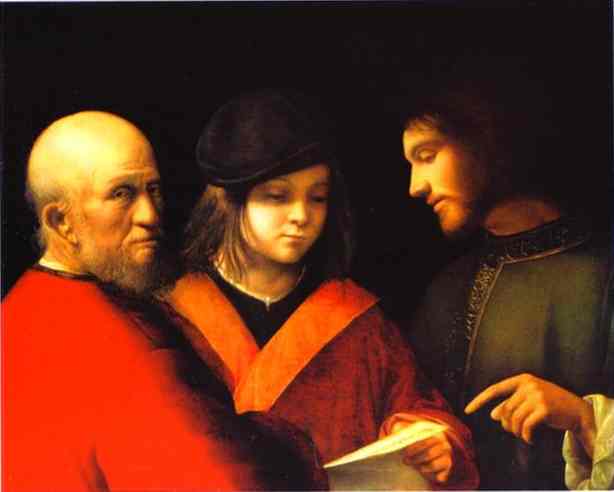
Since 2010 I have been using this site to discuss my interpretations of famous Renaissance paintings including Giorgione's "Tempest" as "The Rest on the Flight into Egypt"; his "Three Ages of Man" as "The Encounter of Jesus with the Rich Young Man"; Titian's, "Sacred and Profane Love" as "The Conversion of Mary Magdalen"; Titian's "Pastoral Concert" as his "Homage to Giorgione", and Michelangelo's"Doni Tondo." The full papers can now be found at academia.edu.

Wednesday, October 9, 2013

Renaissance Art Mysteries: Young St. Joseph


My original intuition that Giorgione’s “Tempest” was actually a depiction of the “Rest on the Flight into Egypt” naturally led me to see the young man in the painting as St. Joseph standing guard over the Madonna and Child. But how could that be? Since Joseph was usually portrayed as a sleepy old man, I had to find evidence to corroborate Giorgione’s departure from tradition.


A little investigation found a contemporary theological basis for a young, powerful Joseph who could be regarded as an able protector of his family and also as a protector of the Church. I also found that this young virile Joseph had also been depicted by some of Giorgione’s artist contemporaries, most notably by Raphael in the “Sposalizio”. 

However, the failure to see a young Joseph has led scholars to misunderstand or even mis-identify some paintings that all feature a young, virile St. Joseph. In earlier posts I have discussed these paintings and would just like to summarize them here.  


Paris Bordone: Mystic Marriage of St. Catherine
(private collection)

First, Paris Bordone painted at least two versions of the “Mystic Marriage of Catherine of Alexandria” that depicted a powerful St. Joseph prominently displaying a muscular bare leg. The first is in a private collection but was featured in the great 2006 “Bellini, Giorgione, Titian” exhibition that was jointly sponsored by Washington’s National Gallery and Vienna’s Kunsthistorisches Museum.* The second is in the Hermitage.

Paris Bordone: Mystic Marriage, Hermitage

There is no doubt concerning the subject of these paintings but so far no one has been able to explain the mystery of the muscular bare leg. I have argued that Bordone employed that device to indicate a contemporary practice used to “consummate” a marriage by proxy. In both of these paintings a young vigorous Joseph plays a very prominent role.


Second, I have argued that the young man in a depiction of the “Mystic Marriage of St. Catherine” by Lorenzo Lotto is also St. Joseph. Modern scholars have seen the man as St. Mark or St. Thomas but there is no good reason for either of them to be present at that legendary event. But again, St. Joseph acts as a proxy and Catherine directs her gaze to him. It is the spear point at the end of Joseph’s traditional staff that has confused scholars. That is strange but the next two paintings might shed some light on this martial aspect.


In his influential 1969 study of Giorgione’s “Tempest” Edgar Wind noted the similarity of two contemporary Venetian paintings to Giorgione’s “Tempest.” ** The first (shown above) he called Fortezza and Carita and attributed it to a follower of Giorgione. It is now on loan to Harvard’s Fogg Art Museum. Like the “Tempest” it depicts three figures in a landscape: a standing soldier off to the side holding a halberd, and a plainly dressed woman seated on the ground with her infant son. Despite the weapon and the youthful soldier, I have interpreted this painting as a version of “The Rest on the Flight into Egypt.”

"Allegory", Philadelphia Museum

The second painting Wind called “The Peaceable Warrior (ex bello pax) and attributed it to Palma Vecchio. It is now in the possession of the Philadelphia Museum which will only label it “Allegory”. Like the first, it depicts a soldier with a halberd standing guard over a seated woman, but this time there are two young children embracing. It is hard for me to believe that Wind and other scholars could have seen the two children and not at least considered the possibility that they are Jesus and the young Baptist embracing in the desert on the return of the Holy Family from Egypt, a scene depicted over and over again during the Renaissance.

It is true that in both these paintings Joseph has taken on the trappings of a warrior capable of defending his family. Actually both these paintings fit the description, "a soldier and a gypsy," that Marcantonio Michiel gave to the “Tempest” when he saw it in the home of Gabriele Vendramin.  However, something has happened in a short space of time to turn the traditional staff in the hands of Giorgione’s man into the weapons depicted in these other paintings. It would seem more fruitful to try to understand the reasons for this change in the depiction of St. Joseph than to just pass these paintings off as allegories.

In this and the previous two posts I have now listed 10 paintings in addition to the "Tempest" that have now been re-interpreted either completely or partially as a result of seeing Giorgione's most famous painting as a "sacred" subject. Others will be listed in future posts. This should serve as a lesson to all students struggling in the field of Art History. There is much more to be discovered in the world of Renaissance art.

###

* See the exhibition catalog. Brown, David Alan, and Ferino-Pagden, Sylvia, Bellini, Giorgione, Titian, and the Renaissance of Venetian Painting, Washington, 2006.

** Wind, Edgar: Giorgione’s Tempesta, Oxford, 1969.

Thursday, September 26, 2013

Renaissance Art Mysteries: Mary and Judith


In my last post I listed my four major interpretive discoveries concerning some of the most famous and mysterious works of the Venetian Renaissance. Although I believe that the name of Giorgione’s “Tempest” should never be changed, it does depict “The Rest on the Flight into Egypt”. Also, his “Three Ages of Man” in the Pitti Palace represents the “Encounter of Jesus with the Rich Young Man”. Titian’s “Sacred and Profane Love” should now be seen as “The Conversion of Mary Magdalen”, and his “Pastoral Concert” could best be understood as Titian’s “Homage to the Deceased Giorgione” utilizing the biblical story of David and Jonathan.

My work on these interpretations has led to a number of other significant discoveries concerning heretofore mysterious or mis-understood paintings. In this post I will list two that have already been discussed on this blog as well as on my site, MyGiorgione.


The first is a painting that is usually called “The Discovery of Paris.” In 1525 Marcantonio Michiel saw this painting in the home of Taddeo Contarini and described it as follows.
The picture on canvas, representing the birth of Paris, in a landscape, with two shepherds standing, was painted by Giorgio di Castelfranco, and is one of his early works. [104]
The editor of Michiel’s notes pointed out that only a fragment of this early Giorgione painting survives but that there does exist a seventeenth century copy by David Teniers. The editor referred to a description in an old manuscript  catalogue.
 A landscape on canvas, in oil, where there are on the one side two shepherds standing; on the ground a child in swaddling-clothes, and on the other side, a half nude woman and an old man, seated, with a flute.
This early Giorgione is a very important painting since Michiel’s description has been almost universally accepted and some eminent scholars have even based elaborate interpretations of the "Tempest" on Giorgione’s apparent awareness and fondness for the legend of Paris. However, Michiel guessed wrong and I believe that Giorgione has actually represented “The Encounter with Robbers on the Fight into Egypt”, a popular apocryphal legend.

In my interpretation the painting takes on new importance since it reinforces my interpretation of the Woman in the “Tempest.” In this painting Giorgione has dared to depict a Madonna with bare leg in danger of sexual assault. A full discussion of this lost Giorgione can be found in my “Tempest” paper or on its own at MyGiorgione.


There is no disagreement about the subject of Giorgione’s “Judith” that now hangs in the Hermitage. The mystery of that painting revolves around the bare leg of the Jewish heroine. Its prominence is striking and to some shocking. No good explanation has so far been offered. However, I believe that I have found the reason for the bare leg in the Book of Judith itself. Just as in “The Encounter with the Robbers” Giorgione uses a bare leg to indicate a woman in danger of sexual assault. In each case they are spared by their trust in God. The essay with biblical text can also be found at MyGiorgione.

###

Wednesday, September 11, 2013

Renaissance Art Mysteries


This September marks the third anniversary of Giorgione et al… Previously, I had created a website for my work on Giorgione's Tempest but was advised that blogspot would reach a wider audience. Seeing the Tempest as a sacred subject, "The Rest on the Flight into Egypt", provided the key that opened the door to a number of other new interpretations of equally famous and mysterious paintings of the Venetian Renaissance. Below are brief summaries of the four major interpretive discoveries. In a subsequent post I will list a number of secondary but significant discoveries that have arisen from my work on Giorgione and Titian.

Discussions of these interpretations can be found throughout Giorgione et al... by clicking on the labels or using the search box. The full papers have been published at MyGiorgione.

Incredibly, I am not a professional art historian. Although I hold a doctorate in History my field of study was eighteenth century British politics, and I left academe in 1972. Until my retirement in 2007 I was a financial advisor. Only in the last few years did travel and some other factors lead me to Venice.


Giorgione: The Tempest. In the fall of 2005 I interpreted the subject of the Tempest as “The Rest on the Flight into Egypt.” In this interpretation all the major elements in the painting are identified. The nude woman nursing an infant is the Madonna. The man standing at the left functioning as an “interlocutor” is St. Joseph with his staff. The broken columns are commonplace in depictions of the “Rest on the Flight into Egypt.” The city in the background is Judea from where the Holy Family has fled but could also be equated with Padua during the Cambrai war. The scraggly plant in the foreground is identified as a “belladonna” a plant associated with witchcraft and the Devil. Even the bird on the distant rooftop is shown to be derived from a famous Psalm. A short essay was published in the Masterpiece column of the Wall St. Journal In may, 2006. In 2010 I presented a paper on the “Tempest” at the annual meeting of the Renaissance Society of America held that year in Venice.


Titian: Sacred and Profane Love. In 2010 after a visit to Rome’s Borghese Gallery, I realized that the subject of Titian’s Sacred and Profane Love was the Conversion of Mary Magdalen. In this interpretation all the elements in Titian’s famous painting are identified. The finely dressed Woman is Mary Magdalen in the guise of a Venetian courtesan. The nude Woman is the converted Magdalen in the process of throwing off her worldly finery. In her hand she holds the jar of ointment that is found in practically every depiction of the great sinner/saint. The antique relief on the sarcophagus-like fountain, which so far has eluded explanation, can now be seen to depict three great sinners: Adam and Eve, Cain and Abel, and St. Paul falling from his horse. In 2012 I presented my interpretation of the Sacred and Profane Love at the annual meeting of the South Central Renaissance conference in New Orleans.


Giorgione: Three Ages of Man. After seeing the Tempest as a “sacred subject” I was able to take a fresh look at some of his other mysterious paintings. For example, I discovered the subject of the Three Ages of Man to be the Encounter of Jesus with the Rich Young Man derived from an episode in the Gospel of Matthew. So far there has been no scholarly agreement on the subject of this famous depiction of three half-length figures that now hangs in the Pitti Palace in Florence.  The young man in the center, whose clothing indicates his wealth, has just asked how he can achieve eternal life. On the right, Jesus dressed in a green vestment points to the commandments that he has directed the man to follow. On the left, an aging, bald Peter, dressed in martyr’s red, invites the viewer to enter the scene.


Titian: Pastoral Concert. Earlier this year I argued that this famous and mysterious painting whose attribution has been variously given to Giorgione and Titian should be considered as Titian's Homage to Giorgione. There are signs in the painting that the finely dressed lute player is not only Giorgione, but also that he has recently died. His face is in shadow; the lute has no strings; and the female muse at the left is pouring out his soul into the well. I believe that all the Giorgionesque elements in the painting were  put there by Titian in homage to his mentor. The shepherd and flock in the background indicate that Titian, the young rustic on the right, portrayed himself as David grieving over the loss of Jonathan. Both the female nudes are the muse, Euterpe.

Needless to say, these interpretations have not met with acclaim in the scholarly community. It is my hope that young scholars and students (with better tools and more energy than I possess) will be open to see with their own eyes and explore the possibility that Venetians living during the Renaissance were primarily interested in beautiful renditions of traditional sacred subjects.

###


Saturday, August 31, 2013

Stokstad on Giorgione's Tempest


Marilyn Stokstad’s “Art History”* is apparently one of the most popular art history textbooks in America. It has gone through at least five editions and has  made enough money for the now retired professor from the University of Kansas to enable her to make substantial financial grants to the great Midwestern university.

In many ways it is an admirable piece of work. It is no easy task to put together a volume that starts with pre-historic cave paintings and goes through the whole spectrum of world art right up to modern graffiti. My 1999 edition is so large that I can’t imagine how a student could have even carried it to class.

I must confess that I don’t like such textbooks and only looked into Stokstad to see what she had to say about Giorgione and the Venetian Renaissance. I could see that the images were beautiful and well placed and that there were some interesting sidebars on techniques etc. However, I was most interested in her approach to Giorgione. Fortunately, she chose to highlight the Tempest, his most famous painting.


A large reproduction of the painting was featured in chapter 18. The caption dated it c. 1510 and read as follows:

Recently scholars have made many attempts to explain this enigmatic picture—a number of which are so well reasoned that any of them might be a solution to the mystery. However, the subject of this painting…seems not to have particularly intrigued sixteenth century observers, one of whom described the painting matter-of-factly in 1530 as a small landscape in a storm with a gypsy woman and a soldier. [p.707]

This description of the interpretive history started ok but the conclusion was definitely unwarranted. How is it possible to say that the subject was not of interest to contemporary observers based on only one brief note by a person (Marcantonio Michiel) on a visit to the home of the painting’s owner, Gabriele Vendramin? The painting was in a private home and remained in private hands for over 400 years. We do know that Vendramin and other Venetian patricians prized their collections. Moreover, practically every other painting in the Vendramin collection had a clearly defined sacred subject.

Stokstad then went on to augment the caption with almost 200 words of text. Admirably, her words mainly concentrated on what can actually be seen in the painting. Again she started very well:

Simply trying to understand what is happening in the picture piques our interest. At the right, a woman is seated on the ground, nude except for a long white cloth thrown over her shoulder. Her nudity seems maternal rather than erotic as she turns to nurse the baby at her side.
This description is really good. Even specialists often fail to note the white cloth draped over the nude woman’s shoulder. She also clearly sees the maternal rather than erotic nature of the woman. However, she then refuses to trust her eyes when describing the man on the left.

Across the dark, rock-edged spring stands a man wearing the costume of a German mercenary soldier. His head is turned toward the woman but he appears to have paused for a moment before continuing to turn toward the viewer.

How can one by merely looking at the painting identify the “costume of a German mercenary soldier”? Here she is letting her knowledge of the interpretive history cloud her vision. The man is neither armed nor armored. Moreover, is there anything particularly German about his costume? She does see that his head is turned toward the woman, an improvement over those scholars who see no connection between the two, but she can only guess that the man is about to turn toward the viewer.

She then goes on to describe the landscape.

The spring between them feeds a lake surrounded by substantial houses, and in the far distance a bolt of lightning splits the darkening sky. Indeed the artist’s attention seems focused on the landscape and the unruly elements of nature rather than on the figures.

I fail to see how she could describe the body of water as a lake and not a river. How many lakes have bridges over them? I would also argue with her on the artist’s attention to the landscape rather than the foreground figures. It is true that most scholars see the Tempest as a pioneering work of landscape but the figures in the foreground are large and beautifully painted, and the woman is bathed in bright sunlight as if Giorgione had put a spotlight on her. I think it would be a good exercise for any college instructor to ask their students where their attention is directed on first looking at the masterpiece.

Finally, she ends with a discussion of a pentimento or change of mind.

X-rays of the painting show that Giorgione altered his composition while he was still at work on it—the woman on the right was originally balanced by another woman on the left—which seems to rule out a specific story as its subject matter.

At this point she is no longer looking at the finished product that the artist wanted his patron to see. I doubt if during her long distinguished career as a professor, Dr. Stokstad ever let anyone see the first draft of a paper that she planned to give at a conference. I don’t question the scientific study of underpainting but do believe that scholars and students should be very careful when drawing conclusions from things the artist has painted over.

###

*Marilyn Stokstad: Art History, revised ed. 1999.


Monday, August 19, 2013

Giorgione's Laura, Titian's Flora, and Mary Magdalen


The following article is a compilation and updating of previous posts on Giorgione's "Laura", Titian's "Flora" and other mysterious beautiful women of the Venetian Renaissance who could all be Mary Magdalen.


Giorgione’s “Laura” had defied interpreters for over 500 years. It is a relatively small half-length painting (41 x 33.6 cm) of a pensive young woman who looks off to the right at the source of light that illuminates her face and partially bare chest. She seems to wear only an oversized fur-lined garment that is opened to reveal one bare breast. The painting now hangs in Vienna’s Kunsthistorisches Museum.

The catalog of the 2004 Giorgione exhibition, jointly sponsored by the Kunsthistorisches Museum and the Accademia in Venice, called it a “Portrait of a Young Woman,” and only placed the popular title “Laura” in parenthesis. Sylvia Ferino-Pagden, and Giovanna Nepi-Scire, two of the world’s leading Giorgione scholars, and curators of their respective museums, edited the entire catalog and also combined on the “Laura” catalog entry. They did an excellent job of tracing the provenance of the painting and firmly supporting the attribution to Giorgione. They also did a thorough evaluation of the unique inscription on the back of the painting: “on June 1 1506 this was made by the hand of master Giorgio from Castelfranco, the colleague of master Vincenzo Catena, at the instigation [instanzia] of misser Giacomo.” [i] The inscription was only deciphered in the nineteenth century but the two scholars believed that there was good evidence to support its authenticity.

Today, most scholars agree that the seventeenth century identification of the young woman as Petrarch’s lover, Laura, is not tenable. Moreover, the painting cannot even be considered a portrait since no respectable woman of the time would have sat for such a depiction. Some have argued that it could be a depiction of a Venetian courtesan. The catalog pointed out the finding of one scholar that the sumptuous fur-lined robe was “the winter dress of a Venetian woman of pleasure.” On the other hand, there are signs such as the thin white veil and the laurel that traditionally refer to conjugal virtue. Here is the catalog’s summation.

 as noted by Goffen (1997), the thin white veil that partly covers her hair and falls over her breast is a typical accessory of married women…. The paradox that accompanies the interpretation of this painting lies in the fact that laurel is also a symbol of conjugal virtue…Giorgione’s Laura—regardless of whether she is a learned courtesan or a virtuous wife—is characterized by the extraordinary charge of sensuality and eroticism that makes this image unique in the painting of the early 16th century.

The “Laura” might not be as unique as the authors of the catalog entry suggest.  Other contemporary paintings also exhibit a mixture of eroticism and conjugal virtue and they have also defied interpreters. However, I believe that the “Laura” and these other paintings might all have a “sacred” subject, and that subject is Mary Magdalen. 

I don’t know if I am the first to suggest Mary Magdalen as the subject of the “Laura” but recent catalogs do not even consider the possibility. All do point out the paradoxical iconographic symbols: the appearance of a Venetian courtesan combined with symbols of chastity and conjugal love such as the laurel leaves and headscarf.

Mary Magdalen is the only person who fits such a description. After the Madonna she was the most famous female saint of the Middle Ages. During the Renaissance she was regarded as a prostitute who after her encounter with Jesus became a true and virtuous bride of Christ. After her conversion she is often portrayed with breasts bared as a sign that she has thrown away her worldly finery and chosen the life of a desert contemplative. Correggio's later version of the saint bears a striking similarity to Giorgione's "Laura." Her breasts are bared but the rest of her is covered with a sumptuous blue robe, She is easily recognized by her jar of precious oil, a stock symbol that Giorgione characteristically omitted.


Correggio: Mary Magdalen


In 2001 Paul Joannides discussed another painting of a young woman that he claimed bore a similarity to the "Laura." He noted that it had often been attributed to Giorgione but insisted that "the closest comparisons are with Titian's work and there can be no serious doubt that it is his…."[ii]  He continued:

The Bust of a Young Woman is often thought to be a portrait of a courtesan,…There is an obvious link of mood and gesture with Giorgione’s Laura,…it is probably a fragment of a narrative composition….But the action is ambiguous: is she opening her dress to reveal her breast, like Laura, or closing it in modesty? Given the high finish and luxurious color, this fragment is more likely to have formed part of a painting for a private house than a public place…
Perhaps more likely is that she is a Magdalene in a Mary and Martha, the subject represented in Milan in the work of Bernardino Luini and his circle and one that would certainly have appealed to Titian, allowing him to contrast female types. But without further evidence no suggestion can be more than speculative.


Joannides failed to mention that the multi-colored striped shawl that covers the shoulder of the woman in the “Bust of a Young Woman” is the same one that Titian used years later in one of his many obvious depictions of Mary Magdalen.


Titian became the most prolific and famous painter of Mary Magdalens, and his many versions of a beautiful, semi-nude, weeping penitent Magdalen spread all over Europe. He did not depict the gaunt Magdalen of Donatello, emaciated after years of fasting in the desert, but a still beautiful woman who has only recently thrown off her courtesan's finery, and appears covered only by her gorgeous red hair.

It is also possible that before he settled on these full figured bare breasted Magdalens, the young Titian also painted a more discrete but equally beautiful Mary Magdalen in the mysterious painting that is now called “Flora.” This famous painting that now hangs in the Uffizi gallery is dated to around 1517, only a decade after the “Laura.” It also features a beautiful young woman in an obvious state of undress who looks pensively off to the right at the source of the light that illuminates her face and torso.


No one has ever been able to make more than a guess about the subject of the “Flora”. It was only in the mid-seventeenth century that a commentator attached the name of the Roman goddess of flowers to the beautiful woman in the painting. Although the name has stuck, modern scholars have brought forth objections and offered their own hesitant interpretations.

 In 1980 Charles Hope introduced the painting in his catalog by noting that Titian “painted virtually no mythological pictures based in this way on ekphrastic texts, and none at all of comparable scale or importance.” He added that while Venetian patrons might have been interested in erotic subjects, “they were relatively indifferent to classical precedent.”[iii]

Hope looked in another direction for the meaning of the “Flora.”

But there was also a distinctive and more pervasive local tradition of pictures in portrait format of anonymous pretty girls, either clothed or partially nude, which were no more than elaborate pin-ups…. The identity of the girl as Flora is established both by the flowers in her hand and by her costume, which is of the type worn by nymphs in contemporary stage productions…

Although he remarked that the subject was treated with “extreme sensitivity and discretion,” the painting was still a pin-up whose erotic implications are “central to its meaning.”

In a 2003 catalog of an exhibition at London’s National Gallery, David Jaffe saw the connection between Flora and Laura.

Flora is perhaps the supreme example of a genre developed in early sixteenth-century Venice showing ‘belle donne’, beautiful women, for the sake simply of their beauty. They were neither portraits—as such they would have seemed improper—nor did they usually have allegorical significance or mythological references….Titian did not invent the type, but developed the tradition represented by works such as Giorgione’s ‘Laura’….
The painting is a magnificent evocation of sensuality. The tumbling locks of hair, sometimes minutely described, trail down across her cheek and shoulder to her undergarment, which laps her breast and shoulder in undulating waves…before ebbing into the barely supported rose cloth which she gathers, or is perhaps discarding…
The image may be read as a generalized ‘Venus’ type. The flowers, perhaps roses, suggest identification with Flora.[iv]

In the catalog of the 2006 Bellini, Giorgione, Titian exhibition jointly sponsored by Washington’s National Gallery and Vienna’s Kunsthistorisches Museum, Sylvia Ferino Pagden considered the Flora “the finest and most successful of all sensuous half-length female figures in sixteenth-century Venetian painting….” She noted its “Venus-like sensuousness” but pointed out the ambiguity of the subject.

If it was Titian’s intention here to depict Flora, was he thinking of Ovid’s goddesses or Boccaccio’s courtesan? Or is his portrait an artistic blending of the two?...yet his Flora has more the demeanor of a goddess….her lack of attention to the viewer makes him aware of his own insignificance….
Titian’s re-creation of the classical goddess, however, lacks any reference to antiquity, even in the drapery….Flora’s chemise—usually seen merely peeking out from under a gown at the neck and sleeves but here serving as her main article of clothing overlaid by a cloth of brocade or damask—does not correspond to that of any classical figure and certainly not a Venetian bride…[v]

It should be noted that Titian’s “Flora” bears little resemblance to the goddess of flowers. There are no flowers tumbling from her hair and her dress was depicted by Ovid as adorned with many colors. Ferino-Pagden did identify the flowers in the hands of Flora as rose, jasmine, and violet and claimed that they provide “a key to interpreting her.” However, she provided no further explanation.

In her study, “Nature and Its Symbols,” Lucia Impelluso noted that “the jasmine has often been considered a flower of Heaven or a symbol of divine love.” While usually associated with the innocence and purity of the Virgin Mary, it can often be seen “woven into garlands adorning the heads of angels and saints.” Moreover, “if associated with roses, it can connote faith.”[vi] The wild rose is traditionally associated with Mary Magdalen. As far as the violet is concerned, Impelluso noted:

In the popular imagination, the little, strong-scented violet is a symbol of modesty and humility, and it was interpreted likewise by the Fathers of the Church as well.

I realize that the jasmine, rose, and violet that “Flora” holds in her hand could refer to some one else, but one should certainly at least suspect Mary Magdalen.

Giorgione’s “Laura,” Titian’s early “courtesan,” and the “Flora” could all be considered versions of Mary Magdalen. One significant objection, however, is the absence in each instance of the jar of ointment that is always associated with the Magdalen. Later, Titian displayed it prominently in his more obvious Magdalens.
  
Perhaps in this brief moment in time Venetian artists had come to believe that they could depict the essence of the Magdalen without resort to obvious iconographical symbols. Earlier, Giovanni Bellini had painted a Madonna and Child surrounded by two female saints. One is obviously Mary Magdalen but she is only recognized by her flowing red hair.


Appropriately, “Flora” was the poster girl for the recently concluded Tiziano exhibition at Rome’s Scuderie del Quirinale. Her image was on the cover of the little pamphlet given to all visitors and posters of her were plastered all over Rome. Perhaps she and Laura and the other “belle donne” of the Venetian renaissance can be called pin ups but it is certainly conceivable that they are also Mary Magdalen.

###

Dr. Francis P. DeStefano
8/19/2013


[i] Giorgione, Myth and Enigma, ed. Sylvia Ferino-Pagden and Giovanna Nepi-Scire, Vienna, 2004, pp. 197-8. Only the first catalog quote is cited. 

[ii]Joannides, Paul: Titian to 1518, Yale, 2001, pp. 94-96.

[iii]Hope, Charles: Titian, NY, 1980, pp. 61-2.

[iv] Titian, catalogue edited by David Jaffe, London, 2003, catalog entry 11.

[v] Brown, David Alan, and Ferino-Pagden, Sylvia, Bellini, Giorgione, Titian, and the Renaissance of Venetian Painting, Washington, 2006, p. 226.

[vi] Impelluso, Lucia: Nature and Its Symbols, translated by Stephen Sartarelli, Los Angeles, 2003, p. 101.
Giorgione: "Portrait of a Young Woman (Laura)." 41 x 33.6 cm. Kunsthistorisches Museum, Vienna.