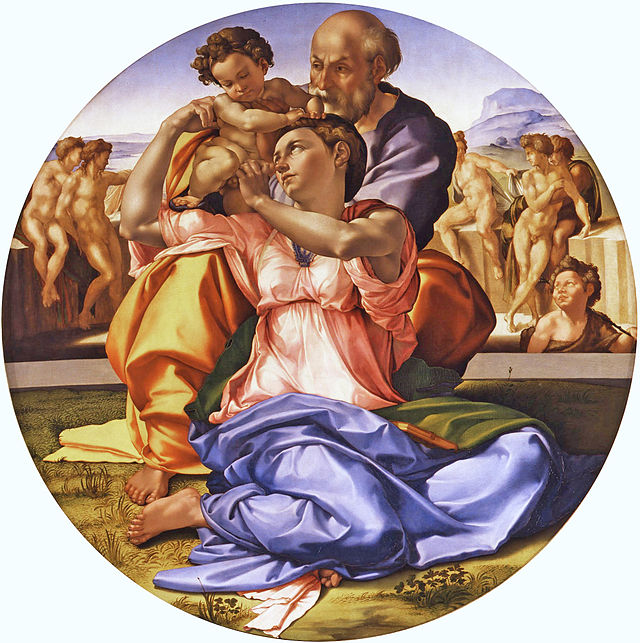
Since 2010 I have been using this site to discuss my interpretations of famous Renaissance paintings including Giorgione's "Tempest" as "The Rest on the Flight into Egypt"; his "Three Ages of Man" as "The Encounter of Jesus with the Rich Young Man"; Titian's, "Sacred and Profane Love" as "The Conversion of Mary Magdalen"; Titian's "Pastoral Concert" as his "Homage to Giorgione", and Michelangelo's"Doni Tondo." The full papers can now be found at academia.edu.

Wednesday, August 12, 2020

Giorgione, Titian, and Mary Magdalen

On October 4, 2010 I put up a post on this site that suggested that Mary Magdalen is the subject of Giorgione's Laura. Since that time I have put up a number of posts that have argued that other mysterious paintings of beautiful women of the Venetian Renaissance could also be Mary Magdalen. Below find a summary article. 


Giorgione’s Laura has defied interpreters for over 500 years. It is a relatively small half-length painting (41 x 33.6 cm) of a pensive young woman who looks off to the right at the source of light that illuminates her face and partially bare chest. She seems to wear only an oversized fur-lined garment that is opened to reveal one bare breast. The painting now hangs in Vienna’s Kunsthistorisches Museum.

The catalog of the 2004 Giorgione exhibition, jointly sponsored by the Kunsthistorisches Museum and the Accademia in Venice, called it a “Portrait of a Young Woman,” and only placed the popular title Laura in parenthesis. Sylvia Ferino-Pagden and Giovanna Nepi-Scire, two of the world’s leading Giorgione scholars, and curators of their respective museums, edited the entire catalog and also combined on the Laura catalog entry. They did an excellent job of tracing the provenance of the painting and firmly supporting the attribution to Giorgione. 

They also did a thorough evaluation of the unique inscription on the back of the painting: “on June 1 1506 this was made by the hand of master Giorgio from Castelfranco, the colleague of master Vincenzo Catena, at the instigation [instanzia] of misser Giacomo.” [i] The inscription was only deciphered in the nineteenth century but the two scholars believed that there was good evidence to support its authenticity.

Today most scholars agree that the seventeenth century identification of the young woman as Petrarch’s lover, Laura, is not tenable. Moreover, the painting cannot even be considered a portrait since no respectable woman of the time would have sat for such a depiction. 

Some have argued that it could be a depiction of a Venetian courtesan. The catalog pointed to the finding of one scholar that the sumptuous fur-lined robe was “the winter dress of a Venetian woman of pleasure.” On the other hand, there are signs such as the thin white veil and the laurel that traditionally refer to conjugal virtue. Here is the catalog’s summation.

 as noted by Goffen (1997), the thin white veil that partly covers her hair and falls over her breast is a typical accessory of married women…. The paradox that accompanies the interpretation of this painting lies in the fact that laurel is also a symbol of conjugal virtue…Giorgione’s Laura—regardless of whether she is a learned courtesan or a virtuous wife—is characterized by the extraordinary charge of sensuality and eroticism that makes this image unique in the painting of the early 16th century.

The Laura might not be as unique as the authors of the catalog entry suggest.  Other contemporary paintings also exhibit a mixture of eroticism and conjugal virtue and they have also defied interpreters. However, I believe that the Laura and these other paintings might all have a “sacred” subject, and that subject is Mary Magdalen. 

I don’t think I am the first to suggest Mary Magdalen as the subject of the Laura but recent catalogs do not even consider the possibility. All do point out the paradoxical iconographic symbols: the appearance of a Venetian courtesan combined with symbols of chastity and conjugal love such as the laurel leaves and headscarf.

Mary Magdalen is the only person who fits such a description. After the Madonna she was the most famous female saint of the Middle Ages. During the Renaissance she was regarded as a prostitute who after her encounter with Jesus became a true and virtuous bride of Christ. 

However, she is often portrayed after her conversion with breasts bared as a sign that she has thrown away her worldly finery and chosen the life of a desert contemplative. Correggio's later version of the saint bears a striking similarity to Giorgione's Laura. Her breasts are bared but the rest of her is covered with a sumptuous blue robe. She is easily recognized by her jar of precious oil, a stock symbol that Giorgione characteristically omitted.


Correggio: Mary Magdalen


In 2001 Paul Joannides discussed another painting of a young woman that he claimed bore a similarity to the Laura. He noted that it had often been attributed to Giorgione but insisted that "the closest comparisons are with Titian's work and there can be no serious doubt that it is his…."[ii]  He continued:

The Bust of a Young Woman is often thought to be a portrait of a courtesan, …There is an obvious link of mood and gesture with Giorgione’s Laura,… it is probably a fragment of a narrative composition…. But the action is ambiguous: is she opening her dress to reveal her breast, like Laura, or closing it in modesty? Given the high finish and luxurious color, this fragment is more likely to have formed part of a painting for a private house than a public place… Perhaps more likely is that she is a Magdalene in a Mary and Martha, the subject represented in Milan in the work of Bernardino Luini and his circle and one that would certainly have appealed to Titian, allowing him to contrast female types. But without further evidence no suggestion can be more than speculative.

Titian: Bust of a Young Woman
Norton Simon Museum, Pasadena

Joannides failed to mention that the multi-colored striped shawl that covers the shoulder of the woman in the “Bust of a Young Woman” is similar to the one that Titian used years later in one of his many obvious depictions of Mary Magdalen.


Titian became the most prolific and famous painter of Mary Magdalens, and his many versions of a beautiful, semi-nude, weeping penitent Magdalen spread all over Europe. He did not depict the gaunt Magdalen of Donatello, emaciated after years of fasting in the desert, but a still beautiful woman who has only recently thrown off her courtesan's finery, and appears covered only by her gorgeous red hair. 

It is also possible that before he settled on these full figured, bare breasted Magdalens, the young Titian also painted a more discrete but equally beautiful Mary Magdalen in the mysterious painting that is now called Flora. This famous painting that hangs in the Uffizi gallery is dated to around 1517, about a decade after the Laura. It also features a beautiful young woman in an obvious state of undress who looks pensively off to the right toward the source of the light that illuminates her face and torso.


No one has ever been able to make more than a guess about the subject of the Flora. It was only in the mid-seventeenth century that a commentator attached the name of the Roman goddess of flowers to the beautiful woman in the painting. Although the name has stuck, modern scholars have brought forth objections and offered their own hesitant interpretations.

 In 1980 Charles Hope introduced the painting in his catalog by noting that Titian “painted virtually no mythological pictures based in this way on ekphrastic texts, and none at all of comparable scale or importance.” He added that while Venetian patrons might have been interested in erotic subjects, “they were relatively indifferent to classical precedent.” [iii]

Hope looked in another direction for the meaning of the Flora.

But there was also a distinctive and more pervasive local tradition of pictures in portrait format of anonymous pretty girls, either clothed or partially nude, which were no more than elaborate pin-ups…. The identity of the girl as Flora is established both by the flowers in her hand and by her costume, which is of the type worn by nymphs in contemporary stage productions…

Although he remarked that the subject was treated with “extreme sensitivity and discretion,” the painting was still a pin-up whose erotic implications are “central to its meaning.”

In a 2003 catalog of an exhibition at London’s National Gallery, David Jaffe saw the connection between Flora and Laura.

Flora is perhaps the supreme example of a genre developed in early sixteenth-century Venice showing ‘belle donne’, beautiful women, for the sake simply of their beauty. They were neither portraits—as such they would have seemed improper—nor did they usually have allegorical significance or mythological references…. Titian did not invent the type, but developed the tradition represented by works such as Giorgione’s ‘Laura’….The painting is a magnificent evocation of sensuality. ... The image may be read as a generalized ‘Venus’ type. The flowers, perhaps roses, suggest identification with Flora. [iv]

In the catalog of the 2006 Bellini, Giorgione, Titian exhibition jointly sponsored by Washington’s National Gallery and Vienna’s Kunsthistorisches Museum, Sylvia Ferino Pagden considered the Flora “the finest and most successful of all sensuous half-length female figures in sixteenth-century Venetian painting….” She noted its “Venus-like sensuousness” but pointed out the ambiguity of the subject.

If it was Titian’s intention here to depict Flora, was he thinking of Ovid’s goddesses or Boccaccio’s courtesan? Or is his portrait an artistic blending of the two?... yet his Flora has more the demeanor of a goddess….her lack of attention to the viewer makes him aware of his own insignificance….Titian’s re-creation of the classical goddess, however, lacks any reference to antiquity, even in the drapery….Flora’s chemise—usually seen merely peeking out from under a gown at the neck and sleeves but here serving as her main article of clothing overlaid by a cloth of brocade or damask—does not correspond to that of any classical figure and certainly not a Venetian bride... [v]

It should be noted that Titian’s Flora bears little resemblance to the goddess of flowers. There are no flowers tumbling from her hair and her dress was depicted by Ovid as adorned with many colors. Ferino-Pagden did identify the flowers in the hands of Flora as rose, jasmine, and violet and claimed that they provide “a key to interpreting her.” However, she provided no further explanation.

In her study, “Nature and Its Symbols,” Lucia Impelluso noted that “the jasmine has often been considered a flower of Heaven or a symbol of divine love.” While usually associated with the innocence and purity of the Virgin Mary, it can often be seen “woven into garlands adorning the heads of angels and saints.” Moreover, “if associated with roses, it can connote faith.” [vi] The wild rose is traditionally associated with Mary Magdalen. As far as the violet is concerned, Impelluso noted:
In the popular imagination, the little, strong-scented violet is a symbol of modesty and humility, and it was interpreted likewise by the Fathers of the Church as well.
I realize that the jasmine, rose, and violet that “Flora” holds in her hand could refer to someone else, but one should certainly at least suspect Mary Magdalen.

Giorgione’s Laura, Titian’s early “courtesan,” and the Flora could all be considered versions of Mary Magdalen. One significant objection, however, is the absence in each instance of the jar of ointment that is always associated with the Magdalen. Later, Titian displayed it prominently in his more obvious Magdalens.
  
Perhaps in this brief moment in time Venetian artists had come to believe that they could depict the essence of the Magdalen without resort to obvious iconographical symbols. Earlier, Giovanni Bellini had painted a Madonna and Child surrounded by two female saints. One is obviously Mary Magdalen but she is only recognized by her flowing red hair.


Appropriately, Flora was the poster girl for the magnificent 2013 Tiziano exhibition at Rome’s Scuderie del Quirinale. Her image was on the cover of the little pamphlet given to all visitors and posters of her were plastered all over Rome. Perhaps she and Laura and the other “belle donne” of the Venetian renaissance can be called pin ups but it is certainly conceivable that they are also Mary Magdalen.

###


[i] Giorgione, Myth and Enigma, ed. Sylvia Ferino-Pagden and Giovanna Nepi-Scire, Vienna, 2004, pp. 197-8. Only the first catalog quote is cited. 

[ii] Joannides, Paul: Titian to 1518, Yale, 2001, pp. 94-96.

[iii] Hope, Charles: Titian, NY, 1980, pp. 61-2.

[iv] Titian, catalogue edited by David Jaffe, London, 2003, catalog entry 11.

[v] Brown, David Alan, and Ferino-Pagden, Sylvia, Bellini, Giorgione, Titian, and the Renaissance of Venetian Painting, Washington, 2006, p. 226.

[vi] Impelluso, Lucia: Nature and Its Symbols, translated by Stephen Sartarelli, Los Angeles, 2003, p. 101.

Tuesday, July 28, 2020

Titian: Madonna of the Rabbit


Titian’s so-called “Madonna of the Rabbit,” currently hangs in the Louvre whose website notes the popular title but more accurately labels the painting as “The Virgin and Child with St. Catherine and a Shepherd, known as the Madonna of the Rabbit.” Actually, a better title would be “The Mystic Marriage of St. Catherine,” a common devotional subject during the Renaissance.  Below I reproduce an interpretive essay that takes issue with the Louvre and others about two important details in the painting. 


In the first place, I do not believe that Titian has depicted a shepherd in this painting.  In my interpretation the man dressed in rustic attire in the mid-ground is St. Joseph, the protector of Mary and the infant Jesus. He is often included in versions of the Mystic Marriage by Venetian Renaissance artists. 

Secondly, I disagree with the Louvre’s explanation that the white rabbit is a sign of Mary’s virginal fecundity. X-ray examination has shown that the rabbit was not originally present. Initially, Titian placed Mary’s left arm on her lap. Why, on second thought, did he add the white rabbit?  The following essay argues that the white rabbit is the equivalent of the Eucharistic host.

*************************************


Titian’s “Virgin and Child with Saint Catherine and a Shepherd” is commonly called the “Madonna of the Rabbit” because of the white rabbit prominently featured in the center. The rabbit is held by the Madonna with a thin white cloth that is hardly visible today. The relatively small painting (71 x 87 cm.) that bears Titian’s own signature is in the Louvre and most scholars date it to 1530 although some believe it could have been laid in as early as 1520. 

The Louvre’s website provides a very comprehensive audio-visual examination of the painting featuring curator Jean Habert. He begins with a discussion of Titian’s naturalism and suggests that these figures in a landscape could almost be a genre painting, something like a picnic in the countryside. Nevertheless, Habert admits that it is obviously a religious painting and a “sacra conversazione” in particular. The Madonna and Child are in conversation with St. Catherine while the shepherd off to the right represents pagan antiquity.

This description echoes what can be found in a number of catalogues beginning with the 1991 “Titian, Prince of Painters” where the essay on the painting was also written by Habert. Subsequently, Filippo Pedrocco discussed the painting in his Titian catalog of 2001, and then two years later David Jaffe wrote the article in another exhibition catalog, entitled simply “Titian”. 

Despite this virtual unanimity the painting is still largely misunderstood. The title, Madonna of the Rabbit, is almost childish and the painting is not a “sacra conversazione.” The painting is a version of the “Mystical Marriage of St. Catherine,” a very popular subject in the early sixteenth century.

It is very difficult for scholars today to understand the importance of St. Catherine in the Renaissance. It would even be difficult for a modern devout Catholic. Writing in the nineteenth century Anna Jameson noted that Saints Catherine, Barbara, Ursula, and Margaret were in a class by themselves.

Other female martyrs were merely women glorified in heaven, for virtues exercised on earth; but these were absolutely, in all but the name, Divinities… with regard to these, all such traces of an individual existence seem to have been completely merged in the abstract ideas they represented. The worship of the others was confined to certain localities, certain occasions; but these were invoked everywhere, and at all seasons; they were powers…and though the Church assumed that theirs was a delegated power, it was never so considered by the people. They were styled intercessors; for when a man addressed his prayers to St. Catherine to obtain a boon, it was with the full conviction that she had power to grant it. * 

In “Sacred and Legendary Art” Mrs. Jameson devoted a long section to St. Catherine, her legend, and her representations in art. Although largely forgotten today, the legend must have been well known during the Renaissance especially given the fact that the famous monastery on Mt. Sinai that bore her name had become a favorite pilgrimage site. Let me just paraphrase Mrs. Jameson’s telling of the story with special attention to elements that might help to explain Titian’s painting. 

According to the legend Catherine was born late in the third century to the pagan King and Queen of Egypt. By the time she was fourteen the young princess had already won renown for her great beauty and intellect. At that point her father died and she acceded to the throne. Despite her breeding and wisdom, her noble subjects insisted that she find a husband who could assist her in governing the Kingdom. She agreed but only if they could find a man whose wisdom and wealth exceeded her own. Of course, no such man could be found.

However, the Madonna, from her place in heaven, intervened and directed an Egyptian hermit to approach Catherine and tell her that Mary’s son is more than worthy of her hand. Then, Catherine has a dream and is taken up into the heavens where she enters into a room filled with beautiful saints and angels. They take her deeper into the sanctuary where she is introduced to Madonna herself, who then escorts her into the presence of her Son. But Jesus turns away and refuses to accept her. At this point, an anguished Catherine wakes from her dream. What had gone wrong? She seeks out the hermit who tells her she was rejected because she was a heathen. Immediately, Catherine takes instruction and is baptized a Christian.

Now Catherine has another dream. Once again she is welcomed into Heaven and ushered into the presence of the Madonna who presents her to her son and vouches for her by saying that she herself has become godmother to Catherine at the baptism. This time the Lord accepts Catherine and places a ring on her finger, a ring that is still there when she wakes from the dream. 

It is only after this “mystical marriage” that Catherine would go on to suffer torture and death at the hands of a cruel Roman tyrant whose offers of marriage she spurns. 

Titian’s painting is not about historical accuracy. It is an account of Catherine’s dream. Painters typically portrayed the mystical marriage as taking place in the Egyptian desert three hundred years before the time of Catherine. The Holy Family is returning from their sojourn in Egypt when Catherine comes upon them.


In Titian’s version of the Mystic marriage Catherine is easily identified by her regal, golden finery although she is somewhat disheveled. Her red robe has fallen around her thighs. She kneels on a wooden box that most commentators have identified as the broken wheel, the famous instrument of her later torture. She has taken the Christ Child in her arms and while he looks away at the rabbit, he strokes her chin with his hand.

Madonna sits on the ground wearing her familiar red dress and blue robe. She has obviously handed the child off to Catherine but still looks intently at him. Scientific investigation of the underpainting has revealed that she was originally looking at the man off to the side. Her right arm is hidden but her left hand holds, with a hardly visible white cloth, a striking white rabbit. 

The man on the right dressed in rustic clothing is usually called a shepherd but he can only be St. Joseph. Who else would be with Mary and the Child in the Egyptian desert? In contemporary paintings of the same subject by Paris Bordone and Lorenzo Lotto he would figure even more prominently. Both Bordone and Lotto portrayed Joseph as quite young and virile and in one Bordone version, now in the Hermitage, Joseph’s garb is also rustic. 

Paris Bordone: Mystic Marriage
Hermitage

Moreover, even when commentators have called him a shepherd, they note some regal features like the laurel wreath in his hair. Some think it might even be a portrait of Titian’s noble patron. The fact that the underpainting shows that the Madonna was originally looking at him also points to his elevated status. Joseph sits on the ground stroking another animal, either a black sheep or ram. 

Titian’s “Madonna of the Rabbit” is full of Eucharistic significance. In the 1991 catalog entry Jean Habert noted: 

The fruit in the basket…gives the scene, notwithstanding the naturalism of a motif that indicates autumn, a mystical significance of redemption, since these fruits are the symbols of the Passion (original sin redeemed by the wine of the Eucharist). **

There is much more than the fruit in the basket to indicate the Eucharist. The strawberry plant in front of St. Catherine is often associated with an earthly paradise, but can also symbolize the Passion. The prominent plant in the foreground to the viewer’s right appears to be the cinquefoil (Potentilla simplex), with its characteristic five pointed leaf. It was common in Europe and was often used in Medieval architectural decoration. This painting would seem to indicate that its five leaves symbolize the five wounds of Christ.

The Passion of Christ was re-enacted at every Mass and in Franciscan theology Mary was regarded as the altar on which her child is consecrated. Her infant son and the symbolic white rabbit are one and the same. The Infant looks at the rabbit to affirm their identity. Habert claimed that the rabbit is a sign of Mary’s purity or fecundity but why then would she be holding it with a white cloth? In her study of Titian’s famed Pesaro altarpiece Rona Goffen noted the symbolism of the white cloth or corporale. The corporale is always placed on the altar on which the host rests. ***  

Catherine like all her pious admirers has just offered herself to the Lord and now receives Him from Mary. Catherine herself holds the Infant with a white cloth. It’s as if she had just been handed the communion host by a priest. Joseph sits off to the right and strokes a black sheep or ram, itself recalling the Eucharistic symbolism of the scapegoat from Leviticus 16:20-22.

“When Aaron has finished making atonement for the Most Holy Place, the tent of meeting and the altar, he shall bring forward the live goat. 21 He is to lay both hands on the head of the live goat and confess over it all the wickedness and rebellion of the Israelites—all their sins—and put them on the goat’s head. He shall send the goat away into the wilderness in the care of someone appointed for the task. 22 The goat will carry on itself all their sins to a remote place; and the man shall release it in the wilderness.”
Years ago famed art historian Erwin Panofsky noted that it is important to go beyond the naturalism and beauty of these famous and mysterious Renaissance paintings.

In a work of art, “form” cannot be divorced from “content”; the distribution of color and lines, light and shade, volumes and planes, however delightful as a spectacle, must also be understood as carrying a more-than-visual meaning. ****

In the years immediately following the onset of the Protestant Reformation, the Catholic Church responded with renewed devotion to the Eucharist. Artists and their patrons naturally followed suit. Titian, Bordone, and Lotto became increasingly responsive to the devotional needs of their patrons.

###


* Anna Jameson, Sacred and Legendary Art, ed. By Estelle H. Hurrl, II, Boston and New York, 1895, v. II, 458.

**Titian, Prince of Painters, 1991, cat. entry #23.

*** Rona Goffen, Piety and Patronage in Renaissance Venice, Yale, 1986, 114.

****Titian’s Allegory of Prudence: a Postscript, in Erwin Panofsky, Meaning in the Visual Arts, Garden City, NY, 1955, p. 168.


Tuesday, July 14, 2020

Michelangelo: Doni Tondo Nudes


I published my interpretation of Michelangelo's Doni Tondo in installments on this site back in 2015. I published the whole paper on my website, MyGiorgione, on 7/7/2016. In my previous post I presented the first part of that paper which argued that in the foreground of the painting Michelangelo depicted the  Madonna offering her Son in the same way that a priest offers the Eucharistic host during the Consecration of the Mass. Today, I reprise the conclusion of that paper that identified the nudes in the background as the Nephilim of the Hebrew scriptures at the time of Noah.

***

In recent years the five nude young men in the background of Michelangelo’s Doni Tondo have received as much, if not more, attention than the Holy Family in the foreground. There would appear to be no agreement as to who they are or what they represent. Among other things, they have been variously interpreted as angels without wings, sinners, penitents awaiting Baptism, figures from pagan antiquity, or figures from the Old Testament.


In a paper, entitled “Michelangelo’s Doni Tondo: Holy Family and Family Myth,” Andree Hayum concentrated on the scene in the background. She noted the many different interpretations offered for the five nude men, but found the source in the Old Testament account of the drunkenness of Noah. She saw an obvious connection between the young men and Michelangelo’s famous depiction of the Noah story on the ceiling of the Sistine chapel.

But if one thinks of them as a constellation of three, the figures they recall are Michelangelo’s sons of Noah in the Sistine fresco of Noah’s Drunkenness. The most notable feature of Michelangelo’s sons of Noah is their nudity.*


Michelangelo: Drunkenness of Noah

In her interpretation the three men on the viewer’s right in the Doni Tondo would be Noah’s sons Ham, Seth, and Japheth before the incident of their father’s humiliating drunkenness. After drinking of the fruit of the vine, Noah had fallen naked into a stupor in his tent. Ham looked upon his father’s nakedness but the other two averted their faces and covered him. When Noah awoke and realized what had happened, he cursed Ham. Hayum argued that the two innocent or sinless sons are therefore depicted after the episode on the viewer’s left.

There is a connection between the young John the Baptist in the midground of the Doni Tondo and the story of Noah. Not only did theologians and artists see the Baptist, the last and greatest of the Hebrew prophets, as a link between the Old and New Covenants, but also they had related the story of Noah to Baptism.

In the First Letter of St. Peter the saving of Noah and his family are seen as prefiguring Baptism. Just as the waters of the Flood wiped away sin, so too do the waters of Baptism. There can be no doubt of the prominence of the Noah story during Michelangelo’s time. Savonarola, his favorite preacher, had given perhaps his most famous series of sermons on Noah and the Flood right before the French invasion of Italy in 1494. Michelangelo featured the Noah story on the ceiling of the Sistine chapel only a few years after the completion of the Doni Tondo.

Nevertheless, I have some questions about Hayum’s hypothesis. In the first place, where is Noah in the Doni Tondo? For Hayum this question was not a problem because she saw Noah in the figure of St. Joseph.

As in the sacrifice of Noah, the Holy Family alludes to Noah and his sibylline daughter-in-law. They have come to rest holding up the future male child. Like the ritual of sacrifice, the thanksgiving and the gift are one, and a sense of celebration prevails. **

Noah’s daughter-in-law was reputed to be a sibyl and given the sibyls in the Sistine chapel, it was easy for Hayum and others to recognize a sibyl in Mary’s posture. Nevertheless, I believe it would be impossible to find another reference to Joseph as Noah. If anything, Noah is a type of Christ, not of St. Joseph. Noah’s salvation of mankind from destruction at the time of the Flood prefigured the salvation effected by Christ on the Cross.

My second question relates to the postures of the nude figures in the Doni Tondo. Rather than participating in the scene of their father’s drunkenness, they lounge about like modern Italian men on a street corner ogling passing young women. A similar posture can be seen in an earlier devotional tondo by Luca Signorelli that is usually called the Medici Madonna. Hayum and others have seen a connection between the five nudes in Michelangelo’s tondo and the four practically nude young men in Signorelli’s painting.

Luca Signorelli: Medice Madonn

In the foreground of Signorelli’s painting the Madonna sits on the ground while her son appears to be taking his first step. St. Joseph and John the Baptist are absent but a bust of the Baptist as a man appears in the fictive frame above the tondo with a banner reading “Ecce Agnius Dei”. However, the four young men in Signorelli’s tondo also appear to be idlers. It is hard to see how they could be the sons of Noah either before or after the incident of his drunkenness.


I would like to suggest that the nudes in both paintings are related to the story of Noah but that they are not his sons. In the Book of Genesis there is a brief reference to giants upon the earth. Here is an English translation of the Vulgate Latin.

Now giants (gigantes) were upon the earth in those days. For after the sons of God went in to the daughters of men, and they brought forth children, these are the mighty men of old, men of renown. [Genesis 6:4]

The Golden Legend embellished the biblical account of the time of Noah.

This time men began to multiply upon the earth, and the children of God, that is to say of Seth, as religious, saw the daughters of men, that is to say of Cain, and were overcome by concupiscence and took them to their wives. This time was so much sin on earth in the sin of lechery, which was misused against nature, wherefore God was displeased…
A fuller account can be found in the apocryphal legends of the Jews.

Unlike Istehar, the pious maiden, Naamah, the lovely sister of Tubal-cain, led the angels astray with her beauty, and from her union with Shamdon sprang the devil Asmodeus. She was as shameless as all the other descendants of Cain, and as prone to bestial indulgences. Cainite women and Cainite men alike were in the habit of walking abroad naked, and they gave themselves up to every conceivable manner of lewd practices. Of such were the women whose beauty and sensual charms tempted the angels from the path of virtue. The angels, on the other hand, no sooner had they rebelled against God and descended to earth than they lost their transcendental qualities, and were invested with sublunary bodies, so that a union with the daughters of men became possible. The offspring of these alliances between the angels and the Cainite women were the giants, known for their strength and their sinfulness… ***

The legends of the Jews ascribed a number of names to these giants but one was Nephilim, “because bringing the world to its fall, they themselves fell.” The modern Jerusalem bible does use the word Nephilim instead of giants to describe these troublemakers whose sins were so great that it took a flood to wipe them out. In addition to walking about naked, the Nephilim were noted for their arrogance and wantonness.

They knew neither toil nor care, and as a consequence of their extraordinary prosperity they grew insolent. In their arrogance they rose up against God…. It was their care-free life that gave them space and leisure for their infamies. ***


The description of the Nephilim in the Jewish legends fits the depiction of the nude young men in the background of both Signorelli’s Medici Madonna and Michelangelo’s Doni Tondo. The painter of the ceiling of the Sistine chapel certainly had knowledge of the Book of Genesis. Scholars have demonstrated that he could have read the text in Italian because of the publication of the vernacular Malerbi bible in 1490. He obviously used the Malerbi woodcuts in his work in the Sistine chapel.

Could he have been familiar with the folklore and legends of the Jews? Michelangelo grew up in a Florence that was a center of Hebraic studies. Michelangelo trained at the Medici court where Pico della Mirandola was known for his knowledge of the Hebrew lore and traditions that were all lumped together under the heading of Cabala. Most of Savonarola’s sermons were based on the books of the Old Testament. Also, Sante Pagnini, who succeeded Savonarola as Prior of San Marco, was a Dominican specialist in Hebrew language and grammar. He spent practically his entire career translating the Hebrew Scriptures into Latin.

Finally, another source for the Nephilim was readily available in a book published only a decade before Michelangelo painted the Doni Tondo. David Whitford’s 2009 study, The Curse of Ham in the Early Modern Era, included a chapter devoted to the Giants or Nephilim. In particular, he discussed the Commentaria of Annius of Viterbo, a Dominican friar, whose book containing alleged writings and fragments of pre-Christian Greek and Latin authors appeared in 1498. Contemporary humanists suspected that the Commentaria and its author were frauds. Annius claimed linguistic knowledge that he did not possess, and even planned a fake archaeological discovery. Nevertheless, the book became very popular and was reprinted in 1515 with only minor corrections.

Here is Whitford’s account of Annius on Noah and the Nephilim.


Book One begins by stating that before the “famous catastrophe of the waters, by which the entire world perished, many ages passed.” In these ages, giants ruled the world from their great city, Enos. The giants were corrupt and prone to tyranny, lechery, and debauchery. They devoted themselves to sexual immorality such that, “they had intercourse with their mothers, their daughters, their sisters, with other men and with wild beasts.” They also despised religion and the gods. Despite warnings and prophecies that the world would be destroyed because of this wickedness, the giants continued their impiety. Only one giant, who was more “reverential to the gods and wiser than the rest,” paid any attention to the prophecies; because of this he survived. His name was Noa “and he had three sons, Samus, Japetus, and Chem.” Noa (or Noah) survived because he could read the stars and foresaw the deluge to come. Thus, beginning 78 years before the Flood, he built an ark. When the floods came, the whole human race was drowned, except for Noa and his family. From this family sprang all the peoples of the earth. #

Despite the spurious nature of the Commentaria, it would appear that the story of the Nephilim was in the air even before its publication in 1498, and that the Commentaria of Annius only added to its popularity.

Why would Michelangelo place the proud giants or Nephilim in the Doni Tondo? I can only offer the following suggestion. The painting is a devotional image. The Madonna elevates her infant Son in the way a priest elevates the Host at Mass. John the Baptist looks at the Host and utters the words of the Agnus Dei: Behold the Lamb of God…. But the full version of the ancient prayer is “Behold the Lamb of God, who takes away the sins of the world, have mercy on us.

The Nephilim represent the sins of the world. I suggest that they are the nudes in the background of both the Doni Tondo and Signorelli’s Medici Madonna. In both paintings the Madonna and Child have turned their backs on the nudes in the background. Instead of a Flood, the Lord has sent his only Son to take away the sins of the world.

###


*Andree Hayum, "Michelangelo’s Doni Tondo: Holy Family and Family Myth". Reprinted in Michelangelo, Selected Scholarship in English, edited with Introduction by William E. Wallace, New York and London, 1995, V. 1.Life and Early Works, p. 421-424.

** Hayum, op. cit., p. 427.

*** Louis Ginzberg, The Legends of the Jews, 1909, V. 1, c. 4. Available online.

# David Whitford, The Curse of Ham in the Early Modern Era. 2009.

Sunday, June 28, 2020

Michelangelo: Doni Tondo

Michelangelo’s Doni Tondo is one of the greatest masterpieces of the High Renaissance. It is his only surviving panel painting and now hangs in the Uffizi in its original frame. Most scholars date it somewhere between Michelangelo’s completion of the David in 1504 and his departure from Florence to Rome in 1506. Like many of the masterpieces of this era, it has elicited many different interpretations. At first glance it appears to be simply a traditional rendering of the Holy Family but, on closer inspection, a number of questions arise.


In the foreground Mary, Joseph, and the Infant Jesus are situated  in a landscape. But what is going on? Is Mary handing the Child to Joseph, or is Joseph handing the Child to Mary? Why does Mary look as she does with muscular arms shockingly uncovered? What is Joseph doing in the painting? Why, despite tradition, has he been brought so prominently into the center to play an apparently key role? What is the young John the Baptist doing behind a parapet or wall in the mid-ground? Finally, who are the five male nudes in the background, and why are they there?

As far as the first question is concerned, I originally agreed with  Giorgio Vasari’s view that Mary “presents” the child to Joseph. In his life of Michelangelo, Vasari wrote:

There came to Angelo Doni, a Florentine citizen and a friend of Michelagnolo. who much delighted to have beautiful things both by ancient and by modern craftsmen, a desire to possess some work by Michelagnolo; wherefore that master began for him a round picture containing a Madonna, who, kneeling on both knees, has an Infant in her arms and presents Him to Joseph, who receives him. Here Michelagnolo expresses in the turn of the head of the Mother of Christ and in the gaze of her eyes, which she keeps fixed on the supreme beauty of her Son, her marvelous contentment and her lovingness in sharing it with that saintly old man, who receives Him with equal affection, tenderness, and reverence, as may be seen very readily in his countenance, without considering it too long.*

Most modern scholars disagree with Vasari’s opinion, and have offered some strange and contradictory interpretations.**  Vasari was often mistaken or ill informed but he was a close friend and confidant of Michelangelo. It would be almost the height of temerity to reject his eyewitness description of the central feature in this painting. Nevertheless, it would appear that he did not take more than a glance at the painting. For example, he saw the Madonna kneeling although she is obviously sitting. 

It is so easy to overlook or ignore important and obvious details in a Renaissance masterpiece, but there are significant elements in the Doni Tondo that call for a new interpretation. Rather than handing off the Child to Joseph, I have argued that Mary is actually elevating the body of her Son in the same way that a priest elevates the Host or Body of Christ at the Consecration of every Mass. The keys to this interpretation are the hands of Mary, and the posture of Joseph. 


The position of Mary’s hands and fingers cannot allow her to either hand the Infant Jesus off to Joseph or take the Child from him. As I pondered the painting, I asked myself where had I seen hands like that before. Eventually, I realized that Mary’s hands and fingers resembled a priest’s at the Consecration of the Mass. After the Second Vatican council liturgical norms in the Catholic church were somewhat relaxed, but I remembered from my childhood that the priest would take the host between the thumb and forefinger of both hands before and during the elevation. Naturally, his other fingers would then close or cup in the shape of Mary’s as he raised the host. Since the priest’s back was to the congregation, he would raise the Host high above his head and look at it intently in the same way Mary does in the Doni Tondo.


In the art of the Renaissance it was common to equate the infant Jesus lying on his mother’s lap, or on the ground surrounded by various worshippers, with the Eucharistic host. The Portinari Altarpiece is one of the best examples. The infant Jesus lies on the ground surrounded by worshippers including angels wearing the vestments of altar servers. In Franciscan theology, for example, even when Mary was holding her infant Son on her lap, she was the altar on which the Eucharist rested. 


Hugo van der Goes: Portinari Altaroiece

In 1974 famed art historian Leo Steinberg published a brief essay on the Doni Tondo in Vogue magazine. Steinberg’s reputation was so great that practically every commentator on the Doni Tondo refers to the Vogue essay. In that essay Steinberg saw deliberate ambiguity in Michelangelo’s famous painting that makes it very difficult to determine who is handing the Child to whom. But he did find four levels of meaning including a Eucharistic one. Here is his ending. 

Christian tradition made the Virgin’s identity interchangeable with Ecclesia; and it made Joseph the typus apostolorum, protector and spouse of the Church, “guardian of the living bread for himself and the whole world” (St. Bernard). And as the maternal function of the Church culminates in the Mass, which engenders the sacramental body of Christ, so in the tondo, the unprecedented pitch of the Child above the Madonna prefigures the Elevation of the Host, of the Corpus Verum, the Eucharist—literally, a “Thanksgiving.”***

Steinberg did note the “furled fingers” of Mary but only concluded that since no woman would ever receive a child in that way, “she must have just let it go.” So, in his opinion, the raising of the Child only “prefigures the Elevation of the Host….”


I would also like to point out that the garments of Mary indicate a priestly role. Michelangelo depicted her in her traditional red dress with her blue cloak or mantle draped over her legs. But there is also a green cloth wrapped around her on which a book, perhaps a Missal, rests. Green is still the color of the priest’s vestments on most of the Sundays of the Church year.

The concept of St. Joseph as protector and spouse of the Church is sufficient to explain his prominent position in the Eucharistic celebration. The man in Michelangelo’s tondo bears all the characteristics of St. Joseph as he was portrayed during the early decades of the sixteenth century. Joseph was increasingly depicted as a virile man quite capable of protecting his family especially on the flight into Egypt. One just has to look at Raphael’s Sposalizio in the Brera. In addition, the purple and gold coloring of his garments also identifies Joseph as from the line of King David.

Even more than these characteristics, the posture of Joseph confirms his identification. He is behind Mary and the Body of Christ. At the consecration of the Mass the sacrifice is offered to the Father above at the heavenly altar. Also, we see that Joseph is not standing since he does not tower over the sitting Madonna. Is he squatting awkwardly? Is he sitting on a hidden stool? We can only see his right leg but it is bent at the knee. It would appear that Joseph is kneeling or genuflecting as all worshippers do as the priest elevates the Body of Christ. At the same time his left hand is placed firmly on the Infant’s chest. Is he actually receiving Communion or just indicating the central  role of the Church in the acceptance of the Real Presence of Christ in the Eucharist? 

In the mid-ground the young John the Baptist looks at the elevated Christ and implies the  Agnus Dei, an ancient prayer still found in every Mass: "Behold the Lamb of God Who takes away the sins of the world." The five nudes in the background were explained in my full paper and will be discussed in a subsequent post. 


###


Note; In a 1968 essay Mirella Levi d’Ancona, because of her belief that Michelangelo was supporting a Dominican view of Mary’s Immaculate Conception, saw the Child raising himself out of his mother’s body as if he was actually being born and sanctifying his mother at the moment of his birth. She wrote,

The Christ child—God incarnated in human form—is issuing from the body of the Virgin to take his human form, and at the same time blesses his mother, to bestow on her a special sanctification.


On the other hand, in 2003 Timothy Verdon believed that the source of the Doni Tondo could be found in Marsilio Ficino’s Neoplatonic concept of three kinds of love. As a result, Verdon argued that not only was Mary receiving the Child but that the man in the painting was not even St. Joseph. 

the old man in the Tondo Doni seems to flout the tradition of a passive Joseph, separate from Mary, for the simple reason that he is not Joseph: he does not represent the surrogate father, but the real one, God, from whom the Son proceeds ab aeterno. Vasari was mistaken when he said that the old man “takes” the baby from Mary; it is rather the baby who emerges from the Father, with his left foot on the Father’s thigh and his little hands in Mary’s hair to maintain his balance. The Baby, with his right foot on Mary’s arm, is about to push himself up and over, in order to descend into the Virgin’s womb.

*Giorgio Vasari, Lives of the Painters, Sculptors and Architects, translated by Gaston du C. De Vere, with an introduction and notes by David Ekserdjian, Everyman’s Library, 1996, v. II, p. 656.

** See note below.

*** Leo Steinberg, “Michelangelo’s Doni Tondo,” Vogue, December, 1974, pp. 138.

Note: Mirella Levi D’Ancona: The Doni Madonna by Michelangelo: An Iconographic Study. Reprinted in Michelangelo, Selected Scholarship in English, edited with Introduction by William E. Wallace, New York and London, 1995, V. 1.Life and Early Works, p. 404. This paper originally appeared in the Art Bulletin in 1968.

 Timothy Verdon, Mary in Florentine Art, Firenze, 2003, pp. 97-98.


Saturday, June 13, 2020

Titian: Memorial to Giorgione


This post is designed to draw attention to an interpretation of the Fete Champetre or Pastoral Concert published in 1999 by Dr. Christiane Joost- Gaugier. The article,“The mute poetry of the Fete champetre: Titian’s memorial to Giorgione” appeared in the January 1999 issue of the Gazette des Beaux Arts. As the title suggests, Dr. Joost-Gaugier attributed the famous painting to Titian and regarded it as a memorial to the recently deceased Giorgione.


I originally published my interpretation of the painting on the website, MyGiorgione, in May, 2013. I believed then and still do that the famous painting that hangs in the Louvre is indeed a homage by the young Titian to Giorgione. Only last year did I discover that Dr. Joost-Gaugier had seen the same thing back in 1999. *

Initially, this discovery was embarrassing since I should have found Dr. Joost- Gaugier's interpretation earlier. However, it became somewhat comforting to find that I had come independently to a similar conclusion with someone of her stature, knowledge, and experience. I also found that the technical evidence of the underpainting presented in her article also supported my paper. 

Nevertheless, while I agree with much of Dr. Joost-Gaugier's analysis, I do have disagreements with some of the conclusions she drew from her insights. I will explore both the areas of agreement and disagreement in this review article. 

In an abstract to her paper Dr. Joost-Gaugier laid out her thesis.

This paper will attempt to propose a new reading of this most unusual, indeed unique, picture which will suggest that it was initiated by Giorgione as a poesia based on an antique theme but incorporating his views about painting and, after his death completed by the grieving young Titian who, inspired by Virgil, turned the painting into a memorial to his beloved master who is portrayed as the center around which the entire composition and subject revolve. It will also suggest that Titian valued this painting as a private painting. (2)
Dr. Joost-Gaugier observed that the focus of the painting, despite the scholarly interest in the two nude women, was the young man in the center clothed in red. 

Indeed, the brilliance of his presence makes it clear that he, and not the nude women who have so intrigued former viewers is at the center of the painting…. In contrast to the soft beiges, browns, and olive colors which prevail elsewhere in the painting, the glowing reds of his mantle and hat accentuate the centrality and importance of his presence. (5)
She identified the man in red as Giorgione but saw signs, as I did years later, that he has died. 


Contrary to what many observers have assumed, the brilliantly colored young man at the center of the painting is not playing his instrument. Indeed, his instrument has no strings, a fact that has gone unnoticed and which is assured by the evidence of x-rays. Nor does the protagonist of the painting sing. His lips are closed. In fact, his head is averted so as to cause his features to be lost in deep shadow and darkness. From him there is only silence. He is playing but not playing, singing but not singing. He is seen but not seen. 
The other young man, dressed in plain, rustic garb would then possibly be Titian.
The suggested identification of the young lutist as Giorgione leads to another possibility. Perhaps his companion—who focuses his respect as well as his energies on the main actor—is a self-portrait of the younger Titian who expresses his devotion in a moment of quiet reverence. (6)
In regard to the two nude women, Dr. Joost-Gaugier differed from earlier scholars who regarded them as wood nymphs or muses invisible to the men. For her, the four figures in the painting are “distinctly human beings.” Moreover, both women are the same.
The same figure is represented from the front…and from the back, suggesting different modes or tempos for the engagement of the beholder. (4)
She then speculated that the woman was actually Giorgione’s lover who also died of the plague, and that Giorgione had originally begun the painting in her memory. 
The fact that the two women appear to have been painted from the same model suggests that they may refer to the woman with whom Giorgione had fallen in love shortly before his death. (6)
In summing up Dr. Joost Gaugier believed that while the painting has an Arcadian mood based possibly on an eclogue by Virgil, Giorgione had begun the painting shortly before his own death of the plague as a poetic memorial of his recently deceased lover but that Titian then altered it into a memorial of Giorgione himself. 
Taken together, the above observations show that this painting is neither a “Fete Champetre” nor a “Pastoral Concert, nor a (live) concert at all. They suggest rather a funeral motif.
In the paper that I posted on my website I also saw that the elegantly dressed man with the lute is Giorgione, and the other more simply dressed man is Titian. I agree that the painting is Titian’s homage to the recently deceased Giorgione. 
I agree that the absence of strings on the lute is a sign that Giorgione has died and will play no more. I also agree that Giorgione’s face in shadow is another sign of death. Titian would use it later in a crucifixion scene. I went a little further though in seeing another sign of death in the pouring action of the nude on the left. I see her pouring Giorgione’s spirit into the well. 
Moreover, I believe that the dark sky in the background is also a sign of death. I did not mention it in my paper because I could not be certain that the dark sky was original or just the result of aging. Dr. Joost-Gaugier’s examination of the underpainting indicates that the original sky is cloudy and certainly not the appropriate background for a pleasant pastoral idyll.
I agree that the two nude women are one and the same, but I do not believe that they are human. I follow Fehl, Wind, and Egan in this regard but go further and argue that she is Euterpe, the muse of lyric poetry. **
I find it difficult to accept the suggestion that the painting was initially begun by Giorgione as a memorial to his deceased lover, or that the unfortunate woman is depicted in the painting. According to Vasari’s sources, Giorgione died of the plague after contact with his lover. Death for both of them would have been rapid and within days of each other.  He would have been in no shape physically or emotionally to commence a tribute to his lover. A recent discovery indicated that Giorgione spent his last days away from his studio in quarantine on an island in the lagoon.
Moreover, if he meant the painting as a tribute to his lover, why would he include Titian in the painting? Why would he have shown the young woman handing her flute to Titian? According to Dr. Joost-Gaugier all the figures in the painting are original. Scientific analysis of the underpainting reveals that only the standing nude was altered.
I can accept the idea that Titian might have kept this painting in his studio for years but that could mean that he revised and retouched it at a later date using paints mixed years later than 1510. Given this fact, I do not believe the scientific evidence firmly establishes a dual authorship.
I do believe that Titian painted in the style of Giorgione as an act of homage to his recently deceased friend. I would also not be surprised if Titian used Giorgione cartoons. I believe that the young Titian acted more as a colorist than a designer on the walls of the Fondaco de Tedeschi with the result that onlookers mistook his work for Giorgione’s. 
Rather than an Arcadian poesia in an antique style, I believe that Titian used the biblical story of David and Jonathan to express the depth of his sorrow at Giorgione’s passing. Jonathan was the son and heir of King Saul, and David was a young shepherd boy. They became the closest of friends during Israel’s struggle with the Philistines. 
Titian dressed Giorgione in the finery befitting a King’s son while he clothed himself in rustic garb. In my interpretation the shepherd in the mid-ground would then be David’s father left behind with his flocks, and not a typical gamboling Arcadian shepherd. 
Renaissance art historians never tire of trying to find sources in ancient literature for paintings whose subjects mystify them. They go to great lengths to show that painters like Giorgione and Titian were familiar with these texts even though there is little evidence that they could even read Latin. For some reason they find it difficult to imagine that the sources of many of these beautiful paintings are in the Bible and the apocryphal legends that embellished the sparse biblical account. ***
###

* Joost-Gaugier, Christiane L. The mute poetry of the Fete Champetre: Titian’s memorial to Giorgione. Gazette des Beaux Arts, January 1999, Issue 1560, pp. 1-14.  After my initial intuition I  discovered that famed art historian S. J. Freedberg had also seen the painting as a homage to Giorgione, and noted that in my paper.  S.J. Freedberg, Painting in Italy, 1500-1600, London, 1990, pp. 139-140.

** Euterpe was also seen by Ethanan Motzkin in "The Meaning of Titian’s Concert champetre in the Louvre.” Gazette des Beaux Arts, 116 (1990), pp. 51-66.

*** The late Ross J. Kilpatrick, a classicist, argued that instead of Virgil, the source of the Pastoral Concert could be found in Horace and Propertius. "Horatian Landscape in the Louvre's "Concert Champetre," Artibus et Historiae, Vol. 21, No. 41 (2000), pp. 123-131. He included a discussion of Dr. Joost-Gaugier's interpretation.