Since 2010 I have been using this site to discuss my interpretations of famous Renaissance paintings including Giorgione's "Tempest" as "The Rest on the Flight into Egypt"; his "Three Ages of Man" as "The Encounter of Jesus with the Rich Young Man"; Titian's, "Sacred and Profane Love" as "The Conversion of Mary Magdalen"; Titian's "Pastoral Concert" as his "Homage to Giorgione", and Michelangelo's"Doni Tondo." The full papers can now be found at academia.edu.

Tuesday, June 1, 2021

Giorgione's Tempest: Bernard Aikema's Interpretation

In December 2010 I attended a symposium at Princeton University honoring Patricia Fortini Brown, Professor Emeritus of Art and Archaeology at Princeton, on her retirement this year after 27 years at Princeton. The symposium entitled, "Giorgione and His Times: Confronting Alternate Realities," was also intended to commemorate the 500th anniversary of Giorgione's death. 


 The Symposium produced some thoughtful and even provocative sessions. The organizers at Princeton had assembled an all star cast. The four main speakers, Bernard Aikema, professore ordinario of Art History at the University of Verona; Deborah Howard, Professor of Architectural History in the Faculty of Architecture and History of Art and a Fellow of St. John’s College, Cambridge; Sarah Blake McHam, Professor of Italian Renaissance Art at Rutgers University; and Salvatore Settis, Chair of Art History at the Museo del Prado in Madrid and Director of the Scuola Normale Superiore di Pisa, all had international reputations. I was particularly interested to hear Aikema and Settis both of whom have written extensively on the Tempest. As it turned out most of the fireworks at the symposium were produced by these two speakers. Both tried to deal with a very basic question. What can explain the obvious differences in the works attributed to Giorgione, differences in style, technique, size, and subject? 


Aikema indicated at the outset of his paper, “Giorgione: Myth and Reality” that he planned a very provocative presentation. He divided his talk into two sections. In the first, he presented a long analysis of Carlo Ridolfi’s seminal seventeenth century study of Venetian Renaissance artists, "Le maraviglie dell’ Arte ovvero, Le vite degli Illustri Pittori Veneti and dello Stato." Aikema claimed that Ridolfi was largely responsible for the myth of Giorgione. Ridolfi, Aikema argued, saw a dramatic change in Venetian art from Giovanni Bellini to Titian. It was a change from an old, traditional manner to a new or modern manner. Ridolfi then made Giorgione the pivotal link or transition between the two manners. To establish his claim Ridolfi had to attribute an extraordinary number of paintings, about 65, to the short-lived Giorgione. These works fell into four major areas: fresco, portraits, mythological, and large figures like the "Three Ages of Man." 

Aikema agreed with those scholars who have over the last century whittled Ridolfi’s attributions down to a handful. Nevertheless, the myth of Giorgione persists. He also argued that Ridolfi was wrong in seeing Giorgione as the bridge between the old and the new manner. Giorgione represented the “end of an epoch.” In the second part of his talk Aikema pointed out that Ridolfi did not mention the Tempest because it did not fit into his elaborate scheme. The Tempest with its finely painted figures in a landscape was omitted by Ridolfi because of what Aikema considered its obvious “northern” influences.  In this session Aikema went over much the same ground that he had covered in a 2004 paper, “Giorgione: Relationships with the North and a New Interpretation of La Vecchia and La Tempesta,” published in Giorgione, Myth and Enigma, the catalog of the groundbreaking 2004 Giorgione exhibition sponsored jointly by the Kunsthistorisches Museum in Vienna, and the Accademia in Venice.

 In that catalog Aikema’s was one of three different interpretations of the Tempest. For Aikema there are obvious “northern” influences in Giorgione’s work, especially in a small landscape like the Tempest with its carefully depicted figures in the foreground. In particular, Aikema believes that a group of artists from various centers along the Danube, the so-called “Donauschule”, holds the key to the Tempest. In 2004 he wrote,“ the Giorgionesque  innovations share quite a few correspondences with the landscapes formulated around 1500 in the drawings and paintings of a group of artists, including Lucas Cranach the Elder, Albrecht Altdorfer, Wolf Huber, as well as Durer, who all were active in various centers of the Danube valley and whose work is known as the Donauschule.” [88]

 Although Aikema pointed to some sacred subjects depicted by these Danube artists, he believed that Giorgione was mainly interested in their depictions of primitives living in the wilds. Indeed, he argued that the subject of the Tempest is a deliberate response to these German primitives. His view had not changed since 2004 where he wrote, “ If our hypothesis is correct,…the painting presents itself as a kind of Venetian reaction to the images of a primitive German world, which claimed superiority to the Mediterranean one…” [96]

In Aikema’s opinion it would be useless to search for an underlying text for the Tempest or to attempt to identify any of the iconographical elements. The Woman could be a gypsy but there is no need to explain her nudity. The Man is not a soldier but so what. The broken columns refer to nothing else than the classical world. Why they are broken doesn’t matter. The city in the background refers to no specific event, certainly not the Cambrai war. He doesn’t even consider the prominent plant in the foreground. Finally, Aikema maintained his hypothesis even though he himself had pointed out the obvious differences between the Danubian works and the Tempest. Giorgione was just reacting against them. In 2004 he also admitted that there was no evidence that any of these Danube “primitives” ever found their way into Venetian homes.

In his 2004 essay, he regarded the Tempest is “the most original artistic expression of the fundamental historical-philosophical and ideological debate about the origins of humanity and the superiority of the Mediterranean civilizations and, more specifically, that of the Veneto….” Stylistically, the Tempest, a “unicum, a work effectively without successor in Venetian painting…”, is a finely executed landscape which marks the end of an era and which has no impact on the future of painting. “In the final analysis it seems particularly significant that the painting presents itself as a work sui generis that cannot be classified in any of the conventional typological categories.” 

Settis, the last speaker of the day, would have none of Aikema’s thesis. He attributed the obvious differences in Giorgione’s work to the traditional process of negotiation between painter and patron. The title of his presentation, “Format and Purpose in Giorgione’s Paintings,” says it all. The differences in format that are obvious in Giorgione’s work can be attributed to the purpose for which they were done. He also said nothing about “northern’ influence tacitly suggesting that Aikema was trying to concoct a myth of his own. In the Q and A that followed it was obvious that no consensus would be reached between the “northerner”, Aikema, and the Italian, Settis. 

Finally, I would just like to point out that in his talk at Princeton, Aikema failed to mention three paintings with similarities to the Tempest that he had mentioned in his 2004 essay. 

David Teniers: Copy of a lost Giorgione


“ It must be noted that the figurative elements in the Tempesta somehow resemble those we can discover in a painting by David Teniers the Younger…depicting “the birth of Paris.”… The question of the nature of the relationship between this lost painting by Giorgione…and the Tempesta cannot feasibly be resolved except by pure speculation.” [p, 102, n. 80.]  Only two paintings from the early 16th century inequivocably reflect the Tempesta; one is on loan to the Fogg Art Museum in Cambridge, Mass., while the other is preserved at the Philadelphia Museum of Art….”[p. 103, n.99]

Rustic Idyll: Fogg Art Museum


Allegory: Philadelphia Museum


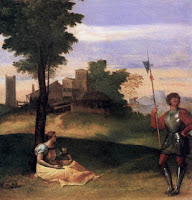
On my website I have presented my interpretation of the Tempest as "The Rest on the Flight into Egypt." I have also have also discussed the three paintings mentioned by Aikema. The first, formerly called, "Discovery of Paris," is actually "The Encounter with the Robbers on the Flight into Egypt." The second with three figures in a landscape by a "follower" of Giorgione is a "Rest on the Flight into Egypt," with Joseph's staff replaced by a halbred. The third depicts the meeting of the Holy Family with the young John the Baptist on their return from Egypt. If these three paintings are all "sacred" subjects what does that say about the Tempest, and what does it do to Aikema’s thesis?

###

Note: This post is a reprise of a earlier post on Giorgione et al... that appeared shortly after the Princeton symposium. 


Thursday, April 29, 2021

Giorgione's Tempest: A Vision


Rainer Metzger’s essay, “Everyday Life and Allegory, An Attempt to Understand Giorgione’s Tempesta” was one of four separate and contradictory attempts to interpret the Tempest in the 2004 Giorgione exhibition catalog, Giorgione, Myth and Enigma. * For Metzger the key to understanding the painting can be found in the young man who stands off to the side looking back at the nursing Woman.


“the gentiluomo has come from the background, from the town, a bridge has helped him abandon his urban life. On the far bank of the stream an ambience loaded with sentiment awaits him, dominated by ruins apparently left behind by antiquity and by now overgrown by nature….But it seems that the gentleman in his elegant breeches and the very latest fashion in codpieces has found a way to fight his way through to the promised land in the foreground. In this he has been supported by a shepherd’s crook, which is clearly only a prop and not an attribute, indicating not the beau’s profession but rather his obsession”….(114) 

The young man has no relationship with the Woman—she is a product of his imagination, an imagination based on his reading of the pastoral literature that was becoming popular in Venice around the year 1500. He is having a vision in the same way that Chancellor Rolin imagined the Madonna and Child in Van Eyck’s famous painting.


The nursing Mother in the Tempest is not a real woman but a personification of fertile nature.

“Here he observes nature in her freedom, and he sees her personified, in the shape of a nymph nursing a child. He sees her as he knows her, as he knows her from the writings that first caused him to take the path to the holy place of nature. It is perfectly obvious that she does not see him, living as she does in a different sphere.” (116)

For Metzger “there is no text, no single text alone, irrespective of its origins, able to explain the painting and its details motif by motif…”(115) The attempts of other interpreters to find the source in Plato, Virgil, Lucretius, or an ancient myth are futile. The city and storm in the background refer to no specific place or event; the broken columns are just antique ruins; and there is no mention of the prominent plant in front of the woman.

He does however attach much importance to one of the pentimenti revealed by technological examination—the nude woman dangling her feet in a stream at the lower left. Although the catalog entry argued that Giorgione never intended to place two women in the painting, Metzger believes otherwise and that the man was a later addition thereby creating a major problem for his interpretation. If the Man is the key figure in the painting, and if the painting represents his vision, why wasn’t he in the original version?

Moreover, like every other interpreter Metzger omitted a discussion of another pentimento discussed in the catalog—the little man on the bridge carrying a pilgrim’s sack. How does that fit into his interpretation?

The examples he uses are also problematic. In Van Eyck’s painting Chancellor Rolin kneels in an attitude of prayer facing the Madonna and Child. Giorgione’s Man faces the viewer but looks back over his shoulder at the Woman. Metzger can provide no image of a nursing nymph because they are never depicted lactating. He can only supply a crude reclining nude being ogled by an aroused satyr from the “Hypnerotomachia Poliphilo”.

Strangely enough, Metzger sees the Christian origins of the painting but since he can’t imagine that Giorgione would depict the Holy Family in this manner, he argues that the painter imposed a classical framework on the old model in order to suit his sophisticated patron.


“more important than any text is the painting, one painting, the Allegoria Sacra. Giorgione subjects it before the highly demanding level of Venetian aristocracy to a comparable reinterpretation from the Christian into the classical….But the vocabulary, the figures and the construction principles of the official route and of the sacred space with its location “somewhere” were Christian.” (115)


“Bellini’s Madonna is replaced, secularized, naturalized by the mythologically derived mother figure, and the holy quarter is a sacred grove.” (115)

He sees the Madonna and Child in the Tempest but cannot bring himself to believe his own eyes. 

###

*Ferino-Pagden, Sylvia, and Nepi-Scire, Giovanna: exh. Cat. Giorgione, Myth and Enigma, Vienna, 2004. This catalog was the result of the historic 2004 joint exhibition sponsored by the Accademia in Venice and the Kunsthistorisches Museum in Vienna. Historic, because for the first time the Tempest left Italy for the Vienna showing. The copious catalog entry did not take sides on the interpretation of the Tempest but left that to the four scholars. 


Thursday, April 15, 2021

Giorgione's Tempest: a Vergilian Interpretation

 In my interpretation of Giorgione's Tempest as the "Rest of the Holy Family on the Flight into Egypt," I did not address the many other interpretations. Not only did I want to concentrate on the actual painting, but also I believed that all the other interpretations had already been demolished by other learned scholars. As I said in my paper, not one interpretation remains standing. For example, if it's the mythical story of Paris and Oenone, it can't be the story of Demeter and Iasion. If the source is in Lucretius, then it can't be in Plato or Virgil. 


Nevertheless, this year I am revisiting some of these interpretations that I originally reviewed ten years ago. Most of them try to find the subject of the Tempest in ancient mythology or poetry. In two preceding posts I have discussed Lucretian and Platonic interpretations. Below find an analysis of a Virgilian interpretation by Rudolf Schier. *

 In Rudolf Schier’s “Giorgione Tempesta, a Virgilian Pastoral,” (Renaissance Studies, 22, Issue 4, 2008, pp. 476-506) we have another attempt to find the subject of the Tempest in the writings of a Roman poet. Schier argues that the source of the Tempest can be found in the Eclogues of Virgil, specifically the 1st and the 4th. In his paper Schier takes issue with other scholars but his own interpretation has serious omissions. 

Most importantly, Schier fails to explain the nudity of the Woman of the Tempest. He also does not even attempt to discuss the white cloth draped over her shoulder, or the plant prominently featured right in front of her. Schier’s interpretation centers on the Man in the painting who he claims is the poet/ shepherd of the Eclogues. For him the disparity between the simple shirt and jacket of the Man, and his fancy leggings indicates that Giorgione was making reference to the poet/shepherd represented in the Eclogues. I don’t think he does such a good job in this respect. First of all, it has been pointed out that the leggings are the dress of contemporary young Venetian patricians, and not that of a poet. Moreover, the Man is holding a staff and not a shepherd’s crook. Also, the Man in the Tempest is young and virile but, as Schier himself points out, the shepherd of the 1st Eclogue is an old man.

Schier maintains that the Woman and Child represent a “vision” of the poet based on the famous reference in the 4th Eclogue to a virgin giving birth to a son destined for great things. To portray the vision Giorgione “deconstructs” the traditional image of the Madonna of Humility into a Pagan virgin. Like others he sees the Madonna in the painting but can’t believe that Giorgione would actually portray her in such fashion. Besides his failure to deal with the “nudity” of the Woman, Schier seems to imply that in the poet’s “vision” she has just given birth. Yet the Child in the Tempest is obviously not a newborn. He supports himself upright, something a newborn could not do, while nursing at his mother’s breast.

Schier views the other elements in the painting in a similar complex fashion. The broken columns are first a sign that the poet is in “Arcadia,” but later come to symbolize the passing of the Pagan world and the coming of the Christian. He disputes Paul Kaplan’s identification of the city in the background and claims it is Jerusalem rather than Padua. But what does Jerusalem have to do with Virgil? He also disputes Kaplan’s dating of 1509 on questionable stylistic grounds. 

Finally, Schier includes a long discussion of the bathing woman in the underpainting. He regards her as a Roman fertility goddess mentioned in the Eclogues but removed by Giorgione because the Woman in the painting had already given birth. It is strange that he gives such attention to this “pentimento” while completely omitting any discussion of the other “pentimento,” the man on the bridge carrying a pilgrim’s sack over his shoulder. 

Schier is obviously well versed in his Virgil but his whole essay is based on the “assumption” that Giorgione’s knowledge of the Roman classic was as good as his own. Like so many other scholars, Schier views the young Giorgione more as an art historian or humanist scholar than as an artist. There is no evidence that Giorgione knew Virgil or Lucretius.

* Note: Dr. Schier responded at length to my original review article. I published his comments in a separate post. Since then, we have agreed to disagree and have continued an amicable correspondence.

###

Saturday, March 27, 2021

Interpretating the Tempest: Plato

In my interpretation of the Tempest as the "Rest of the Holy Family on the Flight into Egypt," I identified the nude Woman nursing her infant as the Madonna, and the colorfully dressed man on the side as St. Joseph watching over his family. I explained the nudity of the Woman as Giorgione's attempt to depict Mary as the Immaculate Conception. In offering this interpretation, I understood that there were many others but felt encouraged back in 2005 by the fact that there was no agreement on the subject of the famous painting. This year I have been revisiting my reviews of some of the other interpretations. Below is a review of an interpretation that finds the subject in Plato's Symposium.


In 2008 Regina Stefaniak published her interpretation of the Tempest based on her reading of Plato's Symposium.  Despite her obvious erudition and exhaustive notes, Stefaniak’s interpretation is a torturous attempt to fit the pieces of the painting into a puzzle that only an art historian could imagine. Her paper, “On Founding Fathers and the Necessity of Place, Giorgione’s Tempesta,” appeared in Artibus and Historiae, (XXIX, No. 58, 2008, pp. 121-155).

Before we get into her thesis I would like to note a couple of points. One is immediately alerted by her description of the child in the painting when she calls it ”newly-born.” In another place she uses the term “post-partum” to describe the woman. A new born baby could never hold its head erect as does the nursing child in the Tempest. The child is obviously supporting itself while it nurses at the mother’s breast. Secondly, like some others she claims that the storm in the background is about to engulf the figures in the foreground, despite the laws of perspective that would place the storm miles away. She sees the winds of the storm blowing in the trees. 

Next, she introduces the figure of Gabriele Vendramin, the owner of the painting when it was seen by Marcantonio Michiel in 1525, but doesn’t quite say that he was the original patron. Nevertheless, as her argument progresses it becomes clear that she assumes that Vendramin was the original patron, and by the end of her paper much of her thesis rests on that assumption. A good case can be made for Vendramin but there is no direct proof that he was the patron. We know that paintings were bought and sold and traded during this period. In his will Vendramin, himself, had to urge his executors not to break up or sell his collection. 

Speaking of Vendramin’s collection, a glance at Michiel’s notes shows that with the exception of a few contemporary portraits and the "little landscape" that we now call the Tempest, all the paintings and drawings were of sacred subjects, including a Flight into Egypt. 

Let’s turn to her description of the painting. For Stefaniak the Man and the Woman represent Wealth and Poverty, a theme derived from a story in Plato’s Symposium. The story deals with the seduction of the drunken god of wealth, Poros, by the impoverished nymph, Poenia. The child of their union is Eros. The Man then is a Venetian patrician who appears as a kind of country gentleman: a shepherd who does not have to work, whose staff is not exactly a crozier, and who has no flock. The Woman is a kind of earth mother. Actually, it is impossible to do justice to all the intricacies of Stefaniak’s interpretation for even though she rightly critiques other theories, she winds up including many of them in her own complex presentation. Indeed, at one point she says that Giorgione must have had a humanist advisor in order to depict all the different levels of meaning. She also suggests that Vendramin must have been pleased to know that he was the only one who knew the real subject of the painting. 

Stefaniak includes a discussion of the mysterious bathing woman that Giorgione painted over. However, like all the others who conjecture about this pentimento, she declines to discuss or even mention the other, pentimento; the little man on the bridge carrying a pilgrim’s staff and bundle. Is there a pilgrim in Plato? Finally, she omits to discuss the plant prominently placed in front of the nursing woman. What is it? Why is it there? 

Finally, it is interesting to note that  Stefaniak draws a comparison between the Tempest and Leonardo's Madonna of the Rocks. Although the latter painting was done for a chapel of the Immaculate Conception, she believes the depiction of the Madonna in an underground cave also derives from a passage in Plato. Actually, the subject of either version of the so-called Madonna of the Rocks is actually the Meeting of the Madonna and Child with the young John the Baptist on the Return from Egypt, a subject very popular at the time.


###

Saturday, March 13, 2021

Interpreting the Tempest: A Gipsy Woman with a Soldier


In 1530, 20 years after the death of Giorgione, Marcantonio Michiel saw the painting that would become known as the "Tempest" in the home of Venetian patrician, Gabriele Vendramin. In his notes Michiel wrote:"the little landscape on canvas, representing stormy weather and a gipsy woman with a soldier, is by Giorgio di Castelfranco." Since that time most scholars have argued that Michiel's descriotion was off the mark. The man is not a soldier and the woman nursing a child is not a gypsy. Today, only a few diehards call the woman a gypsy. (See the end of this post for an analysis of Paul Holberton's hypothesis).


Why did Marcantonio Michiel mistakenly identify the nude woman and the man in the “Tempest” as “a gipsy woman with a soldier”? After all, the nude woman nursing an equally nude infant does not resemble contemporary descriptions of a gypsy. Moreover, the young man’s posture might resemble that of a soldier but he is neither armed nor armored.

It seems obvious that Michiel’s notes were hastily drawn and fragmentary but why did he guess “a gipsy woman with a soldier” for the two characters in the famous landscape? I would like to offer the following as an hypothesis.

In one of his sermons Savonarola criticized the artists of his time for depicting the Madonna dressed in splendor and finery. He said, “think ye that the Virgin should be painted, as ye paint her? I tell ye that she went clothed as a beggar.”

This quotation from Savonarola’s “Prediche sopra Amos e Zaccaria,” is found in Professor Pasquale Villari’s monumental biography of Savonarola, originally published in 1888 after years of research in original sources, many of which he discovered hidden in Florentine archives. In his work Professor Villari devoted a few pages to the famous or infamous Dominican friar’s views on art and poetry. *

Villari disputed the notion, popular in his time and even more popular in ours, that Savonarola was a reactionary opponent of Art, Poetry, and Learning. Although known to popular history as the moving force behind the “Bonfire of the Vanities,” Savonarola was respected and admired by contemporary artists and philosophers.

Villari mentioned Fra Bartolommeo, the whole Della Robbia family, and Lorenzo di Credi, who according to Vasari was “a partisan of Fra Girolamo’s sect.” Vasari also wrote of Cronaca, “that he conceived so great a frenzy for Savonarola’s teachings, that he could talk of nothing else.” Even Sandro Botticelli was an ardent admirer “who illustrated the Friar’s works with beautiful engravings."

Finally, to prove his point Villari argued that ‘it is enough to mention the name of Michelangelo Buonarotti, known to be one of his most constant hearers, and who, in his old age, constantly read and reread the Friar’s sermons, and never forgot the potent charm of that orator’s gestures and voice.”

In the beginning of the sixteenth century it would appear that attempts were made to portray the Madonna as a poor beggar especially in paintings depicting the Rest on the Flight into Egypt. In these paintings Joseph was depicted as an armed protector of the Madonna and Child. Edgar Wind in “Giorgione’s Tempesta” referred to two unusual, almost inexplicable images of a soldier standing guard over a woman and child. Both of these paintings bore a striking resemblance to the "Tempest".


In the first, attributed by Wind to a “Follower” of Giorgione, there are three figures in a landscape. In the foreground a fully clothed but plainly dressed woman sits on the ground with her infant son standing beside her supported by her arm. She is left of center and looks to the right in the direction of an armored soldier standing guard. He leans not on a staff but on a formidable looking halberd, a weapon associated with the Swiss soldiers imported into Italy by Julius II during the Cambrai war. For Wind the subject of the painting was an allegory, “Fortezza and Carita,” the same subject he claimed for the "Tempest". This painting which I consider to be a version of the Rest on the Flight into Egypt could easily be described as a soldier and a gypsy.


Wind called the second painting “The Peaceable Warrior (ex bello pax).” He attributed it to Palma Vecchio, a contemporary of Giorgione. It is now in the Philadelphia Museum of Art where it is identified as an “Allegory.” This painting is also a depiction of the encounter of the Holy Family with the young John the Baptist on their return from Egypt. In the center a young nude Jesus stands and embraces his equally nude elder cousin. A heavily armed Joseph stands off to the right watching over the Madonna and the children. A plainly dressed Madonna sits on the ground observing the children. She wears the headscarf or turban associated with gypsy women!

So even though Giorgione did not paint a “gypsy” woman or a soldier in the "Tempest", the similarity of his painting with depictions of a Madonna dressed like a beggar in the desert with a protector standing guard might have led to Michiel’s mistake 20 years later.

Below find my analysis of Paul Holberton's "gypsy" hypothesis. See Paul Holberton: “Giorgione’s Tempest”, Art History, vol. 18, no. 3, September 1995. (Holberton has posted the article on his website with a slide show.)

In a paper published in 1995 Paul Holberton argued that Marcantonio Michel’s original description of the woman depicted in Giorgione’s "Tempest" is indeed correct. He wrote, “the fact remains that although they differ in their descriptions of the man, both Michiel and the 1569 inventory [of the estate of Gabriele Vendramin] identify the woman as a gypsy.”

For Holberton the "Tempest" has a subject and it is a gypsy family wandering on the outskirts of society about to be engulfed by a storm. He pursues this thesis even though both Michiel and the 1569 inventory do not identify the man as a gypsy. For Michiel, he was a soldier, but in the 1569 inventory he had become a shepherd.

Holberton provided some very useful information on gypsies and the way they began to be depicted in art at the end of the fifteenth century, but his thesis is full of holes. In the first place, he never really explained the nudity of the woman in Giorgione’s painting. He argued that gypsies were depicted as “primitives” but they still are not depicted in the nude. Certainly, there is nothing primitive about the woman of the "Tempest." Look at her hair, for example. If she is a primitive, than you would also have to call the Dresden "Sleeping Venus" a primitive.

Secondly, the handsome young man of the "Tempest", dressed in the garb of a Venetian patrician, can hardly be called a primitive or a gypsy. There is no relationship between his finery and the nudity of the woman and child. How can they belong to the same family? None of the plates that Holberton presented in his paper shows such a striking dis-similarity in the clothing of the major figures.

Next, he confesses that he has no explanation for the broken columns and ruins in the painting. “What does the column symbolize? In my opinion it is no more symbolic than the trees…” Neither does he attempt to identify the plant featured so prominently in the foreground, nor does he see any significance in the city in the background.

Nevertheless, Holberton came so close. If he could only have seen the "Tempest" as Giorgione’s version of the "Rest on the Flight into Egypt", so much of his evidence would have fallen easily into place. Instead of claiming that identifications of images of the Madonna were mistaken, he should have asked why the Madonna came to be depicted wearing a gypsy headdress in some of the paintings he describes.

De' Barbari: Holy Family

At one point he argued that a de’ Barbari drawing could not be a Holy Family because of the gypsy headpiece of the woman. Yet, Correggio painted a Madonna and Child where the Madonna appears with a similar headpiece, and it is commonly called La Zingarella.

Correggio: Madonna and Child
###


*Professor Pasquale Villari, Life and Times of Girolamo Savonarola, New York, tenth edition, 1909. pp. 495-499.