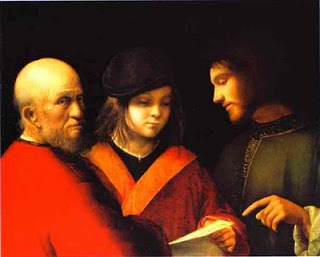
Since 2010 I have been using this site to discuss my interpretations of famous Renaissance paintings including Giorgione's "Tempest" as "The Rest on the Flight into Egypt"; his "Three Ages of Man" as "The Encounter of Jesus with the Rich Young Man"; Titian's, "Sacred and Profane Love" as "The Conversion of Mary Magdalen"; Titian's "Pastoral Concert" as his "Homage to Giorgione", and Michelangelo's"Doni Tondo." The full papers can now be found at academia.edu.

Saturday, March 13, 2021

Interpreting the Tempest: A Gipsy Woman with a Soldier


In 1530, 20 years after the death of Giorgione, Marcantonio Michiel saw the painting that would become known as the "Tempest" in the home of Venetian patrician, Gabriele Vendramin. In his notes Michiel wrote:"the little landscape on canvas, representing stormy weather and a gipsy woman with a soldier, is by Giorgio di Castelfranco." Since that time most scholars have argued that Michiel's descriotion was off the mark. The man is not a soldier and the woman nursing a child is not a gypsy. Today, only a few diehards call the woman a gypsy. (See the end of this post for an analysis of Paul Holberton's hypothesis).


Why did Marcantonio Michiel mistakenly identify the nude woman and the man in the “Tempest” as “a gipsy woman with a soldier”? After all, the nude woman nursing an equally nude infant does not resemble contemporary descriptions of a gypsy. Moreover, the young man’s posture might resemble that of a soldier but he is neither armed nor armored.

It seems obvious that Michiel’s notes were hastily drawn and fragmentary but why did he guess “a gipsy woman with a soldier” for the two characters in the famous landscape? I would like to offer the following as an hypothesis.

In one of his sermons Savonarola criticized the artists of his time for depicting the Madonna dressed in splendor and finery. He said, “think ye that the Virgin should be painted, as ye paint her? I tell ye that she went clothed as a beggar.”

This quotation from Savonarola’s “Prediche sopra Amos e Zaccaria,” is found in Professor Pasquale Villari’s monumental biography of Savonarola, originally published in 1888 after years of research in original sources, many of which he discovered hidden in Florentine archives. In his work Professor Villari devoted a few pages to the famous or infamous Dominican friar’s views on art and poetry. *

Villari disputed the notion, popular in his time and even more popular in ours, that Savonarola was a reactionary opponent of Art, Poetry, and Learning. Although known to popular history as the moving force behind the “Bonfire of the Vanities,” Savonarola was respected and admired by contemporary artists and philosophers.

Villari mentioned Fra Bartolommeo, the whole Della Robbia family, and Lorenzo di Credi, who according to Vasari was “a partisan of Fra Girolamo’s sect.” Vasari also wrote of Cronaca, “that he conceived so great a frenzy for Savonarola’s teachings, that he could talk of nothing else.” Even Sandro Botticelli was an ardent admirer “who illustrated the Friar’s works with beautiful engravings."

Finally, to prove his point Villari argued that ‘it is enough to mention the name of Michelangelo Buonarotti, known to be one of his most constant hearers, and who, in his old age, constantly read and reread the Friar’s sermons, and never forgot the potent charm of that orator’s gestures and voice.”

In the beginning of the sixteenth century it would appear that attempts were made to portray the Madonna as a poor beggar especially in paintings depicting the Rest on the Flight into Egypt. In these paintings Joseph was depicted as an armed protector of the Madonna and Child. Edgar Wind in “Giorgione’s Tempesta” referred to two unusual, almost inexplicable images of a soldier standing guard over a woman and child. Both of these paintings bore a striking resemblance to the "Tempest".


In the first, attributed by Wind to a “Follower” of Giorgione, there are three figures in a landscape. In the foreground a fully clothed but plainly dressed woman sits on the ground with her infant son standing beside her supported by her arm. She is left of center and looks to the right in the direction of an armored soldier standing guard. He leans not on a staff but on a formidable looking halberd, a weapon associated with the Swiss soldiers imported into Italy by Julius II during the Cambrai war. For Wind the subject of the painting was an allegory, “Fortezza and Carita,” the same subject he claimed for the "Tempest". This painting which I consider to be a version of the Rest on the Flight into Egypt could easily be described as a soldier and a gypsy.


Wind called the second painting “The Peaceable Warrior (ex bello pax).” He attributed it to Palma Vecchio, a contemporary of Giorgione. It is now in the Philadelphia Museum of Art where it is identified as an “Allegory.” This painting is also a depiction of the encounter of the Holy Family with the young John the Baptist on their return from Egypt. In the center a young nude Jesus stands and embraces his equally nude elder cousin. A heavily armed Joseph stands off to the right watching over the Madonna and the children. A plainly dressed Madonna sits on the ground observing the children. She wears the headscarf or turban associated with gypsy women!

So even though Giorgione did not paint a “gypsy” woman or a soldier in the "Tempest", the similarity of his painting with depictions of a Madonna dressed like a beggar in the desert with a protector standing guard might have led to Michiel’s mistake 20 years later.

Below find my analysis of Paul Holberton's "gypsy" hypothesis. See Paul Holberton: “Giorgione’s Tempest”, Art History, vol. 18, no. 3, September 1995. (Holberton has posted the article on his website with a slide show.)

In a paper published in 1995 Paul Holberton argued that Marcantonio Michel’s original description of the woman depicted in Giorgione’s "Tempest" is indeed correct. He wrote, “the fact remains that although they differ in their descriptions of the man, both Michiel and the 1569 inventory [of the estate of Gabriele Vendramin] identify the woman as a gypsy.”

For Holberton the "Tempest" has a subject and it is a gypsy family wandering on the outskirts of society about to be engulfed by a storm. He pursues this thesis even though both Michiel and the 1569 inventory do not identify the man as a gypsy. For Michiel, he was a soldier, but in the 1569 inventory he had become a shepherd.

Holberton provided some very useful information on gypsies and the way they began to be depicted in art at the end of the fifteenth century, but his thesis is full of holes. In the first place, he never really explained the nudity of the woman in Giorgione’s painting. He argued that gypsies were depicted as “primitives” but they still are not depicted in the nude. Certainly, there is nothing primitive about the woman of the "Tempest." Look at her hair, for example. If she is a primitive, than you would also have to call the Dresden "Sleeping Venus" a primitive.

Secondly, the handsome young man of the "Tempest", dressed in the garb of a Venetian patrician, can hardly be called a primitive or a gypsy. There is no relationship between his finery and the nudity of the woman and child. How can they belong to the same family? None of the plates that Holberton presented in his paper shows such a striking dis-similarity in the clothing of the major figures.

Next, he confesses that he has no explanation for the broken columns and ruins in the painting. “What does the column symbolize? In my opinion it is no more symbolic than the trees…” Neither does he attempt to identify the plant featured so prominently in the foreground, nor does he see any significance in the city in the background.

Nevertheless, Holberton came so close. If he could only have seen the "Tempest" as Giorgione’s version of the "Rest on the Flight into Egypt", so much of his evidence would have fallen easily into place. Instead of claiming that identifications of images of the Madonna were mistaken, he should have asked why the Madonna came to be depicted wearing a gypsy headdress in some of the paintings he describes.

De' Barbari: Holy Family

At one point he argued that a de’ Barbari drawing could not be a Holy Family because of the gypsy headpiece of the woman. Yet, Correggio painted a Madonna and Child where the Madonna appears with a similar headpiece, and it is commonly called La Zingarella.

Correggio: Madonna and Child
###


*Professor Pasquale Villari, Life and Times of Girolamo Savonarola, New York, tenth edition, 1909. pp. 495-499.

Saturday, February 27, 2021

Giorgione's Tempest: Lucretian Interpretation

In 2003 Stephen J. Campbell argued that the Tempest was “a portrait of didactic or philosophical poetry,” whose source could be found in the “De Rerum Natura,” the most famous work of the Roman poet and philosopher, Lucretius. Five years later in separate papers both Rudolf Schier and Regina Stefaniak gave little credence to Campbell’s interpretation and argued that the source of the Tempest could be found in their own favorite Classical authors, Virgil and Plato respectively. All three pointed to the popularity of their favorites during the Renaissance but then had to undertake the arduous task of making the pieces of the Tempest puzzle fit. 


Campbell’s interpretation, entitled “Giorgione’s Tempesta, Studiolo Culture and the Renaissance Lucretius,” appeared in 2003 in Renaissance Quarterly, 56-2 (Summer, 2003). He examined most of the major iconographical elements in the painting. Let’s look at them one by one.

In the first place, he did not believe that there was any relationship between the Man and the nursing woman in the painting. He wrote, “the figures appear not only spatially but psychologically isolated; it is by no means apparent that they are aware of each other.” (309) Like others he ignored the fact that the Man is looking right at the Woman in the same way that he does in two other paintings that Campbell noted bore a resemblance to the Tempest, but that do constitute a family group. He wrote that the Tempest:

 “could be classed with a series of depictions of family-like groups in landscapes from around 1510-15, such as the Landscape with Halbardier, Woman and Two Children from the Palma Vecchio circle and the Nursing Mother with Halbardier in a Landscape attributed to Titian. However, while these other Venetian works correspond in some formal respects to Giorgione’s picture, there is no consequent basis for the assertion that they reproduce its subject and its meaning.” (307) 


In fact, even though the Man in each of these paintings carries a halberd, they are both depictions of episodes in the sojourn of the Holy Family in Egypt. If it weren’t for the halberd, no one would take the one with two nude children embracing as anything other that the meeting of the Infant Jesus with John the Baptist on the return from Egypt. *

If the figures in the Tempest are not a family, who are they? For Campbell the answer lies in Lucretius. “All of the crucial elements of Giorgione’s painting—wanderer, nursing nude female, ruined columns, and, most importantly, the lightning bolt—can be accounted for through Lucretius’ poem… Nonetheless, the painting is not an illustration of Lucretius: it is an imitation…” (316) 

What about the Man in the Tempest? For Campbell he is the “epicurean philosopher in Lucretius’ poem… characterized throughout as a wayfarer; this includes both Epicurus and the poet, his disciple...” (319) He could be Epicurus or Lucretius, or just “the wanderer figure, whose clothing bears the signs of urban sophistication, [who] has embarked on a literal ‘marching beyond the walls’…he could be a contemporary “epicurean” who has left the city to pursue truth at the point where civilization gives place to nature.“ (320) In short the Man is the “Epicurean poet contemplating his materia.” …”Standing apart to the left, the man like the viewer, calmly surveys the entire spectacle, in its totality: the gathering clouds, the bolt of lightning which renders the city walls below incandescent, perhaps also the mother and child. Both he and she see the storm for what it is, not as a portent or as the raging of a deity, but as the indifferent motion of the elements….”(319) Given that by the rules of perspective the storm is far in the distance, and that the trio are bathed in sunlight, and that the Man has turned his back on the storm, and that he appears totally unconcerned, it seems that Campbell is reading an awful lot into Giorgione’s painting.

This brings us to the nursing Woman. The wandering poet has stumbled upon Venus or a Venus de-mythologized. “In other words, she is not Venus, but a mortal body in which a certain natural property of living things—the ability to arouse desire, to generate and to nurture, a property to which poets and superstitious people had given the name “Venus”—has manifested itself.” [325] He even brings in the Madonna. “Giorgione has made every effort to humanize, even de-mythologize the figure of the divina genitrice…removing her from her shrine and trappings of divinity, accentuating her nudity, and placing her upon the earth like a Madonna of Humility.” [325] But she might also represent Wisdom. “Once again, however, in the Tempest we see not wisdom, but wisdom, as it were, incarnate, in a singularly undivine manifestation.” [325]

Campbell devoted much attention to the lightning since Lucretius took pains to de-mystify this natural phenomenon. Even though the broken columns are not near the storm they are a symbol of how the temples of the gods are not impervious to the forces of nature. He spent little time on the city in the background even though it suffers the brunt of the storm. He mentioned the connection to the Cambrai war discussed in earlier papers by Deborah Howard and Paul Kaplan but tended to downgrade any historical context. Like most others he ignored the prominent plant in the foreground.

Finally, he accepted the common opinion that Gabriele Vendramin was the original owner of the painting and made much of Vendramin’s interest in classical antiquity. “Giorgione’s painting will be identified with a humanist theory and practice of poesia around 1500, but a conception of which would also have been meaningful for the first owner of the picture, the Venetian patrician and collector Gabriele Vendramin (1484-1552).” [301] Furthermore, “Vendramin…was one of several patricians who sought to associate himself, as patron and collector, with the world of classical scholarship and antiquarianism,…Among other paintings by Giorgione, Vendramin owned a work known as The Education of Marcus Aurelius, again suggesting that Vendramin found affirmation of his own morally rigorous outlook in the ethical and pedagogical legacy of the ancient philosophers.“(304) 

This reference to “The Education of Marcus Aurelius” is problematical. The painting which is in the Pitti Palace is usually called “The Singing Lesson,” or “The Three Ages of Man” and was only identified as Marcus Aurelius in an inventory of 1666. I have argued on my website, MyGiorgione, that it is really a depiction of a “sacred” subject, “The Encounter of Jesus with the Rich Young Man.” 


In any event, we know that when Vendramin, whether or not he was the original owner of the Tempest, went into his camerino to contemplate, his walls were covered primarily with “sacred” subjects. It was not for nothing that Titian would later depict him and his family venerating a relic of the True Cross. 


###

*The first painting is now in the Philadelphia Art Museum where it is labeled, "Allegory." The second is in Harvard's Fogg Art Museum and is usually called, "Rustic Idyll." These two paintings were discussed previously on Giorgione et al....

Saturday, February 13, 2021

Interpreting the Tempest: Paris and Oenone


In his essay, “The ‘Favola’ in Giorgione’s Tempesta,” in the 2004 Giorgione exhibition catalog, Jurgen Rapp found the subject of the painting in the mythological story of Paris and Oenone. Rapp took issue with those interpreters, including some in the same catalog, who claimed that there is “no subject” in Giorgione’s most famous painting.


Observation alone forbids viewing the picture,…mainly as a landscape, in which the human figures play a subordinate role as atmospheric decoration. The expressive size and power of the figures, which dominate the lower half of the picture, are in this case independent and provide a precisely balanced counterweight to the landscape that extends into the upper half of the painting….(119)
His short essay, a summary of a larger dissertation, attempted to fit all the iconographical elements into the story of the two ill-fated lovers, Paris and Oenone. It is necessary to provide a brief recap of the legend. 


Peter Lastman: Paris and Oenone, 1619
Worcester Art Museum

As we know from Homer, Paris was the son of King Priam of Troy and his wife, Hecuba. At the birth of Paris, Hecuba had a dream that was interpreted to mean that her new son would be responsible for the destruction of Troy.

To avert this disaster, the parents decided to put their son to death by exposing him to the elements on Mt. Ida. However, he was saved and raised to maturity by a shepherd and grew up to be a shepherd himself, albeit an extremely handsome one. Eventually, his looks caught the attention of the seer-nymph Oenone, daughter of the Ilian river Kebren. They married and she bore his child, Korythos.

Soon after, Paris gets involved in the famous beauty contest known as the Judgment of Paris. Asked to decide who is most beautiful, Juno, Athena, or Aphrodite, he chooses Aphrodite after she bribes him by promising him Helen, the most beautiful woman in the world.

He promptly deserts Oenone and his newborn son, Korythos, and returns to Troy and the rest is history. Not unexpectedly, Oenone is broken-hearted, bitter and enraged. In the post-Homeric legends her son grows up to be even more handsome than Paris. He also travels to Troy where his looks attract Helen. Paris responds by killing Korythos. Later Paris is fatally wounded by a poisoned arrow and returns to Oenone, the only one whose healing powers can save him. Still angry, she refuses and he dies. Quickly repenting she kills herself and both she and Paris are buried in the same grave.

Not surprisingly, in Rapp’s interpretation the key to the painting is Paris, the man on the left.

The key…is to be found in the figure of the standing young man with the crook. The inconsistency of his choice of dress is immediately noticeable: on the one hand the extravagant breeches that point to a noble warrior, on the other a simple, casually worn shirt, and a doublet loosely slung over his shoulders, which in combination with the crook, indicate a shepherd….(119)
Rapp saw Paris in the act of deserting Oenone and their son.

Giorgione depicts the moment, when Paris bids farewell to his nymph Oenone and their child Korythos at the Kebren spring on Mount Ida. As he pauses one last time and looks back to his family, his right foot and the crook are already pointed toward the edge of the picture; in the next moment he will leave the scene. (122)

Although Rapp stressed the importance of looking at the painting, I believe that this observation is way off. I don’t believe that any observer of this masterpiece has ever seen the Man in the process of exiting stage left. Some have claimed that the Man has just encountered the woman, or that he has stumbled upon her in a wilderness. Some think that he might even be thinking of assaulting her. Others claim that she only exists in his imagination.

In my interpretation of the Tempest as “The Rest on the Flight into Egypt,” the Man is St. Joseph and he stands on guard watching over the Woman and Child. Artistically, he acts as an Albertian “interlocuter” directing the viewer’s attention to the nursing woman and her Child. In no way is the Man the central or focal point of the painting.

I also question Rapp’s observational skills concerning the woman whom he identified as the seer-nymph Oenone.

After Paris has left her, the naiad is cast down by a bottomless grief, which soon turns to raging jealousy. (120)…the prophetic woman begins to see the dark fate with her gliding gaze. (122)

How is it possible to see “bottomless grief” and “raging jealously” in the look that Giorgione’s woman directs not at the Man but at the viewer of the painting?


Rapp took on most of the other iconographical symbols. The broken columns in the mid-ground represent the common grave of Paris and Oenone. The City in the background represents besieged Troy.

Thunder, lightning and storms as heralds of personal and political catastrophes were also the subject of the widespread thunder books, called ‘brontologies’." (121-2)

He pointed out that Padua identified itself with ancient Troy. He identified the bird on the rooftop as a heron, and noted that Virgil called the heron a harbinger of tempests. But he drew no connection between the siege of Padua in 1509 during the Cambrai war and the siege of Troy. He dated the painting to 1508.

Despite the importance Rapp attached to Paris, he believed that the pentimenti revealed by scientific studies indicated that the Man was not in the “earlier” version. “The figure of Paris was painted over the left-hand naiad only later.” The earlier version included Oenone’s sister, Astarte, the goddess of lightning.

The earlier version…represents a mental image in a pessimistic mood, or more precisely, a ‘pictorial’ elegy on the unhappy consequences of love, sketched with two mythological fates of women. (122)

Like other interpreters he did not discuss the other pentimento—the little man on the bridge carrying a pilgrim’s staff. Is such a character Homeric?

Finally, it can be said that Rapp’s thesis is partially based on a mistaken identification.

Giorgione and his circle repeatedly used subjects from the youth of Paris,…For Giorgione himself the following are attested: Discovery of the Child Paris (previously in the collection of Taddeo Contarini) and a Judgement of Paris, a “Fauola di Parride” (drawn copy in the inventory of the collection of Andrea Vendramin. (119)


The latter drawing is reproduced in the catalog as “after Giorgione.” The “Discovery of the Child Paris” originally in the Contarini collection only exists today in a seventeenth century copy. In my paper on the Tempest I have demonstrated that this “lost” Giorgione actually represents “The Encounter of the Holy Family with Robbers on the Flight into Egypt.”

If this pillar of Rapp’s interpretation falls to the ground, what happens to the whole edifice?

###

Jurgen Rapp: “the ‘Favola’ in Giorgione’s Tempesta.” Ferino-Pagden, Sylvia, and Nepi-Scire, Giovanna: exh. Cat. Giorgione, Myth and Enigma, Vienna, 2004. Pp. 118-123.


Thursday, January 28, 2021

Giorgione: Tempest Pentimenti

 I did not include a discussion of the "pentimenti" in the "Tempest" in my original paper because I believed that the painting should be evaluated on what Giorgione finally decided he wanted the viewer to see.  However,  because of the continuing interest in the "pentimenti", I  published an essay on the subject  at Giorgione et al... on October, 24, 2010. I repost it here with only slight changes. While not necessary in supporting an interpretation of the painting as "The Rest on the Flight into Egypt," the "pentimenti" do not contradict it, especially the heretofore inexplicable little man on the bridge. See the following.


In Giorgione, Myth and Enigma, the catalog for the ground breaking 2004 Giorgione exhibition, the essay on the Tempest by Giovanna Nepi-Scire included a discussion of “pentimenti” or “changes of mind” revealed by the scientific exploration of what lies beneath the surface of the famous painting.

X-ray and radiographic technology did shed some light on the techniques of the painter and the materials he used but the results were inconclusive when it came to the meaning and subject of the painting. The "pentimenti" did not reveal much of Giorgione's original intention. Or did they?

One of the discarded figures in the underpainting had already received much attention from scholars. Originally, the canvas included a nude woman dipping her legs in a stream at the lower left hand corner. The catalog article indicated that some scholars believe that this figure provides an important clue even though the radiographic image is so indistinct that it is impossible to say whether the figure was even part of the original painting, or whether it was even painted by Giorgione. (Reproductions of this pentimento are an artist's rendering of the very indistinct x-ray image.)


For some, however, the “bathing woman” indicates that Giorgione originally intended the painting to contain two women. This contention would necessarily send the hunt for a “subject” into an entirely different direction.

However, the size of this bathing figure in relation to the nursing woman led the author of the catalog entry to reject the theory that Giorgione had originally intended to place two women in the painting. “In addition, the proportions appear slightly larger than those of the man and the nursing woman in the final version. If this figure really was part of the initial version, then there must have been a male figure on the right…” [p. 192]

Interestingly, a “bathing Madonna” would not be out of place in a depiction of the “Rest on the Flight into Egypt.” One of the apocryphal legends refers to a fountain near the Egyptian village of Matarea that sprang up to nourish the Madonna and her child. In his “Madonna della Scodella,” Correggio painted a version of the Rest on the Flight into Egypt with Mary dipping a bowl into a stream.

But, in my opinion, there is a much more telling pentimento. The Catalog indicated that the radiographic technology revealed,

the presence of a figure walking across the bridge in a long robe and carrying over his right shoulder a stick with a suspended load. (p. 192)

According to the Catalog this discovery contributed “nothing to the deciphering of the painting,” and there has been very little discussion of the little man since.

However, a walking man with a stick bearing a sack over his shoulder is easily recognizable as a pilgrim. St. Joseph’s sack is commonplace in depictions of the Flight into Egypt. Often in depicting the “Rest on the Flight into Egypt,” artists used a narrative format, which included the actual journey in the background and the resting figures in the foreground.

In one of Gerard David’s version of the “Rest on the Flight into Egypt” the Madonna sits in the foreground nursing her Son while in the background she rides atop the Ass with Joseph trailing behind on foot carrying over his shoulder a stick with a suspended load.

Gerard David: Rest on the Flight into Egypt
Metropolitan Museum, NY


This piece of evidence fits no other interpretation of the Tempest. Why would a pilgrim be in a mythological or classical setting? It is only explicable in reference to the “Flight into Egypt.”

Because the man is on the bridge, he must have been in the original painting but then Giorgione changed his mind. I can only guess that he realized he didn’t need it or that it would have been cumbersome to also include a miniature animal and rider.

To argue that Giorgione depicted a traditional subject in the Tempest should in no way detract from his greatness. Another article in the Catalog [“Giorgione’s Materials and Painting Technique: Scientific Investigation of Three Paintings,”] indicated that in technique Giorgione was more traditional than commonly believed.

One could say that the artistic revolution caused by Giorgione does not necessarily translate into strictly technological innovation….Instead, there is clear evidence of an ability to utilize the extensive materials available in Venice and of a sound knowledge of the painting techniques accumulated by Venetian workshops during the 15th century….This demonstrates how the greatness of an artist is in no way bound by ‘vile matter. [p. 260]

### 

Thursday, January 14, 2021

Interpreting the Tempest: Salvatore Settis, Adam and Eve.

Last year the posts on Giorgione et al... were all devoted to the various interpretive discoveries that followed upon my initial intuition that Giorgione's Tempest had a sacred subject, "The Rest of the Holy Family on the Flight into Egypt." This year I intend to reprise some of the review articles that have appeared on this site since its inception in 2010. I begin with a review of Giorgione's Tempest by Salvatore Settis, the essential starting point for any student of Giorgione.


In researching my interpretation of the Tempest as “The Rest on the Flight into Egypt,” no book has been of greater assistance than Giorgione’s Tempest, written by Salvatore Settis in 1990. In addition to providing an in depth analysis of practically every previous interpretation, Professor Settis also laid down a series of iconographical ground rules that should be used in any interpretation. 

For example, in his introduction he noted:

“Interpreting the Tempest means providing “a well documented explanation for each feature, and fitting all together into one persuasive framework.” (2)

Indeed, he came very close to identifying the subject of Giorgione’s most famous painting. At least he did see that the painting had a “sacred subject” but instead of seeing the Woman as Mary, the new or second Eve, he identified her as the original Eve nursing her first-born son, Cain. The Man in the painting is Adam in the guise of a Venetian aristocrat accompanying his wife after their expulsion from the Garden of Eden.

Even though his book is a must for anyone interested in Giorgione, his ingenious and painstaking interpretation came under serious criticism and was accepted by virtually no one. He argued that the famous painting must be treated like a puzzle and that in any interpretation all the pieces must fit, and fit easily without being squeezed into position. 

Unfortunately, he often violated his own maxim. The major pieces of the puzzle are the Man, the Woman and Child, the broken columns, the plant in the foreground, and the storm and city in the background. 


For Settis, the Man is Adam after the expulsion from the Garden of Eden. The nude Woman is Eve nursing her newborn son, Cain. The broken columns are a symbol of death which has entered the world as a result of sin. The plant is there to cover Eve’s nakedness, although obviously doing a very poor job. The city in the background is the lost Paradise forever barred to the Man and Woman who are doomed to a life of toil and hardship. The storm and lightning represent the wrath of God not only on the erring couple but also on what he called a serpent slithering into the rock beneath the heel of the woman. 

Here are his words concerning the Man and the Woman:


 “Adam leans, not on the short-handled spade of his Bergamo counterpart, but on a singularly long staff: various interpreters have agreed that this could be a soldier’s lance, a traveler’s wand or simply a generic tool. The allusion to the manual labor prescribed in the biblical text is underplayed, almost fleeting, for this Adam is an elegant Venetian…The medieval tradition portraying Adam at work…has evolved to show Adam at rest, with Eve as mother at his side….” (113)

 “The handsome clothes belong to a Venetian gentleman, not to a peasant or a fisherman, and are appropriate with the attenuated image of the tool:  in the hands of this meditative, or resting, figure the staff must allude to manual labour. Neither spade nor hoe, it has a point at one end but so hidden in the grass that it is only visible on a close and careful examination.” (114)


 “Eve is seated opposite him a white wrap that barely covers her. (sic) The baby in her lap and her own nakedness indicate recent childbirth, a familiar schema in earlier art. The slender bush that grows out in front of her cannot be a simple decoration in this painting of such deliberate construction: its compositional importance has already been noted by other interpreters…who have tried in vain to establish its meaning.” (115)


In chapter 4 Settis provided a number of images of Adam and Eve after their expulsion from the Garden of Eden. It was an impressive feat but in every image the Man and the Woman do not exhibit the disparity of clothed and unclothed figures found in the Tempest. 

For example, in Amadeo’s, Bergamo bas-relief, both Adam and Eve are nude, just as they are in Jacopo della Quercia’s relief in St Petronio in Bologna. In all the other images it is the same. Either Adam and Eve are both nude, or both clothed. 

The Adam in these images is always a rustic laborer, and not the poised Venetian aristocrat of Giorgione’s painting. This development is one of the main props for the “hidden subject” thesis proposed by Settis. Moreover, the Adam in these images is usually the central or focal point, but in the Tempest the Man directs the viewer’s attention to the Woman and Child.

The Woman’s nudity is only explained as a sign of “recent childbirth,” but the child in the Tempest is obviously almost a year old. He holds himself up nicely while nursing. Settis did not identify the plant in the Tempest, but he did argue that it is there to cover the Woman’s nakedness. He also argued that the dead root beneath the woman’s heel was not part of the plant but the “serpent” slithering into the rock fleeing God’s wrath.

Settis, like some others, argued that the lightning bolt in the background was a symbolic representation of God, and that it and the storm were hovering over the couple forever banished from Paradise. The gates of Paradise have forever been closed to them and the broken columns are symbolic of death. Yet according to the rules of perspective the storm and lightning bolt are miles in the distance. Moreover, in the foreground the couple is bathed in sunlight. They show no trace of fear, anxiety, or loss.

Speaking of Paradise, why would one of the buildings show an emblematic representation of Padua’s Carrara family? 

Salvatore Settis, Giorgione’s Tempest, Interpreting the Hidden Subject, Chicago, 1990.

Dr. Francis P. DeStefano

5/6/2011

Note: Below are some relevant notes from Settis' text.

Chapter 1. Subject and Non-Subject.

p.2. “If we can perceive the beauty of an object within its meaning and not outside it, within its history and not outside it, and if we can comprehend and not simply admire, attribute and acquire, perhaps then we can really slaughter the ‘art’ which we have invented and free it from a contrived immortality.”

p.2. “In the study of art…the history of form has gradually parted company from the history of content: ‘art criticism’ elaborates lists of attributions and comments on aesthetic value and is thus de facto opposed to iconology, which attempts to decipher the meaning of inherited images.”

p.3. “The great, regal, public museum,…the bourgeois drawing-room…In both of them statues and pictures are snatched from their original context, in which co-ordinates of meaning were mapped our around them, and are offered to the visitor for their aesthetic value only.”

p.4. “Art criticism has thus produced pages of exquisitely artistic prose which deliberately competes in stylistic effect with the picture it describes, as well as pages of awkwardly-phrased enthusiasm. But in both cases the cost has been a high one: by favoring form, the function of a statue or painting as bearer of a message…has been completely overshadowed.”

p.10. “A complete understanding of a statue or a painting should place the question of style within the framework of careful research on its meaning as a vehicle of communication, and on its ways of expressing that meaning. For form and content…are born at the same time…”

p.13. “Vasari’s words bear witness to the difficulties of understanding Giorgione’s subjects, even a few decades after his death….Bur Vasari must have momentarily lost his concentration when he looked at the four facades of the Fondaco….The few things we do know about the decoration of the Fondaco indicate a precise iconographical Programme, however disjointed its features may seem to be.”

C. 4.  Interpreting the Tempest,

p.82. “it is usually the case that we instantly recognize a picture  of a woman and child as Mary and Jesus….We recognize Virgin and Child above all by means of the many different images in our memory and form, as it were, a single type. It is visual experience itself, repeated over and over again, but always receptive, that tells us the title of the picture.” …

p.82. “But that memory can be lost; and when this happens an image that was created for a public that could understand it becomes incomprehensible to observers who are alien to that particular figurative culture. This can give rise to absurd and fantastic interpretations.”

c. 5. The Hidden Subject

p. 129. “In choosing a painting as a vehicle for expressing personal feelings, ‘inventiveness’ must have been severely hampered by the inescapable weight of authority represented by previous iconographic tradition. The transformation of an ‘interior subject’ into something less comprehensible entailed searching out an unusual iconography, and also perhaps attenuating its meaning by eliminating or toning down its essential features.”

p. 129/130. “Even more complex and difficult was the task of fitting a religious theme into this ‘closed’ and private use of art….But to a painter in the time of Palma il Vecchio and Giorgione, a Christian subject would have had a different weight….The codification of iconography for religious subjects must have been that much more forceful for being accepted as serving the true Christian faith. Equally, it was that more difficult to dare to choose a Christian theme as a way of expressing personal thoughts.”