Since 2010 I have been using this site to discuss my interpretations of famous Renaissance paintings including Giorgione's "Tempest" as "The Rest on the Flight into Egypt"; his "Three Ages of Man" as "The Encounter of Jesus with the Rich Young Man"; Titian's, "Sacred and Profane Love" as "The Conversion of Mary Magdalen"; Titian's "Pastoral Concert" as his "Homage to Giorgione", and Michelangelo's"Doni Tondo." The full papers can now be found at academia.edu.

Saturday, March 31, 2012

Giovanni Bellini: Pieta


One correspondent has accused me of injecting my Christian beliefs and sensibilities into my interpretation of Titian’s “Sacred and Profane Love”. Any consideration of the two women in the famous painting that sees them as Mary Magdalen must be rejected out of hand since the Renaissance is all about the revival of pagan antiquity.

I admit that I am a Roman Catholic but I have argued elsewhere in this blog that it is my argument that counts, not my religion. I did not paint the “Sacred and Profane Love”, nor for that matter did I paint Giorgione’s “Tempest”. I have only interpreted both paintings as having sacred or religious subjects. It is the religion of late fifteenth and early sixteenth century Venetians that matters.


One example of contemporary Venetian belief can be seen in Giovanni Bellini’s famous depiction of a “Pieta” or “Our Lady of Pity.” 

In “The Stripping of the Altars”, a groundbreaking and exhaustive study of religious practice and belief in pre-Reformation England, Eamon Duffy noted the widespread devotion to the “Pieta.” *

But the most distinctive manifestation of Marian piety in late medieval England was not devotion to the Joys, but rather to the Sorrows of Mary. This was of course a European rather than a merely English phenomenon, and was yet another aspect of the devotion to the Passion…
As it developed in the later Middle Ages the cult of the Sorrows of the Virgin, or the Mater Dolorosa, had a variety of functions, high among them that of serving as an objective correlative for the discharge of grief and suffering in the face of successive waves of plague sweeping through Christendom….
 But the essence of the devotion was that evident in what is arguably its noblest expression, the ‘Stabat Mater’. Here the Virgin’s grief is presented, not as an end in itself, but as a means of arousing and focusing sympathetic suffering in the heart of the onlooker. In this literal compassion, this identification with the sufferings of Christ by sharing the grief of his Mother, lay salvation. (258-9)

Here is Duffy’s English translation of the Stabat Mater.

Come then Mother, the fount of love, make me feel the force of your grief, make me mourn with you.
Make me weep lovingly with you, make me feel the pains of the crucified, as long as I shall live.
I long to stand with you by the Cross, and to be your companion in your lamentation.
Grant that I may carry within me the death of Christ, make me a partner in his Passion, let me relive his wounds.

For Duffy the “quest for a share in the sufferings of Christ, through identification with Mary, dominated the piety of Christian Europe in the fourteenth and fifteenth centuries...Mary was a natural focus for the attempt to realize for oneself the sufferings of Jesus, for she had stood by the cross, supported by John the beloved disciple when the rest of the Apostles had fled….” (260)

Every parish church contained an image of this Mater Dolorosa, for all were dominated by the Rood across the chancel arch, invariable flanked by the mourning figures of Mary and the Beloved disciple. Other images, however, proliferated to sharpen the point. Of these the most widespread was the Pieta, or image of Our Lady of Pity.
Images of Our Lady of Pity exercised a growing attraction throughout the fifteenth and early sixteenth centuries. Lay people in increasing numbers left money in their wills to maintain lights before them, and sought burial near them. (261)

Most of these images have been lost. Many were destroyed during the Reformation. Many could be ugly, even gruesome. But the greatest artists could turn this scene of sorrow into an image of great beauty and meaning. Here is Giles Robertson’s description of Bellini’s “Pieta”.**
                       
To praise or even to attempt to describe the beauty of this picture seems an impertinence.… There is no overemphasis on the drama of grief here, but a deeply restrained rendering of the beauty of sorrow that makes this one of the great classic achievements of European art. The colour is muted: a blue so dark as to be nearly black for the mantle of the Virgin and the robe of St. John, a pale purplish pink for the Virgin’s robe, and a light blue for St. John’s mantle, while a touch of warmer colour is given by his auburn hair. The main emphasis of the lines of the figure group is starkly vertical and contrasts with the simple horizontal lines of the sarcophagus, the ends of which are not seen, and with the striations of cloud in the sky. (54)
There is a perfect balance here between means and intention. Giovanni has developed the traditional tempera technique, which he inherited from his predecessors in Venice, to the fullest possible extent. We may suppose that Giovanni himself recognized this work as a special achievement, for instead of the usual signature just giving his name he added in beautiful classical lettering on a cartellino on the front of the sarcophagus a Latin couplet:
HAEC FERE QVVM GEMITVS TVRGENTIA LVUMINA FROMANT
BELLINI POTERAT FLERE IOANNIS OPVS
“When these swelling eyes evoke groans this (very) work of Giovanni Bellini could shed tears.”

Of course, the most famous Pieta is Michelangelo’s work now in St. Peter’s basilica in Rome. It is very likely that it was originally intended to be placed on a slab atop the grave of the French Cardinal who commissioned it. The genius of Bellini and Michelangelo was so great that you don’t have to be a Christian to be moved by their work. But it is impossible to say that  Christianity did not inspire the work of these and other great Renaissance masters. ###

*Eamon Duffy: The Stripping of the Altars, Traditional Religion in England, c. 1400--c. 1580. Yale, 1992.

**Robertson, Giles: Giovanni Bellini, Oxford, 1968.

Thursday, March 22, 2012

Renaissance Conference New Orleans


The South Central Renaissance Conference held it's annual meeting in New Orleans this year from March 8 to March 11. The Society numbers over 170 members and includes three subgroups: the society for Renaissance Art History, The Queen Elizabeth I society, and The Andrew Marvell society.

Altogether there were 47 panels usually consisting of three papers of no more than 20 minutes in length. This year quite a few papers were dedicated to Shakespeare and Elizabethan drama. Seven panels were dedicated to Art history. (To the left are some of the participants with me tieless in the back row)


I read my paper on Titian’s “Sacred and Profane Love” on Friday morning as part of a panel entitled “Reading the Meanings of Renaissance Art in the Veneto.” I thought my paper was well received by the fifteen or so attendees. Afterwards some told me that they found the Mary Magdalen interpretation convincing. During the question time a couple raised objections or thought further work was necessary, but I believe that all could now at least consider the Magdalen as a possibility for the identity of the two women in Titian's painting.

My paper had been preceded by two others.  One by Jill Carrington (Stephen F. Austin State University in Texas) on “The Paired Altar Tombs of Barolomeo Sanvito and Bartolomeo Urbino in San Francesco Grande in Padua and the Effigy in Tombs of the Veneto.” The other was by Jasmin Cyril  (Benedict College, South Carolina) on “Carlo Crivelli’s Madonna of the Cucumber: Sacred Image and Morphology.” This latter paper was especially interesting to me because I have largely overlooked Crivelli in my work on Giorgione and Titian. Dr. Cyril’s presentation included some beautiful images of Crivelli’s work. She noted that the cucumber or gourd so prominent in Crivelli’s many versions of the Madonna and Child was a sign of Resurrection.

Carlo Crivelli


My wife and I did attend some of the other sessions on Friday and Saturday including papers on such diverse subjects as “The Flea Hunt Reconsidered” by Yael Even of the University of Missouri—St. Louis, and “Francesco Colonna and Edward Burne-Jones: Love among the Ruins” by Liana De Girolamo Cheney of the University of Massachusetts Lowell. The former was a discussion of a genre of paintings that dealt with attractive young women searching in their  bodices for the elusive flea. The latter discussed the interest of the nineteenth century Burne-Jones in Colonna’s “Hypnerotomachia Polphilo,” a work revered by Renaissance art historians but practically unreadable by anyone else. Actually, if it weren’t for the woodcuts in Colonna’s work, I don’t think anyone would be interested.

The conference also featured an optional tour of the New Orleans Art Museum on Friday evening. A docent gave my wife and I a private tour of their excellent collection which seems strong in Asian and African art. They also have a good French section that includes a magnificent portrait of Marie Antoinette by Elizabeth Louise Vigee-Lebrun done in 1788. The Italian Renaissance section was small but included some good things.

 Portrait of Marie Antoinette.


I must confess that we skipped some sessions to tour New Orleans, a beautiful city that seems on the surface to have come back from the devastation of Hurricane Katrina. We took the St. Charles Street Car past some beautiful old homes as well as the lovely campus of Tulane University.

New Orleans is the craziest city I have ever visited. Our excellent Hotel Monteleone was in the midst of the riotous French Quarter. Compounding the usual crush of tourists was a major college basketball tournament going on in the Superdome. The narrow streets were crowded with revelers from morning through the wee hours. New Orleans is one of the few cities that allow people to walk the streets with open drinks in hand.

It all came to a head on Saturday evening with a parade in honor of St. Joseph whose celebration had been moved up from March 19 to make way for the even larger St. Patrick’s parade. The combined noise of marching bands, revving engines from the many exotic vehicles, and the crowd was deafening. It was a fitting end to a Renaissance conference for it brought to mind Venetian processions of old. On the one hand, there were statues of St. Joseph on gaily-colored floats, and on the other beautiful streetwalkers plying their trade.

###   


Wednesday, March 14, 2012

Titian: "Flora"


Is it possible that Titian’s so-called “Flora” could be a representation of Mary Magdalen? In my interpretation of the “Sacred and Profane Love” I argued that  Titian represented Mary Magdalen in two guises: first, as a beautiful courtesan contemplating the error of her ways, and second, as the penitent sinner of the apocryphal gospels.

Titian: Flora, c. 1515-20, Uffizi

Titian painted many versions of the Magdalen during his long career reflecting not only his own regard for the saint as a personal intercessor, but also the demands of his patrons for beautiful images of the female saint who was second only in popularity to the Madonna.


In his study of Titian’s early career Paul Joannides discussed a painting of a young woman “often thought to be a portrait of a courtesan,” and noted “an obvious link of mood and gesture with Giorgione’s Laura.” He wondered about the ambiguity of the action. Was the woman “opening her dress to reveal her breast, like Laura, or closing it in modesty”? He speculated that the woman might be “ a Magdalene in a Mary and Martha,” a subject “that would certainly have appealed to Titian, allowing him to contrast female types.”* [95-6]

Joannides failed to note that the “courtesan” wore a multi colored shawl that was the same as the one worn by one of his Magdalens painted much later.


The similarities between this “courtesan” of the early Titian, Giorgione’s “Laura”, and the “Flora” are remarkable. All three have been seen as courtesans and all are disheveled or in the process of shedding their finery. Scholars agree that their exposed breasts make them idealized images rather than portraits. Also, any erotic aspects are offset by symbols of modesty and chastity.

No one has ever been able to make more than a guess about the subject of the “Flora”. It was only in the mid-seventeenth century that a commentator attached the name of the Roman goddess of flowers to the beautiful woman in the painting. Although the name has stuck, modern commentators have brought forth objections and offered their own hesitant interpretations.

 In 1980 Charles Hope introduced the painting in his catalog by noting that Titian “painted virtually no mythological pictures based in this way on ekphrastic texts, and none at all of comparable scale or importance.” He added that while Venetian patrons might have been interested in erotic subjects, “they were relatively indifferent to classical precedent.” **(61-2)

Hope looked in another direction for the meaning of the “Flora.”

But there was also a distinctive and more pervasive local tradition of pictures in portrait format of anonymous pretty girls, either clothed or partially nude, which were no more than elaborate pin-ups…. The identity of the girl as Flora is established both by the flowers in her hand and by her costume, which is of the type worn by nymphs in contemporary stage productions….(61-2)

Although he remarked that the subject was treated with “extreme sensitivity and discretion,” the painting was still a pin-up whose erotic implications are “central to its meaning.” (62)

In a 2003 catalog of an exhibition at London’s National Gallery, David Jaffe described the painting in this fashion.***(cat. # 11)

Flora is perhaps the supreme example of a genre developed in early sixteenth-century Venice showing ‘belle donne’, beautiful women, for the sake simply of their beauty. They were neither portraits—as such they would have seemed improper—nor did they usually have allegorical significance or mythological references….Titian did not invent the type, but developed the tradition represented by works such as Giorgione’s ‘Laura’….

The painting is a magnificent evocation of sensuality. The tumbling locks of hair, sometimes minutely described, trail down across her cheek and shoulder to her undergarment, which laps her breast and shoulder in undulating waves…before ebbing into the barely supported rose cloth which she gathers, or is perhaps discarding…

The image may be read as a generalized ‘Venus’ type. The flowers, perhaps roses, suggest identification with Flora.

In the catalog of the 2006 Bellini, Giorgione, Titian exhibition jointly sponsored by Washington’s national Gallery and Vienna’s Kunsthistorisches Museum, Sylvia Ferino Pagden considered the Flora “the finest and most successful of all sensuous half-length female figures in sixteenth-century Venetian painting….” She noted its “Venus-like sensuousness” but pointed out the ambiguity of the subject. 

If it was Titian’s intention here to depict Flora, was he thinking of Ovid’s goddesses or Boccaccio’s courtesan? Or is his portrait an artistic blending of the two?...yet his Flora has more the demeanor of a goddess….her lack of attention to the viewer makes him aware of his own insignificance….
Titian’s re-creation of the classical goddess, however, lacks any reference to antiquity, even in the drapery….Flora’s chemise—usually seen merely peeking out from under a gown at the neck and sleeves but here serving as her main article of clothing overlaid by a cloth of brocade or damask—does not correspond to that of any classical figure and certainly not a Venetian bride,…# (226)

It should be noted that Titian’s “Flora” bears little resemblance to the goddess of flowers. There are no flowers tumbling from her hair and her dress was depicted by Ovid as adorned with many colors.

Ferino-Pagden did identify the flowers in the hands of Flora as rose, jasmine, and violet and claimed that they provide “a key to interpreting her.” However, she provided no further explanation. (For a close up of the flowers see link.)

In her study, “Nature and Its Symbols,” Lucia Impelluso noted that “the jasmine has often been considered a flower of Heaven or a symbol of divine love.” While usually associated with the innocence and purity of the Virgin Mary, it can often be seen “woven into garlands adorning the heads of angels and saints.” Moreover, “if associated with roses, it can connote faith.” ## (101)

The wild rose is also associated with Mary Magdalen. As far as the violet is concerned, Impelluso noted:

In the popular imagination, the little, strong-scented violet is a symbol of modesty and humility, and it was interpreted likewise by the Fathers of the Church as well.

I realize that the jasmine, rose, and violet that “Flora” holds in her hand could refer to some one else, but one should certainly at least suspect Mary Magdalen.
Giorgione’s “Laura,” Titian’s early “courtesan,” and the “Flora” could all be considered versions of Mary Magdalen, and not just pin-ups. One significant objection, however, is the absence in each instance of the jar of ointment that is always associated with the Magdalen. Later, Titian displayed it prominently in the “Sacred and Profane Love,” as well as in his more obvious Magdalens.

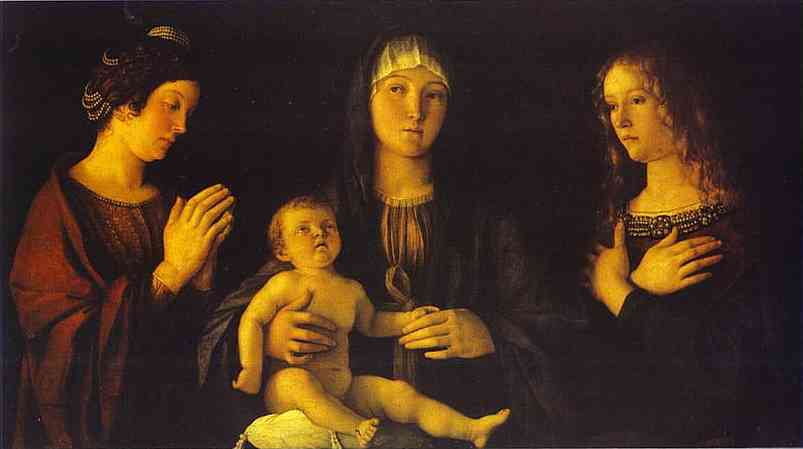
Perhaps in this brief moment in time Venetian artists had come to believe that they could depict the essence of the Magdalen without resort to obvious iconographical symbols. Earlier, Giovanni Bellini had painted a Madonna and Child surrounded by two female saints. One is obviously Mary Magdalen but she is only recognized by her flowing red hair. ###

Giovanni Bellini: Madonna and Child with Female Saints


* Joannides, Paul: Titian to 1518, Yale, 2001.
** Hope, Charles: Titian, NY, 1980.
*** Titian, catalogue edited by David Jaffe, London, 2003.
# Brown, David Alan, and Ferino-Pagden, Sylvia, Bellini, Giorgione, Titian, and the Renaissance of Venetian Painting, Washington, 2006.
## Impelluso, Lucia: Nature and Its Symbols, translated by Stephen Sartarelli, Los Angeles, 2003.


Friday, March 2, 2012

Mary Magdalen


On March 9, 2012 I will present my interpretation of Titian's "Sacred and Profane Love" as "the Conversion of Mary Magdalen" at the annual meeting of the South Central Renaissance Society to be held this year in New Orleans.


Meanwhile, I thought to put up a few images here interspersed with commentary from Anna Jameson's chapter on Mary Magdalen in her "Sacred and Legendary Art." All citations are from v. 1 of the 1895 edition.***

Next to the Madonna, Mary Magdalen was the most popular female saint of the Middle Ages and Renaissance. Around 1495 Giovanni Bellini's depicted her with the legendary Catherine of Alexandria, alongside the Madonna and Child. She stands to the right and her beautiful flowing red hair is enough to identfy her.


Mrs. Jameson believed that many of the attempts to depict the famous sinner/ saint were not so successful.

"As a subject for painting, it is rich in picturesque capabilities. It combines all that can inspire with all they can chasten the fancy; yet, when we review what has been done, how inadequate the result!....Where the penitent prevails, the saint appears degraded; where the wasted, unclad form is seen attenuated by vigils and exposed in haggard unseemliness, it is a violation of that first great rule of Art which forbids the repulsive and the painful.... On the other hand, where sensual beauty has obviously been the paramount home and idea in the artist's work, defeating its holiest purpose and perverting its high significance, the violation on the moral sentiment is yet more revolting. This is especially the fault of the later painters, more particularly of the schools of Venice and Bologna..." (341)

Below find her descriptions of different types of representation.


Donatello

"When exhibited to us as the patron saint of repentant sinners, Mary Magdalene is sometimes a thin wasted figure, with long disheveled hair of a pale golden hue falling over her shoulders almost to the ground;...  But not seldom the sole drapery is her long redundant hair." (348)


Signorelli

"But, in her character of patron St. Mary Magdalene was not always represented with the squalid or pathetic attributes of humiliation and penance. She became idealized as a noble dignified creature bearing no traces of sin or of sorrow on her beautiful face; her luxuriant hair bound in tresses round her head; her drapery rich and ample; the vase of ointment in her hand or at her feet, or borne by an angel near her. Not unfrequently she is attired with the utmost magnificence, either in reference to her former state of worldly prosperity, or rather, perhaps,…it was a common custom to clothe all the ideal figures of female saints in rich habits.... A beautiful instance may be seen in a picture by Signorelli, at Orvieto, where she is standing in a landscape, her head uncovered, and the rich golden hair partly braided, partly flowing over her shoulders; she wears a magnificent tunic embroidered with gold, over it a flowing mantle descending to her feet; she holds a vase with her left hand, and points to it with the right." (348)


Raphael: "St. Cecilia" 


"In the St. Cecilia of Raphael, she stands on the left, St. Paul being on the right of the principal figure; they are here significant of the conversion of the man through power, of the woman through love, from a state of reprobation to a state of reconcilement and grace. St. Paul leans in deep meditation on his sword." (351)


Caravaggio: Martha and Mary
"There are two classes of subjects in which Mary Magdalene is richly habited, and which must be carefully distinguished; those above described, in which she figures as patron saint, and those which represent her before her conversion, as the votary of luxury and pleasure." (352)


Titian

"The Magdalene of Titian was so celebrated in his own time that he painted at least five or six repetition repetitions of it, and copies of engravings have since been multiplied. The eyes, swimming in tears, are raised to heaven; the long disheveled hair flows over her shoulders; one hand is pressed on her bosom, the other rests on the skull; the forms are full and round, the coloring rich; a book and a box of ointment lie before her on a fragment of rock. She is sufficiently woeful, but seems rather to regret her past life than to repent of it, nor is there anything in the expression which can secure us against the relapse.... His idea, therefore, of St. Mary Magdalene was the fusion of an antique statue and a girl taken out of the streets; and with all its beauties as a work of art--and very beautiful it is--this chef-d'oeuvre of Titian is, to my taste, most unsatisfactory." (355)

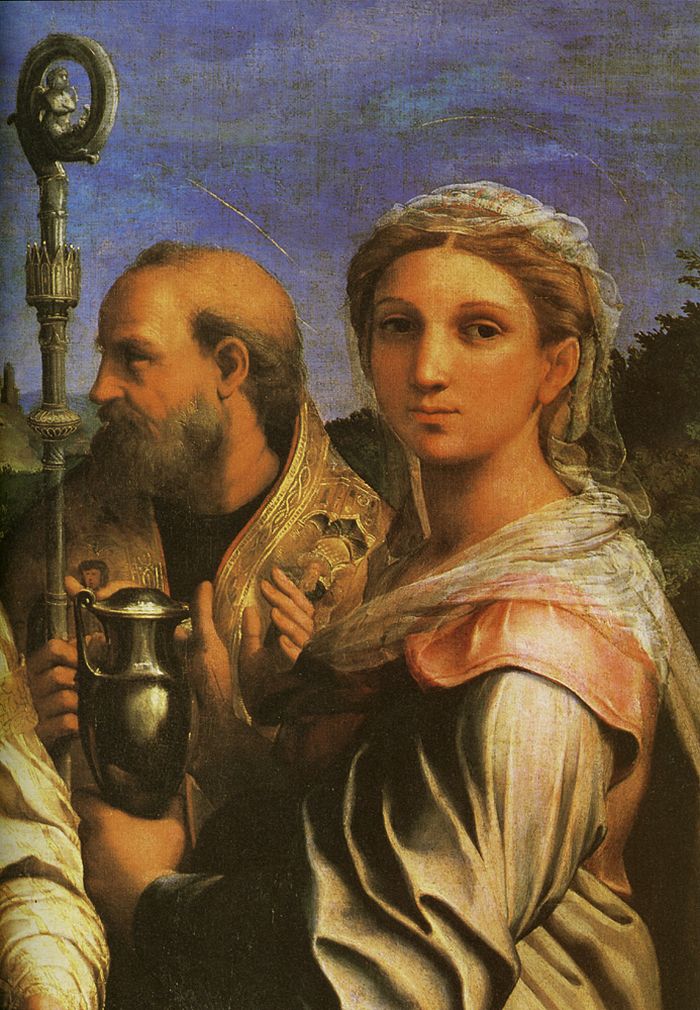
Mrs. Jameson did not approve of Titian's voluptuous penitent sinner but she did admire Raphael's version for a church in Bologna done at about the same time as Titian's Sacred and Profane Love. In this version she looks out at the viewer as if to say, "If I could do it, so too can you,"


Raphael: detail of MM


"Many have well represented the particular situation, the appropriate sentiment, the sorrow, the hope, the devotion; but who has given us the character? A noble creature, with strong sympathies and a strong will, with powerful faculties of every kind, working for good or evil,--such a woman Mary Magdalene must have been, even in her humiliation; and the feeble, girlish, commonplace, and even vulgar women selected as models…by throwing up their eyes and letting down their hair, ill represent the enthusiastic convert or the majestic patroness." (374)###

***For more modern studies of the Magdalen see Susan Haskins, "Mary Magdalen, Myth and Metaphor, NY, 1994, and  Katherine Ludwig Jansen, "The Making of the Magdalen, Preaching and Popular Devotion in the Later Middle Ages", Princeton, 2000. 


Wednesday, February 22, 2012

Giorgione: More Tempests


Giorgione’s most famous painting is called the “Tempest” because of the storm that dominates the background. Why did Giorgione use this device? Was it his own invention or did he rely on a motif common during his time? Are there other examples?

Giorgione: TheTempest

Three years after Giorgione’s untimely death in 1510, his younger associate Titian, who had worked with him on the fresco cycle on the Fondaco dei Tedeschi received a commission from the Venetian government to paint a battle scene for one of the rooms in the Ducal palace. Here is Carlo Ridolfi’s account from his biography of Titian written in the mid seventeenth century.
It was then decreed by the senate that he should paint for the Sala del Gran Consiglio the armed encounter at Cadore between the imperial troops and the Venetians. In this work, he imagined the natural site of his hometown with the castle situated above on a high mountain where the flash from a lightning bolt in the form of an arrow is suspended and misty globes in the manner of clouds are forming, mixed among the terrors of the unexpected tempest; meanwhile the battlefield is obstructed by the horrible conflict of knights and foot-soldiers, some of whom were defending with their rapiers the imperial flag, stirred by the wind and boldly moving in the air.*
Titian: Battle of Cadore (engraving)


The editors of a modern translation of Ridolfi note that Titian’s painting was begun between 1513 and 1516 but that it was only completed in 1537-8. The also point out that the painting was destroyed by fire in 1577 and that Ridolfi was confused about the subject, since the battle depicted was a legendary battle of Spoleto in which Venetian forces did not take part.
Nevertheless, either the painting was described to Ridolfi or he saw an engraving made before the fire. Despite the confusion about the subject, there seems no reason to doubt that shortly after Giorgione’s death Titian used a storm and a bolt of lightning to indicate a scene of violent death and destruction taking place below.
Joachim Patenier was another contemporary of Giorgione. In one of his many versions of the “Rest on the Flight into Egypt”, now in the Prado and dated around 1515, Patenier painted a storm in the left background above the city from which the Holy family had fled. The narrative follows their route since we see the legendary wheat field in the right mid-ground. The field is bathed in light and the sky above is blue with a couple of white clouds. The Madonna and Child sit in the foreground also bathed in bright sunlight.
Joachim Patenier: Rest on the Flight into Egypt

The stormy clouds in the background above the city indicate another scene of death and destruction. This time it is not a battle but the Massacre of the Holy Innocents. It was not uncommon to see some reference to the Massacre in versions of the flight into Egypt.
Finally, although not a painting, Pietro Aretino’s gave a very vivid image of the scene of the Crucifixion in his “Humanity of Christ.”
Meanwhile the darkness which had lasted from the sixth hour to the ninth, grew so black that it seemed day had hidden beneath the cloak of night. The clouds driving through the air and obscuring vision resembled a thousand banners of vast size arrayed against the eye of the sun. The sky itself groaned in unprecedented horror. The pallid lightning flashed. The very globe appeared about to dissolve in mist.**
Once again dark clouds interspersed with lightning cover a scene of death and destruction. Could Tintoretto have been aware of Aretino’s description?
Tintoretto: Crucifixion

Aretino’s popular religious work was written twenty five years after the death of Giorgione but the origins of his imagery can be found much earlier. In 1538 Aretino quarreled with Niccolo Franco, one of his many hangers on, and threw him out of his house. In his biography of Aretino James Cleugh printed Franco’s letter justifying his behavior.
The Aretine cannot say I am ungrateful’—he wrote to the scholar Francesco Alunno,…’for even though I admit he sometimes fed me, he cannot deny that I repaid this courtesy sevenfold by the work I did for him. Everyone knows that if it had not been for me he would not have had the skill to translate all those legends of the Holy fathers which he embroiders and passes off as his own.*** 
It would appear that many of the details in Aretino’s “Humanity of Christ” came from earlier but now forgotten popular religious works.
In each of these three examples a storm signals a tragedy going on below. I have argued that in the “Tempest” Giorgione's painted a version of the “Rest on the Flight into Egypt” where he used the storm and lightning for much the same purpose. Just as in Patinier’s painting Giorgione's Madonna and Child rest in bright sunlight while the storm rages over the city of Bethlehem in the background.
Moreover, in my interpretation I agreed with those who had argued that the city in the background of Giorgione’s painting could also be Padua during the War of the League of Cambrai. In 1509 Padua had been lost, retaken, but then besieged by Imperial forces over the summer. The storm of war was indeed over the city.
Scholars should consider looking for the source of the storm not in antiquity or humanist tracts but in popular vernacular religious stories. They might also consider the theatrical performances so popular in Italy during this time.
On a visit to her home town of Ferrara in 1503 Isabella d’Este, the famed Marchioness of Mantua, attended an elaborate dramatization at the Archbishop’s house on the occasion of the feast of the Annunciation. She wrote,
I…saw the wooden stage which had been erected for the occasion. A young Angel spoke the argument of the play, quoting the words of the Prophets who foretold the Advent of Christ, and the said Prophets appeared, speaking their prophecies translated into Italian verse. Then Mary appeared, under a portico supported by eight pillars, and began to repeat some verses from the Prophets, and while she spoke, the sky opened, revealing a figure of God the Father, surrounded by a choir of angels, and six other seraphs hovered in the air, suspended by chains. On the center of the group was the Archangel Gabriel, to whom God the Father addressed His word, and after receiving his orders, Gabriel descended with admirable artifice, and stood, half-way in the air, at the same height as the organ. Then, all of a sudden, an infinite number of lights broke out at the foot of the angel-choir, and hid them in a blaze of glory…At that moment the Angel Gabriel alighted on the ground, and the iron chain  which he held was not seen, so that he seemed to float down on a cloud, until his feet rested on the floor. After delivering his message he returned with the other angels to heaven, to the sound of singing and music and melody…when they had ascended into heaven, some scenes of the Visitation of St. Elizabeth and St. Joseph were given, in which the heavens opened again and an angel descended,…to manifest the Incarnation of Jesus to Joseph, and set his doubts to rest regarding the Conception of the Holy Virgin. So the festa ended. #
One can only imagine what special effects they might have used in celebrations of the Adoration of the Magi, or the Massacre of the Innocents.
It could also be that Giorgione and Titian were both just painting from nature. In all my years I have never heard a thunderstorm so violent and dramatic as the one I witnessed on a visit to beautiful Lake Garda a few years ago. All night long lightning flashed and thunder reverberated back and forth through the foothills of the Dolomites not far from the respective birthplaces of both Giorgione and Titian. ###

*Ridolfi, Carlo: The Life of Titian, edited by Julia Conaway Bondanella and Peter Bondanella, Bruce Cole, and Jody Robin Shiffman, Penn State, 1996, p. 75.This biography of Titian was part of a larger work, “Le Maraviglie dell’arte ovvero le vite degli illustri pittori veneti e dello stato,” originally printed in 1648.

**Quoted in Cleugh, James: The Divine Aretino, NY, 1966, p. 196-7.

***Cleugh, p. 174.

# Cartwright, Julia, Isabella D’Este, Marchioness of Mantua, 1474-1539, London, 1932, v.1, p. 251.