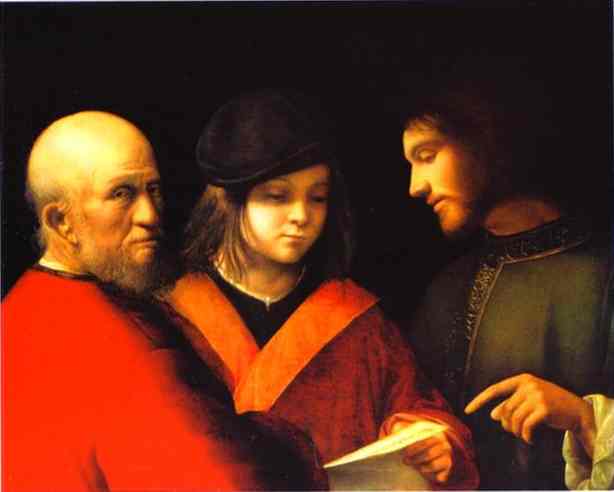
Since 2010 I have been using this site to discuss my interpretations of famous Renaissance paintings including Giorgione's "Tempest" as "The Rest on the Flight into Egypt"; his "Three Ages of Man" as "The Encounter of Jesus with the Rich Young Man"; Titian's, "Sacred and Profane Love" as "The Conversion of Mary Magdalen"; Titian's "Pastoral Concert" as his "Homage to Giorgione", and Michelangelo's"Doni Tondo." The full papers can now be found at academia.edu.

Monday, October 28, 2013

Hasan Niyazi R.I.P.


I just heard that Hasan Niyazi, my friend and fellow Art history blogger, died suddenly over the weekend.  Hasan was from Australia and in the past three years, his blog, Three Pipe Problem (3PP), had become one of the most popular Art history blogs in the world. He was the son of Turkish Cypriots who had migrated to Australia when Hasan was a young boy. Like Raphael, his favorite painter, Hasan died tragically in the prime of life.


His passion was the art of the Italian Renaissance. He claimed that his interest in Art began at the age of nine when he found a copy of a book by famed art historian Erwin Panofsky. I wonder if it began on the island of Cyprus under the eyes of the goddess Aphrodite, the beloved deity of the island.

I first encountered Hasan when I commented on a blog post he had written for 3PP in July of 2010 on Giorgione’s “Tempest.” We had a spirited back and forth that showed that Hasan was willing to engage in debate but that he was also open to new ideas if they could be backed up with hard evidence. Even though he loved the art of the Renaissance, he had trained and worked in the sciences and believed that Art history should be subject to the same rules that governed the sciences.

Our first encounter led to many more. He helped me immeasurably not only with his research into favorite painters like Raphael but also with the technical aspects of blogging. He was a wizard of design and had a great flair for using images in his work. He willingly shared his knowledge with me, a web newcomer.

Eventually, he allowed me to publish some of my discoveries and reviews on his site. His site was growing by leaps and bounds and he gave me the opportunity to reach a much larger audience. It was not easy because he was a stern taskmaster and editor. We had many arguments and disagreements but I believe we both gained by the exchanges. When I sent him my interpretation of Titian’s  “Sacred and Profane Love,” he chided me for not discussing all the previous interpretations, and eventually decided to do that on his own. It was a great example of web-based cooperation.

Speaking of the Web, Hasan ended his last post with these words.
The future of art history and the internet is a very exciting prospect. This goes beyond the fact that more art historians and institutions are engaging online, but also expands to include an increased public participation and interest in learning about art and history outside of an institutional and pedagogical content. The web allows quality knowledge, and fascinating images and video to be accessible everywhere, and by everyone--hence the potential for art history online is essentially limitless.
As a small token I would like to dedicate my most recent discovery to the memory of Hasan. One of his favorite paintings was Titian’s “Pastoral Concert.” Earlier this year I sent him an advance copy before I posted it on my own website and blog. He read it and very kindly spread the word among his friends and followers. I interpreted the painting as Titian’s homage to his friend Giorgione on his sudden and tragic death at the age of 33.


We never met and he lived on the other side of the world in a place he called, Oz. But he was a dear friend and colleague.

Goodbye, young friend.

Frank

###

Monday, October 21, 2013

Renaissance Art Mysteries: Giorgione, "Saturn Exiled" or "Man of Sorrows"


Renaissance Art Mysteries: Giorgione “Saturn Exiled” or “Man of Sorrows”.
In my past few posts I have listed eleven paintings including some of the most famous, beautiful, and mysterious of the Venetian Renaissance. For some I have been able to completely re-interpret these paintings that have mystified scholars for years. For others, I have been able to point out details that have either been mis-interpreted or overlooked. Here is another that brings the total to twelve.***


In his 2009 Giorgione catalog Enrico Maria dal Pozzolo believed that a mysterious painting in London’s National Gallery might be the earliest surviving work by Giorgione. The painting features a forlorn looking man sitting on a kind of throne off to the right. Three young men are around the throne and one seems to be making an offering. To the left a leopard and a peacock are prominent. Pozzolo noted difficulties of attribution, and also mentioned that scholars have not been able to agree on a subject. Some think the Man is David or Solomon, while others suggest Jason, Zeus or an unknown poet. Pozzolo accepted none of these and offered his own new interpretation.  He called it “Saturn Exiled” and argued that the painting represented the defeated Saturn after he had been castrated and exiled by Zeus. Pozzolo admitted that such a subject was unusual.

I have interpreted this painting as a version of the “Man of Sorrows” one of the most popular and ubiquitous subjects of the era. See my June 25, 2011 post on this site.

In the last few years I have sent my interpretations of Giorgione’s “Tempest” and Titian’s “Sacred and Profane Love” to most of the leading scholars in the field but with little response, and even less feedback and comment. I have also sent them to academic journals but with no success. So, I turned to the Web. I created a website and then this blog to publish my ideas and to hopefully reach an audience of interested people.

Publishing on the web does have some negative aspects. I thought that blogging would stimulate discussion and scholarly give and take but it doesn’t seem to work that way. Some scholars even refuse to read anything on the web. Also, although archived, old posts seem to go into a black hole. Finally, I have found that even students who have asked for the papers or for other assistance rarely respond or even show gratitude. Do they take Incivility 101?

But the positives certainly outweigh the negatives. Blogging stimulates thought and regular writing improves skills especially when you know others might read. Working on a paper or essay is like a prospector in a gold mine. He concentrates on the most promising vein but leaves behind many veins for later exploration. My major discoveries have uncovered a number of lesser ones that could not be published anywhere else.

Working in the “sacred subject” vein has proven to be very productive. Just imagine what scholars with much more training, resources and expertise than I possess could achieve if they would work the same vein instead of merely giving into the temptation to call everything they cannot understand "allegory", "poesia", or "capriccio".

###

***Edit. Please note the baldachino above the man in the painting. It looks somewhat like an ornate lampshade. (click on the image to enlarge) David Orme, a friend from England and a lover of Venice, recently told me that he had seen similar ones in still existing statuary. Here is an image supplied by his friend, Albert Hickson.


It is a statue of the Madonna and Child on the Rio Ognisanti near San Trovaso. Many thanks, David and Albert.


Wednesday, October 9, 2013

Renaissance Art Mysteries: Young St. Joseph


My original intuition that Giorgione’s “Tempest” was actually a depiction of the “Rest on the Flight into Egypt” naturally led me to see the young man in the painting as St. Joseph standing guard over the Madonna and Child. But how could that be? Since Joseph was usually portrayed as a sleepy old man, I had to find evidence to corroborate Giorgione’s departure from tradition.


A little investigation found a contemporary theological basis for a young, powerful Joseph who could be regarded as an able protector of his family and also as a protector of the Church. I also found that this young virile Joseph had also been depicted by some of Giorgione’s artist contemporaries, most notably by Raphael in the “Sposalizio”. 

However, the failure to see a young Joseph has led scholars to misunderstand or even mis-identify some paintings that all feature a young, virile St. Joseph. In earlier posts I have discussed these paintings and would just like to summarize them here.  


Paris Bordone: Mystic Marriage of St. Catherine
(private collection)

First, Paris Bordone painted at least two versions of the “Mystic Marriage of Catherine of Alexandria” that depicted a powerful St. Joseph prominently displaying a muscular bare leg. The first is in a private collection but was featured in the great 2006 “Bellini, Giorgione, Titian” exhibition that was jointly sponsored by Washington’s National Gallery and Vienna’s Kunsthistorisches Museum.* The second is in the Hermitage.

Paris Bordone: Mystic Marriage, Hermitage

There is no doubt concerning the subject of these paintings but so far no one has been able to explain the mystery of the muscular bare leg. I have argued that Bordone employed that device to indicate a contemporary practice used to “consummate” a marriage by proxy. In both of these paintings a young vigorous Joseph plays a very prominent role.


Second, I have argued that the young man in a depiction of the “Mystic Marriage of St. Catherine” by Lorenzo Lotto is also St. Joseph. Modern scholars have seen the man as St. Mark or St. Thomas but there is no good reason for either of them to be present at that legendary event. But again, St. Joseph acts as a proxy and Catherine directs her gaze to him. It is the spear point at the end of Joseph’s traditional staff that has confused scholars. That is strange but the next two paintings might shed some light on this martial aspect.


In his influential 1969 study of Giorgione’s “Tempest” Edgar Wind noted the similarity of two contemporary Venetian paintings to Giorgione’s “Tempest.” ** The first (shown above) he called Fortezza and Carita and attributed it to a follower of Giorgione. It is now on loan to Harvard’s Fogg Art Museum. Like the “Tempest” it depicts three figures in a landscape: a standing soldier off to the side holding a halberd, and a plainly dressed woman seated on the ground with her infant son. Despite the weapon and the youthful soldier, I have interpreted this painting as a version of “The Rest on the Flight into Egypt.”

"Allegory", Philadelphia Museum

The second painting Wind called “The Peaceable Warrior (ex bello pax) and attributed it to Palma Vecchio. It is now in the possession of the Philadelphia Museum which will only label it “Allegory”. Like the first, it depicts a soldier with a halberd standing guard over a seated woman, but this time there are two young children embracing. It is hard for me to believe that Wind and other scholars could have seen the two children and not at least considered the possibility that they are Jesus and the young Baptist embracing in the desert on the return of the Holy Family from Egypt, a scene depicted over and over again during the Renaissance.

It is true that in both these paintings Joseph has taken on the trappings of a warrior capable of defending his family. Actually both these paintings fit the description, "a soldier and a gypsy," that Marcantonio Michiel gave to the “Tempest” when he saw it in the home of Gabriele Vendramin.  However, something has happened in a short space of time to turn the traditional staff in the hands of Giorgione’s man into the weapons depicted in these other paintings. It would seem more fruitful to try to understand the reasons for this change in the depiction of St. Joseph than to just pass these paintings off as allegories.

In this and the previous two posts I have now listed 10 paintings in addition to the "Tempest" that have now been re-interpreted either completely or partially as a result of seeing Giorgione's most famous painting as a "sacred" subject. Others will be listed in future posts. This should serve as a lesson to all students struggling in the field of Art History. There is much more to be discovered in the world of Renaissance art.

###

* See the exhibition catalog. Brown, David Alan, and Ferino-Pagden, Sylvia, Bellini, Giorgione, Titian, and the Renaissance of Venetian Painting, Washington, 2006.

** Wind, Edgar: Giorgione’s Tempesta, Oxford, 1969.

Thursday, September 26, 2013

Renaissance Art Mysteries: Mary and Judith


In my last post I listed my four major interpretive discoveries concerning some of the most famous and mysterious works of the Venetian Renaissance. Although I believe that the name of Giorgione’s “Tempest” should never be changed, it does depict “The Rest on the Flight into Egypt”. Also, his “Three Ages of Man” in the Pitti Palace represents the “Encounter of Jesus with the Rich Young Man”. Titian’s “Sacred and Profane Love” should now be seen as “The Conversion of Mary Magdalen”, and his “Pastoral Concert” could best be understood as Titian’s “Homage to the Deceased Giorgione” utilizing the biblical story of David and Jonathan.

My work on these interpretations has led to a number of other significant discoveries concerning heretofore mysterious or mis-understood paintings. In this post I will list two that have already been discussed on this blog as well as on my site, MyGiorgione.


The first is a painting that is usually called “The Discovery of Paris.” In 1525 Marcantonio Michiel saw this painting in the home of Taddeo Contarini and described it as follows.
The picture on canvas, representing the birth of Paris, in a landscape, with two shepherds standing, was painted by Giorgio di Castelfranco, and is one of his early works. [104]
The editor of Michiel’s notes pointed out that only a fragment of this early Giorgione painting survives but that there does exist a seventeenth century copy by David Teniers. The editor referred to a description in an old manuscript  catalogue.
 A landscape on canvas, in oil, where there are on the one side two shepherds standing; on the ground a child in swaddling-clothes, and on the other side, a half nude woman and an old man, seated, with a flute.
This early Giorgione is a very important painting since Michiel’s description has been almost universally accepted and some eminent scholars have even based elaborate interpretations of the "Tempest" on Giorgione’s apparent awareness and fondness for the legend of Paris. However, Michiel guessed wrong and I believe that Giorgione has actually represented “The Encounter with Robbers on the Fight into Egypt”, a popular apocryphal legend.

In my interpretation the painting takes on new importance since it reinforces my interpretation of the Woman in the “Tempest.” In this painting Giorgione has dared to depict a Madonna with bare leg in danger of sexual assault. A full discussion of this lost Giorgione can be found in my “Tempest” paper or on its own at MyGiorgione.


There is no disagreement about the subject of Giorgione’s “Judith” that now hangs in the Hermitage. The mystery of that painting revolves around the bare leg of the Jewish heroine. Its prominence is striking and to some shocking. No good explanation has so far been offered. However, I believe that I have found the reason for the bare leg in the Book of Judith itself. Just as in “The Encounter with the Robbers” Giorgione uses a bare leg to indicate a woman in danger of sexual assault. In each case they are spared by their trust in God. The essay with biblical text can also be found at MyGiorgione.

###

Wednesday, September 11, 2013

Renaissance Art Mysteries


This September marks the third anniversary of Giorgione et al… Previously, I had created a website for my work on Giorgione's Tempest but was advised that blogspot would reach a wider audience. Seeing the Tempest as a sacred subject, "The Rest on the Flight into Egypt", provided the key that opened the door to a number of other new interpretations of equally famous and mysterious paintings of the Venetian Renaissance. Below are brief summaries of the four major interpretive discoveries. In a subsequent post I will list a number of secondary but significant discoveries that have arisen from my work on Giorgione and Titian.

Discussions of these interpretations can be found throughout Giorgione et al... by clicking on the labels or using the search box. The full papers have been published at MyGiorgione.

Incredibly, I am not a professional art historian. Although I hold a doctorate in History my field of study was eighteenth century British politics, and I left academe in 1972. Until my retirement in 2007 I was a financial advisor. Only in the last few years did travel and some other factors lead me to Venice.


Giorgione: The Tempest. In the fall of 2005 I interpreted the subject of the Tempest as “The Rest on the Flight into Egypt.” In this interpretation all the major elements in the painting are identified. The nude woman nursing an infant is the Madonna. The man standing at the left functioning as an “interlocutor” is St. Joseph with his staff. The broken columns are commonplace in depictions of the “Rest on the Flight into Egypt.” The city in the background is Judea from where the Holy Family has fled but could also be equated with Padua during the Cambrai war. The scraggly plant in the foreground is identified as a “belladonna” a plant associated with witchcraft and the Devil. Even the bird on the distant rooftop is shown to be derived from a famous Psalm. A short essay was published in the Masterpiece column of the Wall St. Journal In may, 2006. In 2010 I presented a paper on the “Tempest” at the annual meeting of the Renaissance Society of America held that year in Venice.


Titian: Sacred and Profane Love. In 2010 after a visit to Rome’s Borghese Gallery, I realized that the subject of Titian’s Sacred and Profane Love was the Conversion of Mary Magdalen. In this interpretation all the elements in Titian’s famous painting are identified. The finely dressed Woman is Mary Magdalen in the guise of a Venetian courtesan. The nude Woman is the converted Magdalen in the process of throwing off her worldly finery. In her hand she holds the jar of ointment that is found in practically every depiction of the great sinner/saint. The antique relief on the sarcophagus-like fountain, which so far has eluded explanation, can now be seen to depict three great sinners: Adam and Eve, Cain and Abel, and St. Paul falling from his horse. In 2012 I presented my interpretation of the Sacred and Profane Love at the annual meeting of the South Central Renaissance conference in New Orleans.


Giorgione: Three Ages of Man. After seeing the Tempest as a “sacred subject” I was able to take a fresh look at some of his other mysterious paintings. For example, I discovered the subject of the Three Ages of Man to be the Encounter of Jesus with the Rich Young Man derived from an episode in the Gospel of Matthew. So far there has been no scholarly agreement on the subject of this famous depiction of three half-length figures that now hangs in the Pitti Palace in Florence.  The young man in the center, whose clothing indicates his wealth, has just asked how he can achieve eternal life. On the right, Jesus dressed in a green vestment points to the commandments that he has directed the man to follow. On the left, an aging, bald Peter, dressed in martyr’s red, invites the viewer to enter the scene.


Titian: Pastoral Concert. Earlier this year I argued that this famous and mysterious painting whose attribution has been variously given to Giorgione and Titian should be considered as Titian's Homage to Giorgione. There are signs in the painting that the finely dressed lute player is not only Giorgione, but also that he has recently died. His face is in shadow; the lute has no strings; and the female muse at the left is pouring out his soul into the well. I believe that all the Giorgionesque elements in the painting were  put there by Titian in homage to his mentor. The shepherd and flock in the background indicate that Titian, the young rustic on the right, portrayed himself as David grieving over the loss of Jonathan. Both the female nudes are the muse, Euterpe.

Needless to say, these interpretations have not met with acclaim in the scholarly community. It is my hope that young scholars and students (with better tools and more energy than I possess) will be open to see with their own eyes and explore the possibility that Venetians living during the Renaissance were primarily interested in beautiful renditions of traditional sacred subjects.

###